What Are MLOps Services? Complete Guide for Businesses
How to Get Machine Learning Models Out of the Lab and Into Reliable Production
Building a machine learning model that performs well in testing is the easy part. Keeping it accurate, monitored, and reliable in production, as data shifts and usage scales, is where most ML initiatives quietly fail. MLOps is the discipline that closes that gap.
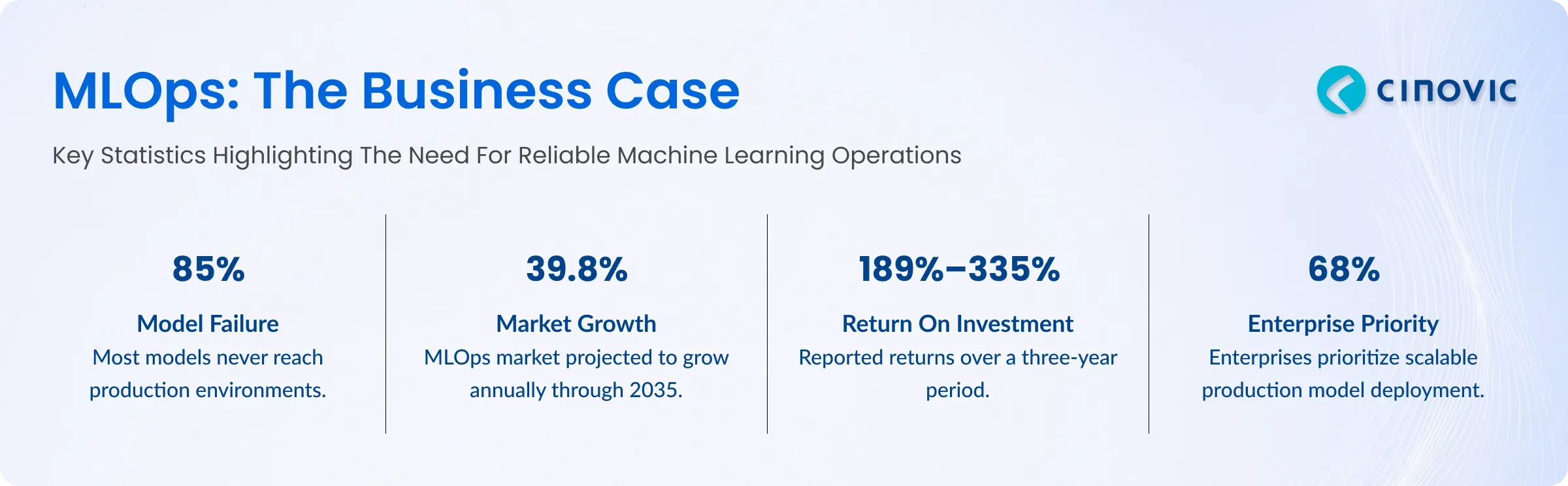
KEY STATISTICS
|
Of ML models never make it to production
|
Projected annual growth (CAGR) of the global MLOps market through 2035
|
Reported ROI over three years from comprehensive MLOps strategies
|
Of enterprises prioritize scalable model deployment in production environments
|
What MLOps Actually Means
MLOps (machine learning operations) applies DevOps discipline to the machine learning lifecycle: version control, automated testing, continuous deployment, and ongoing monitoring, but for models and the data pipelines that feed them, not just application code.
The distinction matters because ML models fail differently than traditional software. Code doesn't quietly degrade on its own, but a model can, as the real-world data it sees drifts away from what it was trained on. MLOps exists specifically to catch that kind of failure before it erodes business value silently.
A model that works perfectly in a notebook and a model that stays accurate in production for a year are two different engineering problems. MLOps is the discipline that solves the second one. Cinovic ML Engineering Team
The Four Pillars of MLOps Services
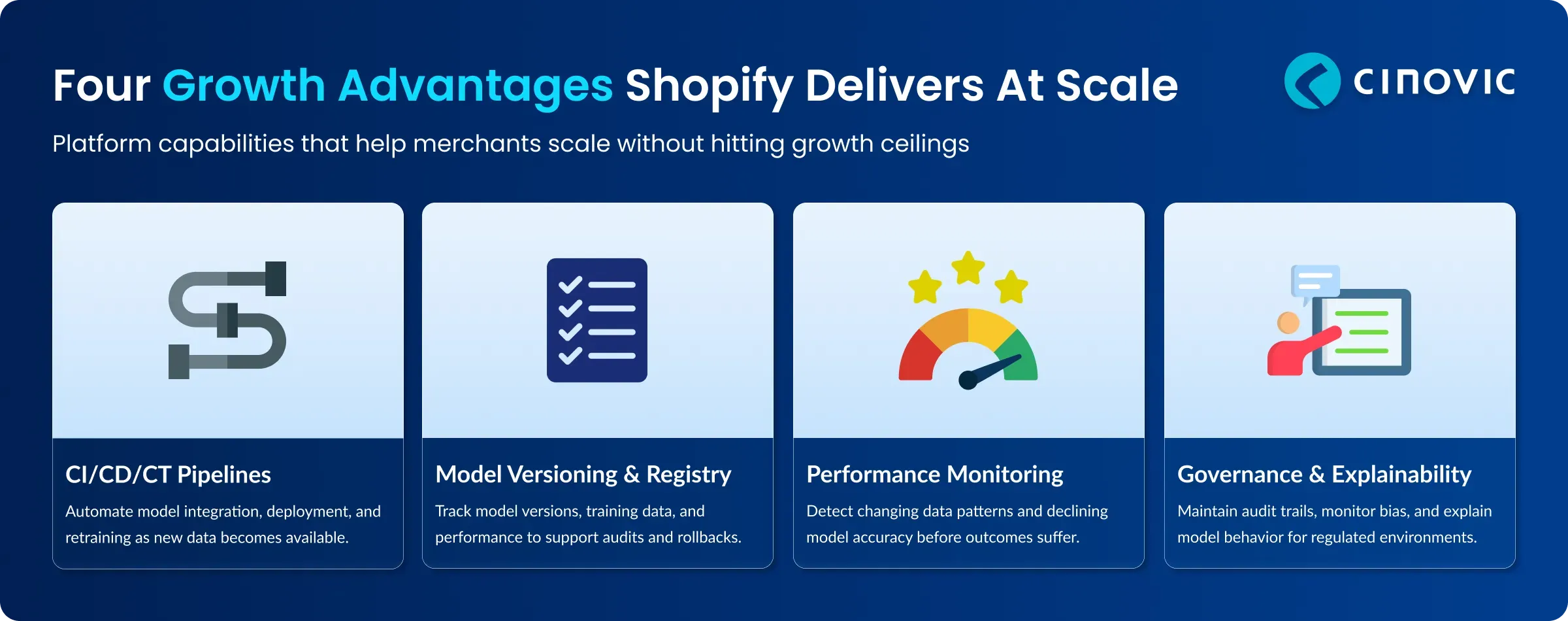
A complete MLOps practice rests on four connected capabilities.
|
CI/CD/CT Pipelines
Continuous integration, delivery, and training pipelines that automate how models move from development into production and get retrained as new data arrives.
|
Model Versioning & Registry
Systematic tracking of every model version, its training data, and its performance, so any deployed model can be audited or rolled back.
|
|
Drift & Performance Monitoring
Ongoing detection of data drift and performance degradation, so declining accuracy is caught before it affects business outcomes.
|
Governance & Explainability
Audit trails, bias monitoring, and explainability tooling that make model behavior defensible in regulated or high-stakes environments.
|
What MLOps Services Typically Include
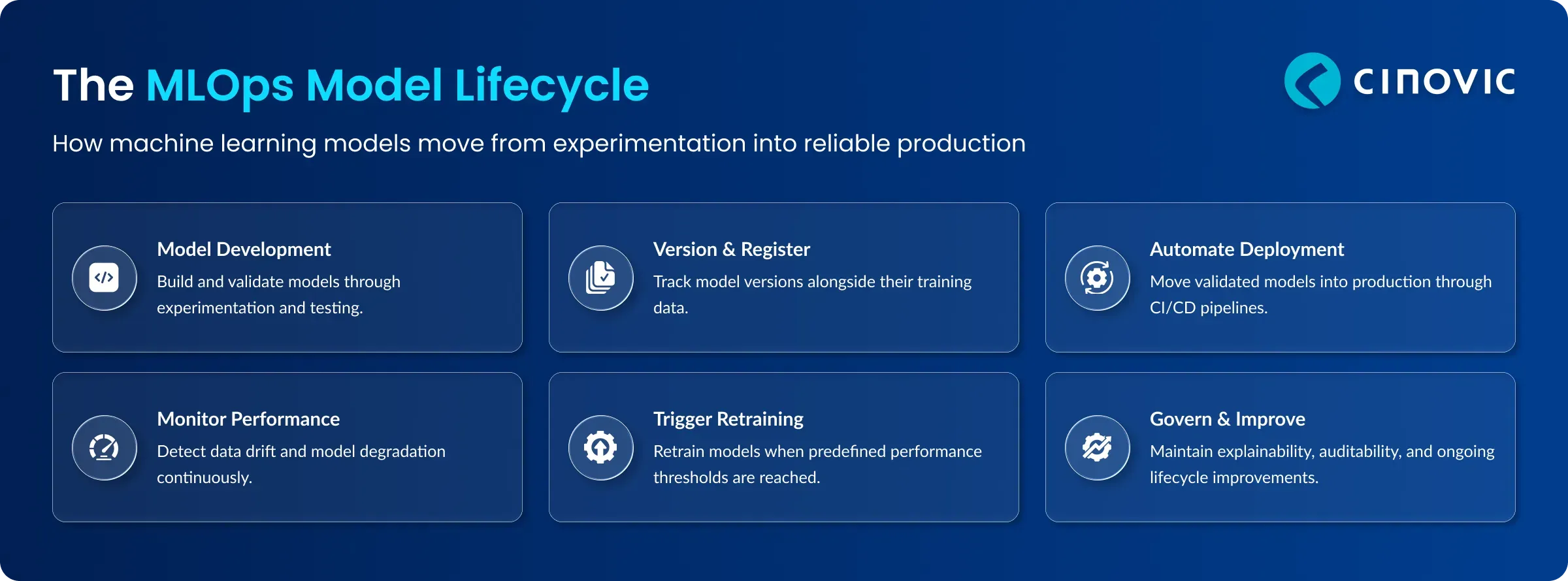
MLOps isn't one tool — it's a set of connected practices and platforms covering the full model lifecycle.
1. Automated Pipeline Engineering
Building the CI/CD/CT infrastructure that takes a model from a data scientist's experiment to a production endpoint automatically, rather than through manual, error-prone handoffs between teams.
2. Model Monitoring & Retraining
Setting up automated drift detection and retraining triggers so models stay accurate as real-world data shifts, instead of quietly degrading until someone notices a business metric slipping.
3. Infrastructure & Cost Management
Designing the cloud or hybrid infrastructure models run on, including cost optimization for inference at scale — an increasingly large budget line as generative AI models join traditional ML in production.
4. Governance & Compliance Tooling
Building the explainability, audit trail, and bias-monitoring capabilities that regulated industries like healthcare and financial services require before models can be trusted in production decisions. Our financial services client operations platform case study shows a production platform built for financial services.
A Practical 6-Step Path to MLOps Maturity
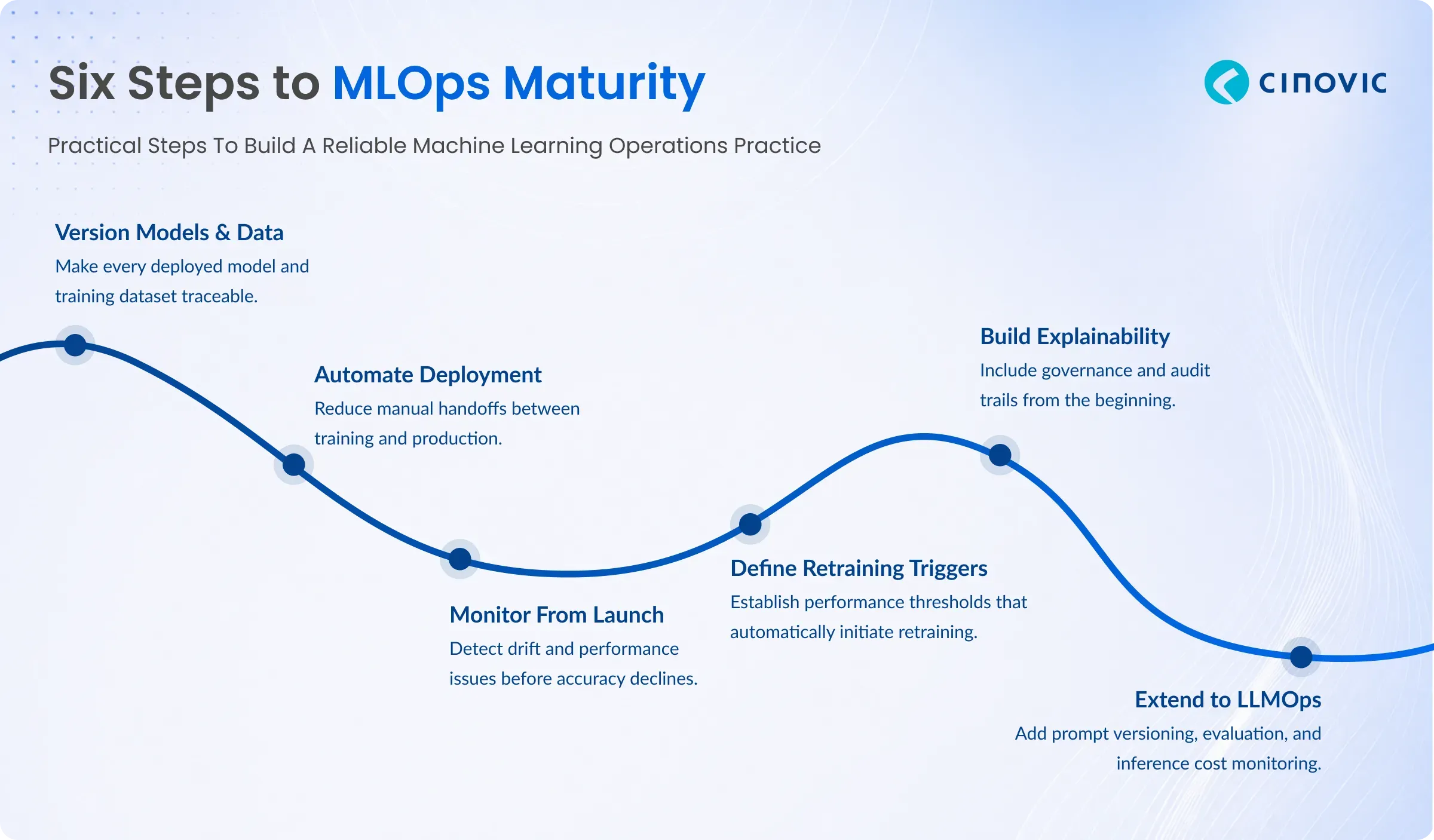
Theory without execution is just wishful thinking. Here is a battle-tested path from ad hoc deployment to a mature MLOps practice.
● Establish Version Control for Models and Data: Treat models and their training data with the same discipline as application code, so every deployed version is traceable.
● Automate the Path From Training to Deployment: Build CI/CD pipelines that move a validated model into production without manual, error-prone handoffs.
● Set Up Monitoring Before You Need It: Instrument drift and performance monitoring at launch, not after the first unexplained accuracy drop.
● Define Automated Retraining Triggers: Decide in advance what performance degradation should trigger retraining, rather than relying on someone to notice manually.
● Build in Explainability From the Start: Especially in regulated industries, governance and audit trail requirements are far cheaper to build in than retrofit.
● Extend the Practice to LLMs and Generative AI: As generative AI models join the production stack, extend MLOps discipline to cover prompt versioning, evaluation, and inference cost — often called LLMOps.
Where MLOps Investment Delivers the Clearest Business Impact
|
High-Value MLOps Capabilities — Where mature MLOps practices are proving out fastest in 2026
|
|
→ Automated CI/CD/CT Pipelines — Cuts the manual handoff time between model development and production deployment.
|
|
→ Drift Detection & Retraining — Keeps model accuracy stable as real-world data shifts, without manual monitoring.
|
|
→ Model Versioning & Registry — Makes every deployed model auditable and reversible, reducing production risk.
|
|
→ Inference Cost Optimization — Increasingly critical as LLM-based inference joins the production cost stack.
|
|
→ Explainability & Governance — Required infrastructure for regulated industries like healthcare and BFSI.
|
|
→ LLMOps Extensions — Applying MLOps discipline to prompt versioning, evaluation, and generative AI-specific monitoring.
|
Common MLOps Mistakes to Avoid
● Treating deployment as the finish line: A model that's deployed but not monitored is a model that will eventually degrade unnoticed, sometimes for months.
● Building monitoring after a problem occurs: Reactive monitoring means the business impact has already happened by the time drift is caught.
● Ignoring the cost of retraining infrastructure: Automated retraining needs its own pipeline and validation step — skipping this turns “automated” retraining into a new manual bottleneck.
● Underinvesting in explainability: In regulated industries, a model without an audit trail is a compliance liability regardless of how accurate it is.
● Treating MLOps and LLMOps as separate problems: As generative AI models enter production alongside traditional ML, the operational discipline needs to extend to cover both, not fragment into two disconnected practices.
How Cinovic Delivers MLOps Services That Keep Models Reliable
At Cinovic, we build the
MLOps infrastructure that keeps machine learning and generative AI models accurate, monitored, and auditable long after the initial deployment — not just the pipeline that gets a model into production once.
Conclusion: Deployment Is the Beginning, Not the End
Getting a machine learning model into production is a milestone, not a finish line. What determines whether that model keeps delivering value is the operational discipline behind it: monitoring, retraining, versioning, and governance.
MLOps isn't an optional layer on top of machine learning. In 2026, it's the difference between a model that works once and a model that keeps working.