Every system that has ever gone down under traffic, lost data during a crash, or ground to a halt after a new deployment has an architecture problem. Modern tech architecture is not about choosing the trendiest stack; it is about making deliberate structural decisions that keep your systems available, fast, and maintainable as your business demands grow.
What Is Modern Tech Architecture?
Tech architecture is the set of structural decisions that determine how a system's components are organised, how they communicate, how they fail, and how they evolve. A well-designed architecture is invisible to end users; systems just work. A poorly designed one becomes visible in the worst possible moments: during a product launch, a traffic spike, or a critical business transaction.
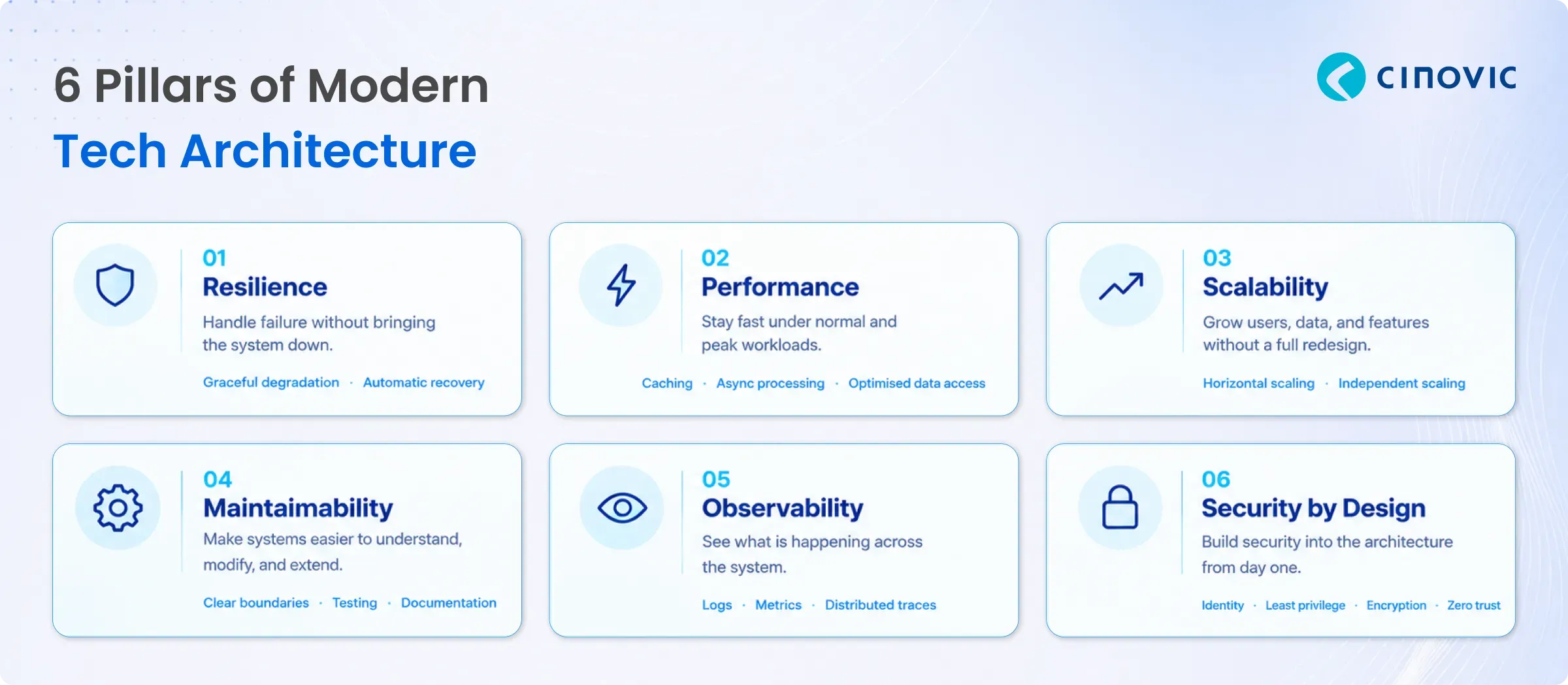
Modern architecture is defined by six core properties:
Resilience: The system handles failures gracefully, degrades without crashing, and recovers automatically without human intervention.
Performance: Fast response times under normal and peak load, achieved through efficient design, caching, async processing, and optimised data access.
Scalability: The system can grow to handle more users, data, and features, horizontally and independently, without a full redesign.
Maintainability: Engineers can understand, modify, and extend the system safely through clear boundaries, documentation, and automated testing.
Observability: The internal state of the system is understandable from external signals, logs, metrics, and traces for rapid diagnosis.
Security by Design: Security is an architectural principle, enforced through identity, least-privilege access, encryption, and zero-trust networking.
"Architecture is the decision that is hard to change. Get them right early, because you will live with them for a long time."Cinovic Architecture Team, referencing Martin Fowler
The Modern Architecture Stack
Modern systems are organised in distinct layers, each with clear responsibilities.
Infrastructure: Cloud (AWS/GCP/Azure) · Containers · Kubernetes · IaC · CDN
Data Layer: Primary DB · Read Replicas · Cache (Redis) · Search · Data Warehouse
Service Layer: Domain Services · Event Bus · Message Queues · Background Workers
API Gateway: Auth · Rate Limiting · Routing · Load Balancing · SSL Termination
Client: Web · Mobile · Third-Party Integrations · Partner APIs
Key Architecture Patterns for Modern Systems
No single pattern fits every system. Modern architecture is about selecting and combining the right patterns for your scale, team, and business context.
Microservices Architecture: Decompose the application into small, independently deployable services, each owning a specific business domain. Teams can build, deploy, and scale services independently. The microservices pattern defined by Martin Fowler has become the dominant model for large-scale, high-velocity organisations, because it aligns software structure with team structure.
Event-Driven Architecture (EDA): Services communicate through events rather than direct calls. A producer emits an event; consumers react asynchronously. Implemented via Apache Kafka, AWS EventBridge, or RabbitMQ, this decouples services, improves resilience, and enables real-time data processing at scale.
CQRS + Event Sourcing: Command Query Responsibility Segregation separates read and write models, allowing each to be optimised independently. Event Sourcing stores every state change as an immutable event, enabling auditability, time-travel debugging, and complex event-driven workflows.
API Gateway Pattern: A single entry point for all client requests that handles cross-cutting concerns, authentication, rate limiting, logging, routing, and protocol translation before reaching backend services.
Circuit Breaker Pattern: When a downstream service begins failing, the circuit breaker "trips" and stops sending requests to it, preventing cascading failures. This is extensively documented by Martin Fowler as one of the most important resilience patterns in distributed systems.
Sidecar / Service Mesh: A service mesh (Istio, Linkerd, AWS App Mesh) manages service-to-service communication including mTLS encryption, observability, traffic shaping, and circuit breaking, without requiring application code changes.
Designing for Resilience: Beyond "It Works"
Gartner research shows that 60% of outages are caused by design and architecture flaws, not hardware failure. Resilience must be designed from the start, not added after the first incident.
Core Resilience Patterns Every System Should Implement
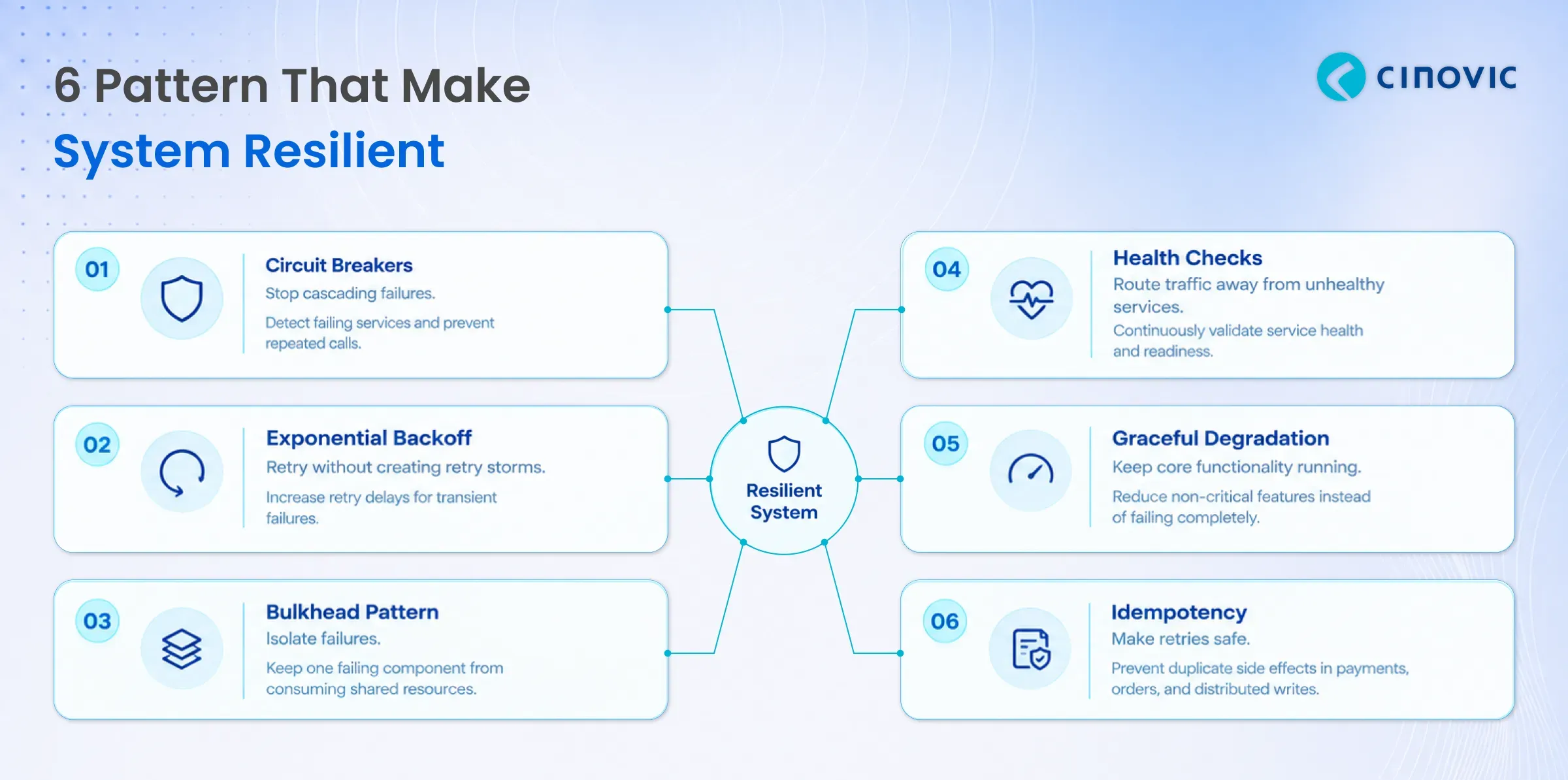
- Circuit Breakers: Detect downstream failures and stop calling failing services, preventing cascading failures across the system.
- Retry with Exponential Backoff: Automatically retry transient failures with increasing delays, reducing retry storms that amplify problems.
- Bulkhead Pattern: Isolate system components so a failure in one pool doesn't drain resources from others.
- Health Checks & Readiness Probes: Continuously validate service health so load balancers can automatically route away from unhealthy instances.
- Graceful Degradation: When a non-critical service fails, the system continues to serve core functionality with reduced features.
- Idempotency: Design operations so they can be safely retried without side effects, critical for payments, orders, and any write in a distributed system.
- Chaos Engineering: Deliberately inject failures in controlled conditions (pioneered by Netflix's Chaos Monkey) to validate resilience assumptions before they are tested in production.
Cloud-Native Architecture: The Modern Standard
Cloud-native architecture is not just hosting on the cloud; it is a fundamentally different approach that exploits cloud capabilities: elasticity, managed services, global distribution, and pay-per-use economics.
DimensionTraditional ArchitectureCloud-Native Architecture
Infrastructure: Fixed servers, manual provisioning; auto-scaling, IaC, containerised
Deployment: Infrequent, high-risk releases; CI/CD, multiple daily deployments
Availability: Single region, manual failover; Multi-AZ, automatic failover
Scaling: Vertical (bigger server) vs. horizontal, per-service, automatic
Cost model: Fixed CAPEX, overprovisioned OPEX, pay-per-use, right-sized
Recovery: Manual, hours to days; automated, minutes or seconds
Observability: You Cannot Fix What You Cannot See
Observability is the capacity to understand a system's internal state from its external outputs. It is built on three pillars, and teams without all three are flying partially blind.
Logs: Structured, timestamped records of discrete events. Centralized log aggregation (Elasticsearch, Datadog, CloudWatch) enables search and correlation across all services.
Metrics: Numerical measurements over time, latency, error rate, throughput, CPU, memory. Dashboards and alerting built on metrics enable proactive intervention.
Distributed Traces: End-to-end request journeys across multiple services (OpenTelemetry, Jaeger, AWS X-Ray). Traces reveal exactly where latency is introduced in complex flows.
The DORA State of DevOps research consistently finds that elite engineering teams, deploying 4x more frequently with lower change failure rates, all share strong observability practices as a foundation.
A 6-Phase Modern Architecture Design Process
- Define Non-Functional Requirements (NFRs): Quantify what the system must achieve: target availability, latency SLOs, data volume, peak concurrent users, and recovery time objectives.
- Map Domain Boundaries: Use Domain-Driven Design (DDD) to identify bounded contexts, the natural seams in the business domain where services should be separated.
- Select Architecture Patterns: Match patterns to the problem: synchronous vs. asynchronous, event-driven vs. request-driven, stateful vs. stateless.
- Design the Data Architecture: Define database-per-service boundaries, replication strategies, consistency models, and caching layers.
- Build Observability and Resilience In: Before writing business logic, wire up logging, metrics, tracing, health checks, and circuit breakers.
- Validate with Architecture Decision Records (ADRs): Document every significant architectural decision, what was decided, why, and what alternatives were considered.
Common Architecture Mistakes That Cost the Most
- Distributed monolith: Splitting a monolith into services that are still tightly coupled through shared databases.
- No data strategy: Services sharing databases, inconsistent data models, and no defined ownership.
- Synchronous everything: Building all service communication as synchronous REST calls creates cascading failure chains.
- Premature microservices: Adopting microservices before the team has operational maturity multiplies complexity without delivering benefits.
- No architecture fitness functions: Without automated checks, architecture degrades silently over time.
- Skipping chaos engineering: Untested failure assumptions are false confidence, not resilience.
How Cinovic Designs Modern Architecture
Cinovic's architecture practice has designed and delivered systems across ecommerce platforms, B2B SaaS products, enterprise integrations, and AI-powered applications, at scales ranging from startup MVPs to multi-million-user production environments.
We begin every engagement with an Architecture Discovery Workshop, mapping the current system landscape, defining NFRs, and producing a prioritised architecture roadmap. For legacy systems, we design phased modernisation paths that reduce risk and deliver value incrementally. Our engineering practice is built on cloud-native deployment (AWS and GCP), Kubernetes, CI/CD from day one, and observability as a first-class architectural concern.
Conclusion: Architecture Is a Competitive Advantage
The architecture decisions your team makes today will determine how fast you can move in two years, how quickly you can deploy new features, how confidently you can handle growth, and how much engineering time goes toward building new value versus fighting fires.
Resilient, high-performing systems don't happen by accident. They are designed that way from the start, and Cinovic is built to help you do exactly that.