Nirav Trivedi
30 September 2026
10 Minutes read

Scalable Product Development Build Products That Grow with Your Business

Most products don't fail because they lack features. They fail because they were built for a size they never reach, or because they outgrow the infrastructure they were built on. Scalable product development is the discipline of building products that can grow with your business, your users, and your ambitions, without becoming a liability.


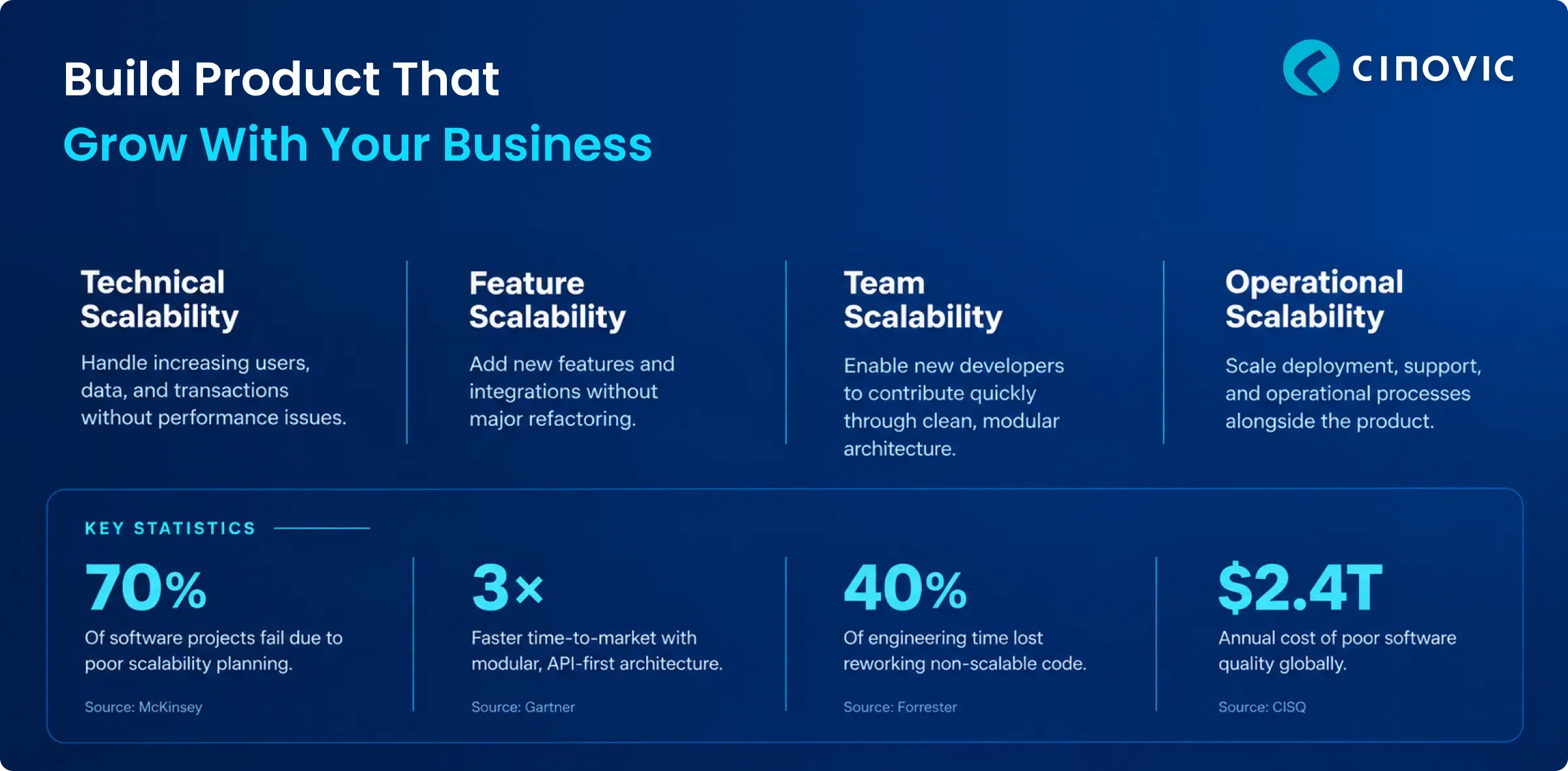
KEY STATISTICS

70%

Of software projects fail due to poor scalability planning

Source: McKinsey

3×

Faster time-to-market with modular, API-first architecture

Source: Gartner

40%

Of engineering time lost reworking non-scalable code

Source: Forrester

$2.4T

Annual cost of poor software quality globally

Source: CISQ

What Is Scalable Product Development?

Scalable product development is the practice of designing, architecting, and engineering software so it can handle growth in users, data, features, and team size, without requiring a complete rebuild. It is not about building everything at once. It is about making the right foundational decisions early so that growth is an asset, not a crisis. Our application modernisation and development practice is built around exactly this principle.

Scalability operates across four dimensions that must be addressed together:

Team Scalability

The ability to onboard new developers without productivity grinding to a halt, enabled by clean architecture and modular code.

Operational Scalability

The ability of support processes and deployment pipelines to scale alongside the product.

Technical Scalability

The ability of your infrastructure and codebase to handle more users, data, and transactions without breaking or degrading.

Feature Scalability

The ability to add new capabilities and integrate tools without causing regression or requiring large-scale refactoring.

"The products that scale are not necessarily those with the best features at launch. They are the ones built on foundations that can bear the weight of growth." Cinovic Engineering Team.

Why Scalability Must Be Designed In, Not Bolted On

One of the most expensive mistakes in product development is treating scalability as a future problem. Teams ship fast, cut corners on architecture, and accumulate technical debt, only to face painful, costly rework when growth arrives.

The data is sobering: 40% of engineering time in the average technology company is spent reworking code that wasn't built to scale (Forrester). That is nearly half your engineering capacity consumed not by building new value, but by fixing the past. Industry bodies like CISQ point to accumulated technical debt as one of the biggest drivers of the cost of poor software quality.

Scalability doesn't mean over-engineering. It means making deliberate architectural choices early about how data flows, how services communicate, and how the codebase is organised- choices that make growth smooth rather than catastrophic.

The MVP Trap: Building Fast Without Building Smart

The MVP model is sound in theory: build the smallest product that delivers real value, learn from users, and iterate. But in practice, many teams use "MVP" as a justification for technical shortcuts that create crippling debt. (We explore how modern tooling changes this equation in From Coder to Architect: Why Vibe Coding Is the Future of MVPs.)

Dimension

Traditional MVP

Scalability-Aware MVP

Architecture

Monolith, tightly coupled

Modular monolith, decomposable

Database

Single DB, no indexing strategy

Indexed, designed for query growth

APIs

Internal-only, undocumented

API-first, versioned, documented

Testing

Manual, sporadic

Automated CI/CD from day one

Monitoring

Added as an afterthought

Built in from launch

Future cost

High — major refactor required

Low — incremental evolution

The goal is not to avoid MVPs; it is to build MVPs that are scalability-aware. The right foundations added at the start cost a fraction of what they cost to add later under pressure.


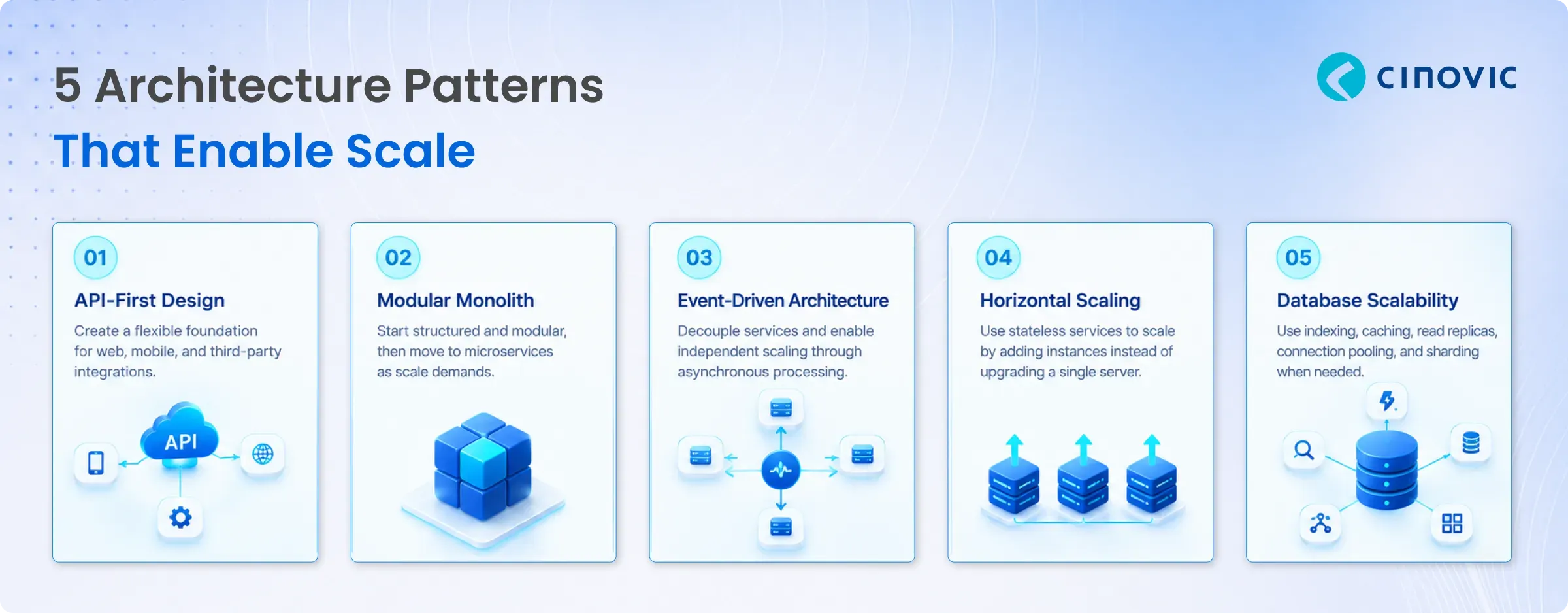
Architecture Patterns That Enable Scale

Scalable products are not accidents. They are the result of deliberate architectural decisions made at the right stage of product maturity.

API-First Design: Designing your product around well-defined APIs, before building any UI, creates a foundation that supports multiple frontends (web, mobile, third-party integrations) and enables teams to work in parallel. Gartner reports that organisations with a mature API strategy achieve 3x faster time-to-market for new product features. For complex enterprise landscapes, platforms like MuleSoft can anchor this API-led approach.

Modular Monolith Microservices: Starting with a well-structured monolith and decomposing it into microservices as scale demands is often wiser than immediately adopting microservices complexity, a view popularised by Martin Fowler's MonolithFirst pattern. A modular monolith enforces clear domain boundaries, making future decomposition straightforward rather than surgical.

Event-Driven Architecture: Decoupling services through event streams (Kafka, RabbitMQ, AWS EventBridge) allows each service to scale independently and enables asynchronous processing that keeps core user flow fast even under heavy load.

Horizontal Scaling & Stateless Services: Designing services to be stateless, storing sessions and state externally in Redis or databases, allows the infrastructure to scale horizontally by adding more instances, rather than vertically and expensively by upgrading single servers.

Database Scalability Patterns: Read replicas, connection pooling, query optimisation, caching layers (CDN, Redis), and, when truly needed, sharding. Getting the data layer right is often the highest-leverage scalability investment a team can make, which is why our data engineering services sit alongside our product engineering work.

A 7-Phase Scalable Product Development Roadmap

Building a product that scales is not a single decision; it is a series of compounding right decisions across the product lifecycle.

  1. Product Discovery & Architecture Planning: Before writing a line of code, define the product's core value proposition, expected scale, and the architectural approach that matches that trajectory. Technology choices made here echo for years.

  2. Scalability-Aware Foundation: Build the core infrastructure: cloud-native deployment (AWS, GCP, Azure), containerisation (Docker/Kubernetes), CI/CD pipeline, automated testing, and monitoring from day one. These are not optional extras; they are on the floor. See our Cloud & DevOps capabilities.

  3. Core Product Build (Scalability-Aware MVP): Build the minimum feature set with maximum architectural integrity. API-first. Modular. Documented. Tested. Deployed to production from the first sprint.

  4. User Validation & Rapid Iteration: Release to real users as early as possible. Instrument everything: user behaviour, performance metrics, error rates. Let data drive the roadmap. Iterate in 2-week sprints. Good UI/UX consulting keeps that feedback loop honest.

  5. Performance Optimisation & Load Testing: Before scale arrives, simulate it. Load testing, stress testing, and chaos engineering reveal weaknesses that only appear under pressure, so you fix them on your terms, not your users'. (Our quality engineering services cover this.)

  6. Incremental Decomposition & Feature Expansion: As the product grows, decompose high-load domains into independent services. Add new features without touching a stable core. Each addition is independently deployable, testable, and scalable.

  7. Continuous Engineering Excellence: Maintain code quality through regular refactoring, technical debt reviews, dependency updates, and architecture reviews. Scalability is a practice, not a milestone.


    How AI Accelerates Scalable Product Development

    AI has fundamentally changed what a small, focused engineering team can build and how fast. Teams using AI-assisted development are compressing timelines that once took months into weeks, without sacrificing quality or scalability. Explore our AI solutions for more.

    AI-Powered Development Capabilities: How Cinovic uses AI to build scalable products faster and smarter.

    AI-accelerated code generation: Generating boilerplate, data models, API endpoints, and test suites at speed, allowing engineers to focus on architecture and business logic.

    Automated code review & quality analysis:
    AI tools that detect anti-patterns, security vulnerabilities, and scalability issues before they reach production.

    Intelligent performance monitoring:
    AI-powered observability tools that detect anomalies, predict bottlenecks, and surface root causes faster than traditional alerting.

    AI-assisted testing:
    Generating comprehensive test cases, edge cases, and regression tests automatically, dramatically increasing coverage.

    Documentation generation:
    Keeping API docs, architecture diagrams, and onboarding materials current automatically, reducing team scaling friction.

    Predictive capacity planning:
    Using historical usage patterns and ML models (supported by MLOps practices) to predict infrastructure needs before they become performance problems.

    Case Study: One Platform, 10K+ Users, Scaling Restaurant & Hospitality Operations

    The principles above are easiest to see in a real build. Cinovic's Restaurant & Hospitality Operations Platform is a single operational backbone for restaurant and hospitality businesses, unifying purchasing, stock, cash management, and finance, designed from the start to grow with the client's locations, users, and operational demands.

    The challenge: restaurant and hospitality groups typically run purchasing, inventory, cash handling, and finance across disconnected tools and manual processes. That works for one site; it breaks as locations and teams multiply, because every new outlet adds more manual effort instead of more leverage.

    The approach: rather than stitching point tools together, we built one scalable digital platform with a shared data foundation and streamlined, automated workflows across the core operational domains- the same modular, scalability-aware thinking described in this article.

    The results:

    60% faster operations: streamlined workflows and automation improved day-to-day operational efficiency.

    3X business growth supported: the platform scaled alongside expanding restaurant and hospitality operations.

    45% improved efficiency: optimised workflows reduced manual effort and improved team productivity.

    10K+ users supported: the architecture handled growing users, locations, and operational demands.

    The platform has since grown into a family of focused modules; see the related work on multi-site procurement, inventory control, and mobile workflows for restaurant teams — which is what "incremental feature expansion without touching a stable core" looks like in practice.

    For a commerce example of the same idea, our multi-brand Magento platform runs four independent storefronts from a single Magento 2 installation with shared infrastructure.

    Common Scalability Mistakes to Avoid

    Premature optimisation: Spending engineering time optimising for scale before product-market fit wastes resources. Scale design, but optimise when the data demands it.

    Ignoring the data layer: Application servers are easy to scale horizontally. Databases are not. The most common scalability crisis is a database not designed to handle query volume.

    No observability from the start: Products without monitoring are flying blind. By the time a problem is obvious to users, it has already caused damage. Instrument everything from launch.

    Shared databases across services: When multiple services share a single database, they are tightly coupled at the data layer, creating a bottleneck and making independent scaling impossible.

    Synchronous everything: Designing all service interactions as synchronous calls creates cascading failure risks. Async patterns for non-critical paths dramatically improve resilience.

    No load testing before launch: Discovering performance limits in production, under real user load, is the most expensive way to learn. Load test before you launch, always.

    How Cinovic Builds Scalable Products

    At Cinovic, we have built scalable products across ecommerce, B2B SaaS, marketplace platforms, and enterprise applications. Our approach combines product strategy, engineering excellence, and AI-accelerated delivery to help clients launch faster and grow smarter. Our Python and cloud & DevOps expertise underpins much of this work.

    We start every product engagement with a Product Discovery Sprint, a structured process that defines architecture, technology stack, data model, and phased roadmap before development begins. We have delivered production-ready MVPs in as little as 8 weeks, with the architecture to scale to millions of users. Browse more of our work in Case Studies.

    Conclusion: Scale Is a Design Decision

    Scalable product development is not a phase you enter after you achieve success. It is a mindset and a practice you adopt from the very first line of code. The choices made in the first weeks of a product's life, about architecture, data design, API contracts, and deployment pipelines, determine how painful or how smooth growth will be.

    Build products that grow with your business, not products that force your business to grow around their limitations.


Ready to Build a Product That Scales?

Talk to a Cinovic product engineering expert. Let's discuss your product and design the right architecture for where you're going.

Contact Us

Recent Blogs

Explore our latest articles, insights, and technology trends.

VIEW ALL BLOGS
Let's Talk

See Cinovic's Expertise in Action Book Your Free 15-Minute Development Demo

Join 100+ teams scaling with Cinovic. Fill out the form below to get personalised tour of the platform.

Frequently Asked Questions About Scalable Product Development

Scalable product development means designing and building software products so they can handle increasing users, data, and features without requiring a complete rebuild. It involves architectural decisions, technology choices, and development practices that allow a product to grow with the business.

An MVP is the smallest version of a product that delivers value to early users. A scalable product is built with architecture and engineering practices that allow it to grow. The best approach is to build an MVP with scalability in mind, so early shortcuts don't become expensive rebuilds later.

It depends on the product's stage and complexity. Early-stage products often benefit from a well-structured modular monolith that can be decomposed later. As scale increases, microservices, event-driven architecture, and API-first design allow teams to scale independently.

It depends on the product's stage and complexity. Early-stage products often benefit from a well-structured modular monolith that can be decomposed later. As scale increases, microservices, event-driven architecture, and API-first design allow teams to scale independently.

A production-ready MVP with scalable foundations can be built in 8-16 weeks depending on complexity. Cinovic's AI-accelerated development approach can compress timelines significantly, delivering in weeks what traditionally takes months.

Technical debt refers to the accumulated cost of shortcuts and quick fixes in a codebase. High technical debt makes products brittle, slow to change, and expensive to scale. Teams that manage it proactively ship faster, scale more easily, and experience fewer production incidents.

combines strategic product thinking with engineering excellence. We start with a Product Discovery Sprint to define architecture, technology choices, and a phased roadmap. We build in agile sprints with automated testing, CI/CD pipelines, and performance monitoring from the start.

Yes. Legacy product modernisation is one of Cinovic's core practices. We assess the existing codebase, identify bottlenecks and scalability constraints, and design a phased modernisation roadmap that reduces risk and delivers value incrementally, without a disruptive big-bang rewrite.