



















Restaurant Wastage & Stock Transfer Control
Discover how restaurant wastage and stock transfer control help track inventory movement, reduce product waste, and improve stock visibility across locations.
From native iOS and Android development to React Native and Flutter cross-platform apps, mobile UX design, App Store launch, and post-launch optimisation, Cinovic builds mobile applications that users download, keep, and recommend.

We partner with product managers, founders, CTOs, and marketing leaders who know their product has a UX problem, high drop-off rates, confused users, low feature adoption, or poor conversion, and need a design partner who understands both the user and the business.
We don't just write mobile code; we think like product builders, design like UX craftspeople, and ship like engineers who know that every day in development is a day not in the hands of users.
Real mobile app development projects. Real user acquisition and retention outcomes. See how Cinovic has helped founders, product teams, and enterprises ship mobile apps that users love and businesses grow with.

Discover how restaurant wastage and stock transfer control help track inventory movement, reduce product waste, and improve stock visibility across locations.

Discover how restaurant inventory control solutions help manage products, improve stock visibility, reduce manual work, and support efficient operations.

Discover how recipe and menu control solutions help kitchens manage recipes, standardize menus, and maintain consistent food operations across locations.
From native iOS and Android development and React Native cross-platform apps to Flutter enterprise mobile, mobile UX design, backend API development, App Store launch, and post-launch growth, we cover the complete mobile app development lifecycle.
Build high-performance native iOS applications in Swift and SwiftUI, leveraging the full Apple ecosystem: Core Data, Core ML, ARKit, HealthKit, StoreKit 2, Push Notifications, WidgetKit, App Clips, Apple Sign-In, and Apple Pay, with Xcode CI/CD integration, TestFlight beta distribution, and App Store Connect submission management.
Build native Android applications in Kotlin with Jetpack Compose, using Android Architecture Components (ViewModel, LiveData, Room), Jetpack Navigation, WorkManager for background tasks, Firebase integration, Material Design 3, Google Pay, and Play Billing Library, with automated testing, Firebase App Distribution for beta, and Google Play Console submission.
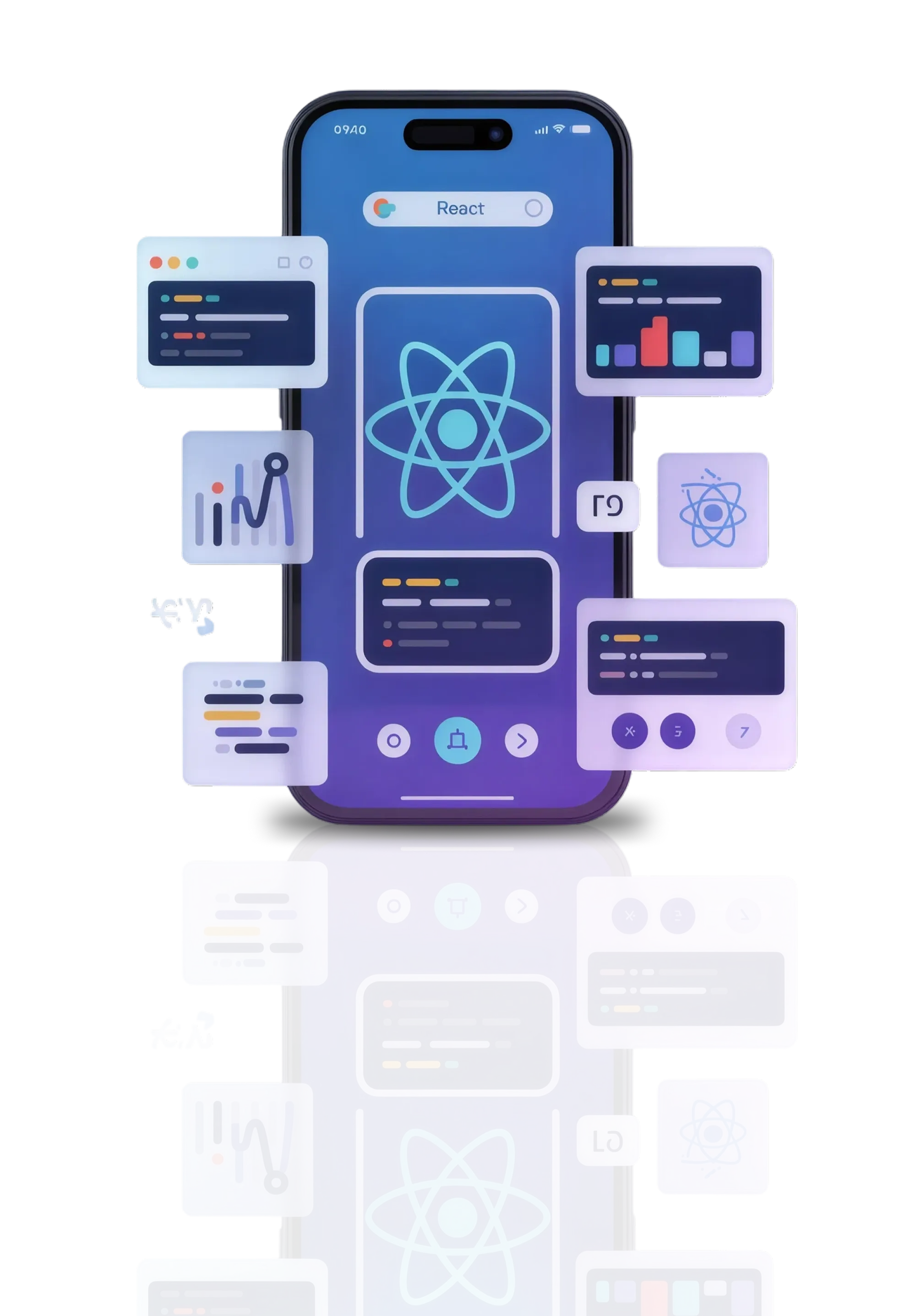
Build a single React Native codebase that delivers native-quality iOS and Android experiences, using Expo or a bare React Native workflow, React Navigation, Redux or Zustand state management, native module bridging for platform-specific features, Reanimated for smooth animations, and New Architecture (Fabric + JSI) for near-native performance.
Build Flutter applications that run natively on iOS, Android, web, and desktop from a single Dart codebase, using BLoC or Riverpod state management, Flutter Navigation 2.0, platform channel integration for native APIs, Firebase or Supabase backend connectivity, offline-first architecture with Hive or Isar, and Dart isolates for background processing.
Design mobile experiences that convert and retain, user research and persona development, mobile user journey mapping, information architecture for small-screen contexts, Figma wireframes and interactive prototypes, iOS Human Interface Guidelines (HIG) and Android Material Design compliance, usability testing on real devices, and design handoff with developer-ready Figma assets.
Build the server-side foundations your mobile app needs — REST and GraphQL API development, backend-for-frontend (BFF) pattern implementation, real-time features with WebSockets or Firebase Realtime Database, push notification infrastructure (APNs, FCM), user authentication (Firebase Auth, Auth0, custom JWT), media upload and CDN delivery, and cloud infrastructure on AWS, Azure, or GCP.
Build high-performance native iOS applications in Swift and SwiftUI, leveraging the full Apple ecosystem: Core Data, Core ML, ARKit, HealthKit, StoreKit 2, Push Notifications, WidgetKit, App Clips, Apple Sign-In, and Apple Pay, with Xcode CI/CD integration, TestFlight beta distribution, and App Store Connect submission management.
Build native Android applications in Kotlin with Jetpack Compose, using Android Architecture Components (ViewModel, LiveData, Room), Jetpack Navigation, WorkManager for background tasks, Firebase integration, Material Design 3, Google Pay, and Play Billing Library, with automated testing, Firebase App Distribution for beta, and Google Play Console submission.
Build a single React Native codebase that delivers native-quality iOS and Android experiences, using Expo or a bare React Native workflow, React Navigation, Redux or Zustand state management, native module bridging for platform-specific features, Reanimated for smooth animations, and New Architecture (Fabric + JSI) for near-native performance.
Build Flutter applications that run natively on iOS, Android, web, and desktop from a single Dart codebase, using BLoC or Riverpod state management, Flutter Navigation 2.0, platform channel integration for native APIs, Firebase or Supabase backend connectivity, offline-first architecture with Hive or Isar, and Dart isolates for background processing.
Design mobile experiences that convert and retain, user research and persona development, mobile user journey mapping, information architecture for small-screen contexts, Figma wireframes and interactive prototypes, iOS Human Interface Guidelines (HIG) and Android Material Design compliance, usability testing on real devices, and design handoff with developer-ready Figma assets.
Build the server-side foundations your mobile app needs — REST and GraphQL API development, backend-for-frontend (BFF) pattern implementation, real-time features with WebSockets or Firebase Realtime Database, push notification infrastructure (APNs, FCM), user authentication (Firebase Auth, Auth0, custom JWT), media upload and CDN delivery, and cloud infrastructure on AWS, Azure, or GCP.
We combine mobile engineering depth, product thinking, UX craft, and AI expertise to build apps that don't just launch well; they grow user bases, maintain high store ratings, and evolve as your business scales.
Maximise app discoverability and conversion on the App Store and Google Play, keyword research and metadata optimisation, compelling screenshot and preview video production, A/B testing of store listings (Google Play Experiments, App Store Product Page Optimisation), ratings and review strategy, competitive category analysis, and featured app submission preparation.
Engineer apps that feel fast on every device: launch time optimisation (cold start under 2 seconds), 60/120fps rendering with frame rate profiling, memory footprint reduction, battery usage optimisation, network request batching and caching strategies, image lazy loading and WebP optimisation, and offline-first architecture with background sync for unreliable networks.
Build secure mobile applications from the ground up, biometric authentication (Face ID, Touch ID, Android Biometric API), certificate pinning, encrypted local storage (iOS Keychain, Android Keystore), OWASP Mobile Top 10 mitigation, jailbreak and root detection, runtime application self-protection (RASP), GDPR-compliant analytics, and HIPAA/PCI-DSS compliance for regulated industry apps.
Integrate AI and machine learning that enhance the mobile experience, on-device inference with Core ML (iOS) and TensorFlow Lite/ML Kit (Android), for instance, privacy-preserving features; LLM-powered chatbots and content generation via OpenAI or Anthropic APIs; computer vision with Vision framework and ML Kit; personalisation engines; and voice interfaces with Whisper transcription or native speech recognition.
Stay ahead with practical guides, framework comparisons, launch strategy deep-dives, and case studies on React Native vs Flutter, native vs cross-platform, mobile UX, App Store Optimisation, and AI in mobile apps.

Discover how to prepare your ecommerce store for agentic AI, from AI-powered shopping experiences to automation, personalization, and smarter commerce.

80% of enterprises are moving toward composable commerce. Compare monolithic vs. composable architecture and find the right fit with Cinovic’s free architecture assessment.

US social commerce hits $109.4B in 2026. TikTok Shop converts at 4.7%, more than double Instagram. Discover how zero-click commerce works across TikTok, Instagram, Google, and what your ecommerce store needs to do now. Free audit from Cinovic.
Tell us about your app idea, your target users, and the platforms you want to reach, and we'll give you an honest technology recommendation, scope estimate, and go-to-market timeline within 48 hours.
Mobile app development costs vary significantly by scope and complexity. A simple MVP app with core features typically costs £15,000–£40,000. A mid-complexity app with a custom backend, third-party integrations, and a polished UX costs £40,000–£120,000. A complex enterprise mobile app or feature-rich consumer app with AI, real-time features, and multi-platform delivery can exceed £150,000. We provide a detailed scope and fixed-price proposal after your free discovery session, so you know exactly what you're getting before committing.
Native (Swift for iOS, Kotlin for Android) delivers the best performance and deepest platform integration, ideal for apps where speed, complex animations, access to device hardware, or platform-specific features are critical. React Native and Flutter deliver near-native performance with a single codebase for both platforms — reducing development time and cost by 30–40%, and ideal when you need to ship to both iOS and Android quickly. We recommend native when performance and platform fidelity are non-negotiable, and React Native or Flutter when time-to-market and budget efficiency are the priority. Most apps are well-served by cross-platform.
React Native uses JavaScript and renders through native UI components, making it familiar to web developers and ideal for apps that share logic with a web codebase. Flutter uses Dart and renders via its own high-performance graphics engine (Skia/Impeller), giving pixel-perfect consistency across platforms and excellent performance for animation-heavy and complex UI apps. React Native has a larger ecosystem and community. Flutter is growing rapidly and excels at enterprise, offline-first, and visually complex applications. Both are excellent choices — the right one depends on your team's skills, app complexity, and existing technology stack.
An MVP mobile app with focused core features typically takes 8–14 weeks. A mid-complexity app with custom design, backend integration, and both iOS and Android delivery takes 14–24 weeks. A complex enterprise or consumer app with AI features, multi-platform delivery, third-party integrations, and rigorous QA takes 6–12 months. We provide a detailed timeline and milestone plan during your free discovery session, and we build in buffer time so we ship on the date we commit to.
Yes, App Store and Google Play submission is included in every mobile project we deliver. We manage the full submission process: setting up your Apple Developer and Google Play Console accounts, preparing all metadata, screenshots, and preview videos, implementing compliance requirements (privacy labels, data safety forms, content ratings), submitting the build, managing review communications, and handling any rejection feedback. We have a 100% first-submission approval track record.