AI/ML CONSULTING | AI/ML services
AI Consulting Services for Digital Transformation
Turn AI ambition into measurable results. Explore the four pillars of AI consulting, a 6-step engagement roadmap, and a real client case study.
Read More


Most ecommerce brands are still designing for how people shopped in 2020. The ones pulling ahead are redesigning for how AI agents browse, recommend, and buy on a shopper’s behalf — and pairing it with the cleanest, fastest UX they’ve ever shipped.
|
AI Personalization |
Conversational Commerce |
Generative Engine Optimization |
|
Ecommerce UX |
Predictive Merchandising |
Agentic Shopping |
|
693% YoY growth in generative AI referral traffic to retail sites this past holiday season |
31% Higher conversion rate from AI-referred shoppers vs. other traffic sources Adobe Analytics |
3x Return for every dollar invested in AI-led retail transformation McKinsey |
AI-powered ecommerce transformation is the shift from a store built around static pages and rule-based features to one built around systems that personalize, predict, and converse, recommendation engines that update in real time, search that understands intent instead of just keywords, chat assistants that close sales, and forecasting models that know what to restock before you do.
It only works alongside modern UX. AI can surface the perfect recommendation, but if the page takes four seconds to load or the checkout buries the buy button, that recommendation never converts. McKinsey research shows that companies that excel at personalization generate roughly 40% more revenue from those efforts than average performers, but that gap belongs to teams that pair AI with a fast, clear, trustworthy experience, not to AI alone.
The acquisition channel itself is changing too. Shoppers increasingly start their research in ChatGPT, Gemini, and Perplexity instead of a search bar, and arrive at retail sites already informed and ready to buy. Adobe Analytics found that generative AI referral traffic to U.S. retail sites grew 693% year over year during the 2025 holiday season and converted 31% higher than every other channel combined. Ecommerce transformation in 2026 means designing for that shopper as deliberately as for the one who typed a query into Google.
AI didn’t change what shoppers want. It changed who or what is doing the shopping on their behalf. Cinovic AI & UX Practice
Effective AI transformation rests on six interconnected capabilities. Strength in the AI layer can’t compensate for weakness in the UX layer beneath it, and vice versa.
|
Personalization at Scale Real-time recommendations, dynamic homepages, and tailored offers based on live behavior, not static segments. |
Conversational Commerce AI shopping assistants that answer questions, compare products, and guide checkout. |
AI-Powered Discovery Semantic and visual search that understands intent — not just exact keyword matches. |
|
Predictive Merchandising Demand forecasting and dynamic, AI-optimized pricing that keep inventory and price right. |
Agentic Readiness Clean, structured product data that AI shopping agents can read and transact against. |
Modern UX Foundation Speed, clarity, mobile-first design, and accessibility are the floor every AI feature stands on. |
The path from discovery to purchase now runs through AI at almost every stage. Mapping where shoppers drop off tells you exactly where to focus transformation effort first.
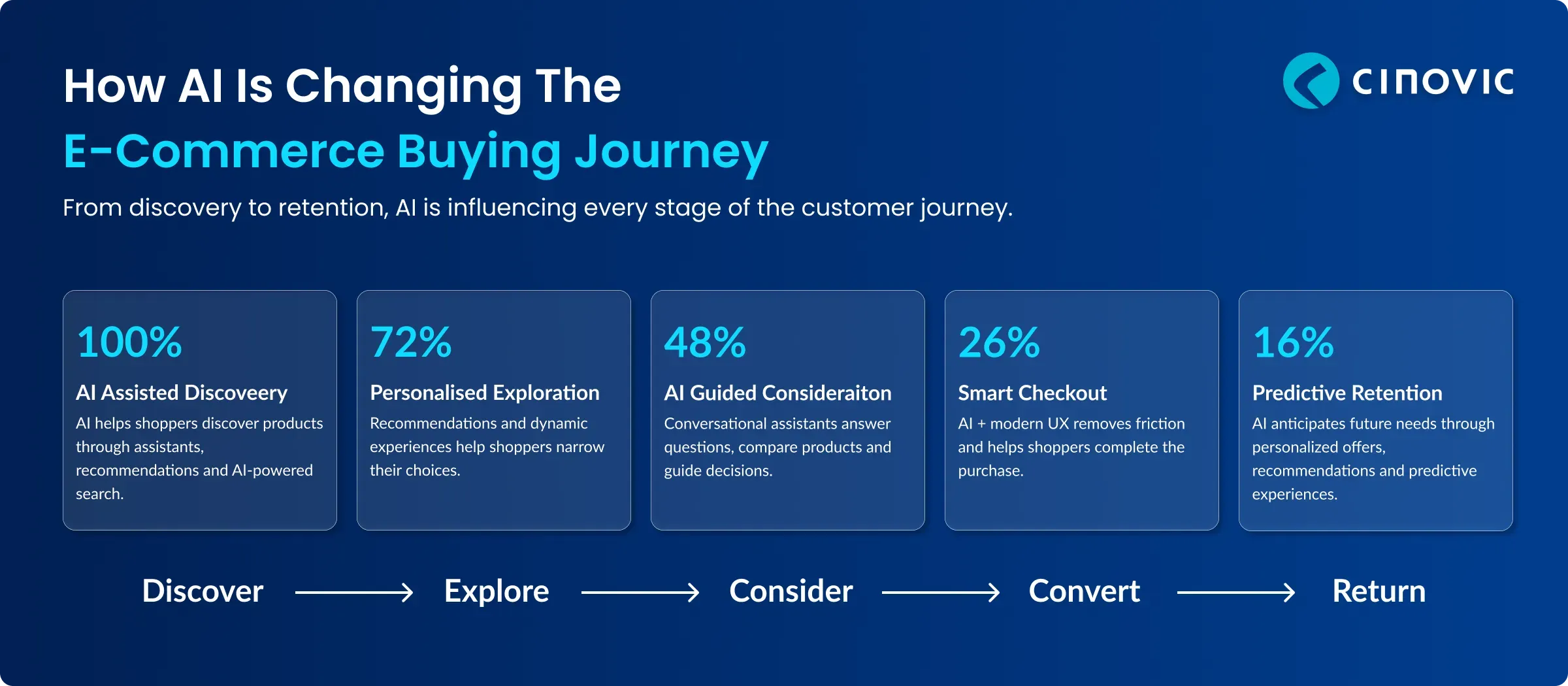
Not all AI investments pay back equally. These are the changes that consistently move conversion and revenue first.
1. Deploy AI-Powered Product Recommendations
Recommendation engines are the fastest path from “we added AI” to “we made money.” Industry research attributes 25–35% of total ecommerce revenue to AI-driven recommendations, with Amazon alone generating roughly a third of its sales through this single feature.
McKinsey’s analysis of gen-AI chatbots found they cut the time it takes a customer to complete an order by 50–70% compared to a traditional storefront, by answering questions in line rather than sending shoppers off to search or compare elsewhere.
3. Upgrade to AI-Enhanced Search & Visual Discovery
Shoppers who use site search convert at significantly higher rates than those who browse manually. Semantic and visual search understand intent, synonyms, and “find something similar to this photo,” extending that advantage to far more sessions.
4. Forecast Demand With Predictive AI
AI-driven demand forecasting reduces forecast error by 20–50% and can cut lost sales from stockouts by up to 65%, according to McKinsey’s operations research, directly protecting revenue that traditional, rule-based reordering quietly leaves on the table.
5. Optimize for Generative Engine Optimization (GEO)
Being recommended by ChatGPT or Gemini now functions like being ranked on page one of Google. Adobe Analytics data shows AI-referred shoppers convert 31% higher than other traffic; brands need clean, structured, well-described product data for AI systems to find and trust.
6. Don’t Skip the UX Foundation
Speed, mobile-first design, and accessibility aren’t optional extras layered on after the AI work; they’re the floor every AI feature stands on. A great recommendation engine on a slow site still loses the sale.
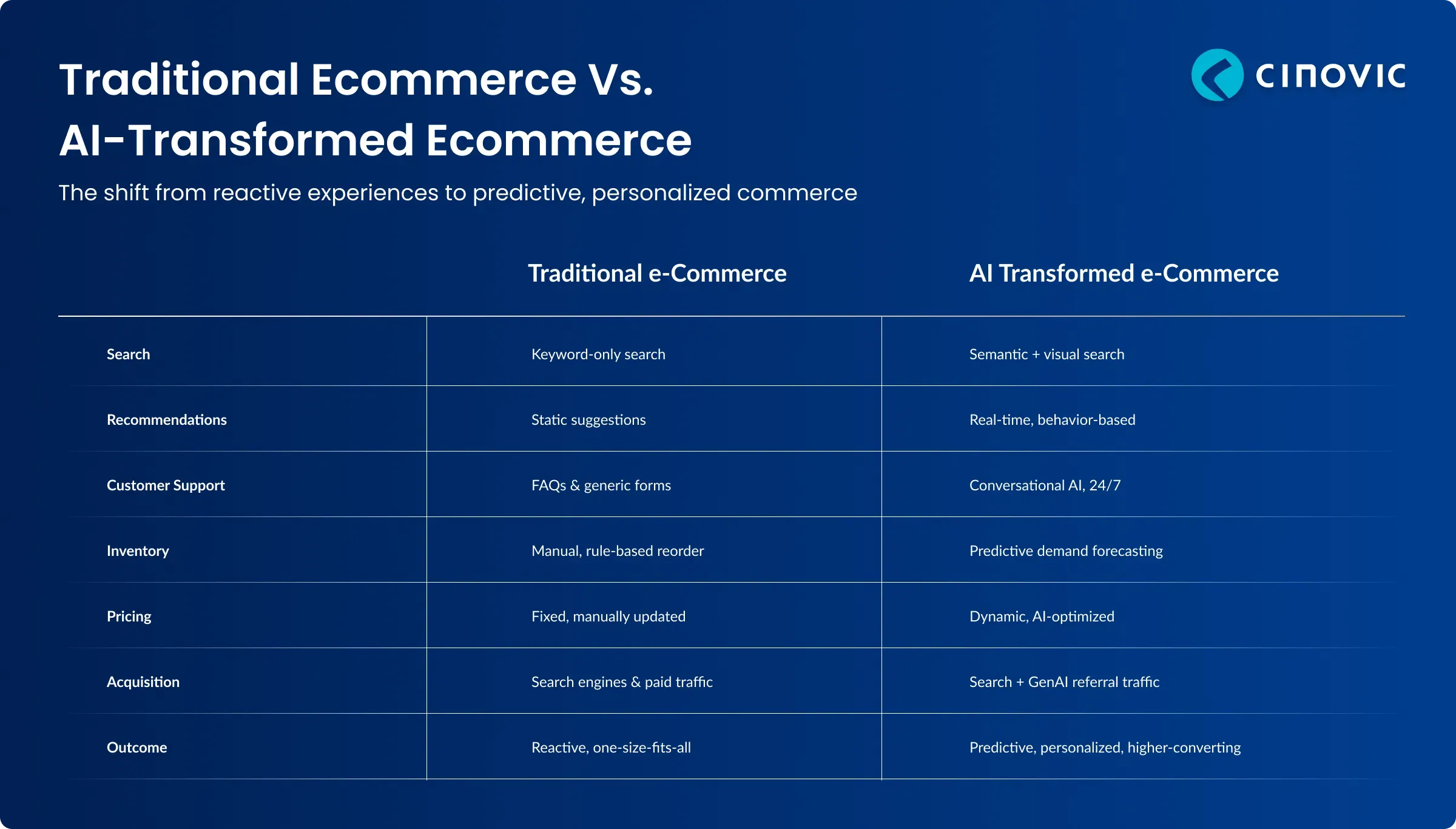
These are the building blocks that consistently deliver the highest measurable return when brands move from “experimenting with AI” to genuinely transforming the buying experience.
Transformation-Critical AI & UX Elements
Where AI investment delivers the highest measurable return in ecommerce.
AI Product Recommendations
Real-time, behavior-based suggestions contribute an estimated 25–35% of total ecommerce revenue and are the fastest AI feature to show ROI.
Conversational AI Assistants
Chat-based shopping assistants cut order-completion time by 50–70% and resolve questions that would otherwise cause drop-off.
AI-Enhanced Search & Discovery
Semantic and visual search help shoppers find products using their own words or a photo, instead of exact catalogue terms.
Predictive Inventory & Demand Forecasting
AI forecasting models cut lost sales from stockouts by up to 65% while reducing excess inventory and holding costs.
Dynamic, AI-Optimized Pricing
Real-time pricing adjusted to demand and competition delivers 5–10% margin gains in early deployments, with payback in 6–12 months.
Generative Engine Optimization (GEO)
Clean, structured product data lets AI shopping agents and assistants find and recommend you, capturing traffic that converts 31% higher than other channels.
The "Modern UX Foundation" pillar above is easiest to see in a real build. Cinovic's multi-brand Magento platform for pet food ecommerce runs four independent storefronts from a single Magento 2 installation with shared infrastructure, the same principle of building a clean, modular platform foundation that any AI layer (recommendations, search, personalization) can then sit on top of without each brand needing its own separate rebuild.
Worth flagging: this case study showcases multi-brand platform consolidation rather than an AI personalization or GEO deployment specifically. If you have a case study that's a closer match to the AI/UX work described in this article a recommendation engine rollout, a conversational assistant build, or a GEO project send it over, and I'll swap it in.
AI transformation isn’t a single feature launch; it’s a structured process of diagnosis, design, and integration across the platform.
|
1 |
AI & Data Readiness Audit Assess the quality, structure, and completeness of product, customer, and inventory data the foundation every AI feature depends on. |
|
2 |
UX & Funnel Analysis Map the current journey using analytics, identifying where drop-off happens and whether the cause is friction, missing trust signals, or a UX gap AI alone can’t fix. |
|
3 |
AI Opportunity Mapping Prioritize recommendations, search, conversational assistants, pricing, and forecasting by estimated revenue impact and implementation effort. |
|
4 |
Design & Prototyping Integrate AI touchpoints directly into the UX flow — recommendations, chat, and search designed as part of the page, not bolted-on widgets — and prototype in Figma before development. |
|
5 |
Implementation & Integration Build on Magento, Shopify, or Shopware, with AI/ML models connected through MuleSoft integration so recommendations, pricing, and inventory data stay in sync across systems. |
|
6 |
Testing, Measurement & Optimization Validate impact with A/B testing and Power BI reporting, treating AI transformation as a continuous improvement engine rather than a one-time launch. |
Bolting AI onto a broken UX foundation: A recommendation engine can’t fix a slow, confusing checkout. Fix the foundation, or the AI investment underperforms.
Treating AI as one feature instead of a system: Recommendations, search, chat, pricing, and forecasting reinforce each other. Implemented in isolation, each delivers a fraction of its potential.
Ignoring GEO in SEO strategy: Optimizing only for traditional search engines misses a channel that’s already converting 31% higher than the rest.
Over-automating support: Removing every human fallback from a conversational assistant erodes the trust it’s meant to build.
Personalizing without a privacy-first data strategy: Shoppers want relevance, not the feeling of being tracked. Transparency about data use is part of the UX, not a legal footnote.
Not measuring AI’s actual revenue impact: “We added AI” isn’t a result. Every feature should be tied to a measurable lift in conversion, AOV, or retention.
Cinovic's practice is built around one question: did the AI and UX work actually move revenue? We combine AI/ML consulting, hands-on ecommerce development, and data analytics to build experiences that perform, not just demo well.
We’ve built and optimized ecommerce experiences on Magento, Shopify, and Shopware, integrated AI/ML models through MuleSoft, and reported the results back through Power BI, always starting with data and ending with a measurable outcome. Whether you need a full AI-driven storefront transformation, a targeted recommendation and search upgrade, or an AI + UX audit that tells you exactly where to focus first, Cinovic brings the technical depth to do it right.
AI-powered ecommerce transformation isn’t a single tool or a one-time project; it’s a fundamentally different way of building the buying journey, where personalization, conversation, and prediction work together with a fast, clear, trustworthy UX foundation.
Brands that wait risk losing both halves of the new shopper: the one researching inside an AI assistant before they ever reach your site, and the one standing in your checkout who simply doesn’t have the patience for friction anymore.
Stop treating AI as a feature you add later. Start designing every part of the journey- discovery, recommendation, conversation, and checkout- to work with it from the ground up.
Start with an AI + UX Readiness Audit we’ll map your highest-impact opportunities in under 3 weeks.
Get an AI + UX AuditExplore our latest articles, insights, and technology trends.
Turn AI ambition into measurable results. Explore the four pillars of AI consulting, a 6-step engagement roadmap, and a real client case study.
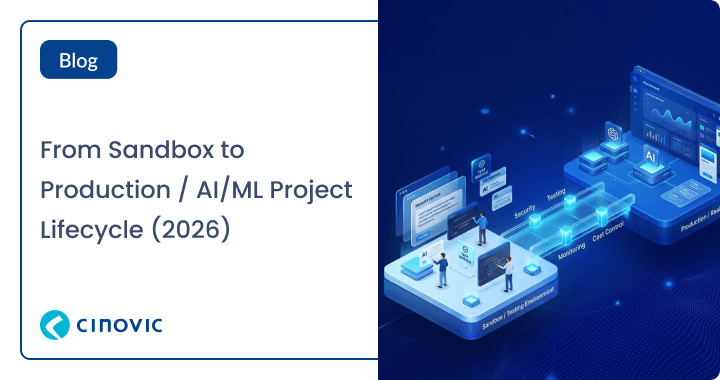
42% of AI projects never reach production. Learn the full AI/ML project lifecycle from feasibility audit to MLOps deployment and how to escape pilot purgatory for good. Free roadmap from Cinovic
Hyvä migration delivers measurable ROI: Magento stores see LCP drop from 4.8s to 1.2s, and 50%+ achieve green Core Web Vitals. See how Cinovic turns performance into profit.
Join 100+ teams scaling with Cinovic. Fill out the form below to get personalised tour of the platform.
It means redesigning the buying journey around two things at once: AI systems that personalize, recommend, forecast, and converse with shoppers, and a modern UX foundation — speed, clarity, accessibility — that lets those AI systems actually convert. Neither works well without the other.
Traditional personalization relies on static rules — “customers who bought X also bought Y.” AI personalization updates in real time based on live browsing behavior, intent signals, and context, and increasingly extends to conversational assistants, visual search, and predictive inventory rather than just product recommendations.
McKinsey research shows companies that excel at personalization earn roughly 40% more revenue from those efforts than average peers, and AI-led retail transformations are generating close to a threefold return per dollar invested. Results vary by starting point, but the direction is consistent across studies.
GEO is the practice of structuring product and content data so AI assistants like ChatGPT, Gemini, and Perplexity can find, understand, and recommend it. Adobe Analytics found generative AI referral traffic to retail sites grew 693% year over year and converted 31% higher than other channels, making it too significant to ignore.
You need a sound UX foundation alongside it, not necessarily before it. AI recommendations layered onto a slow, confusing checkout will underperform. Most teams get the best results from auditing UX and AI opportunities together and sequencing fixes by impact rather than treating them as separate projects.