Building a demo chatbot is easy. Building a production-grade generative AI application that integrates with your data, meets compliance requirements, and holds up under real use is a different discipline. This guide walks through what that actually takes: the architecture, the stack, and the process.
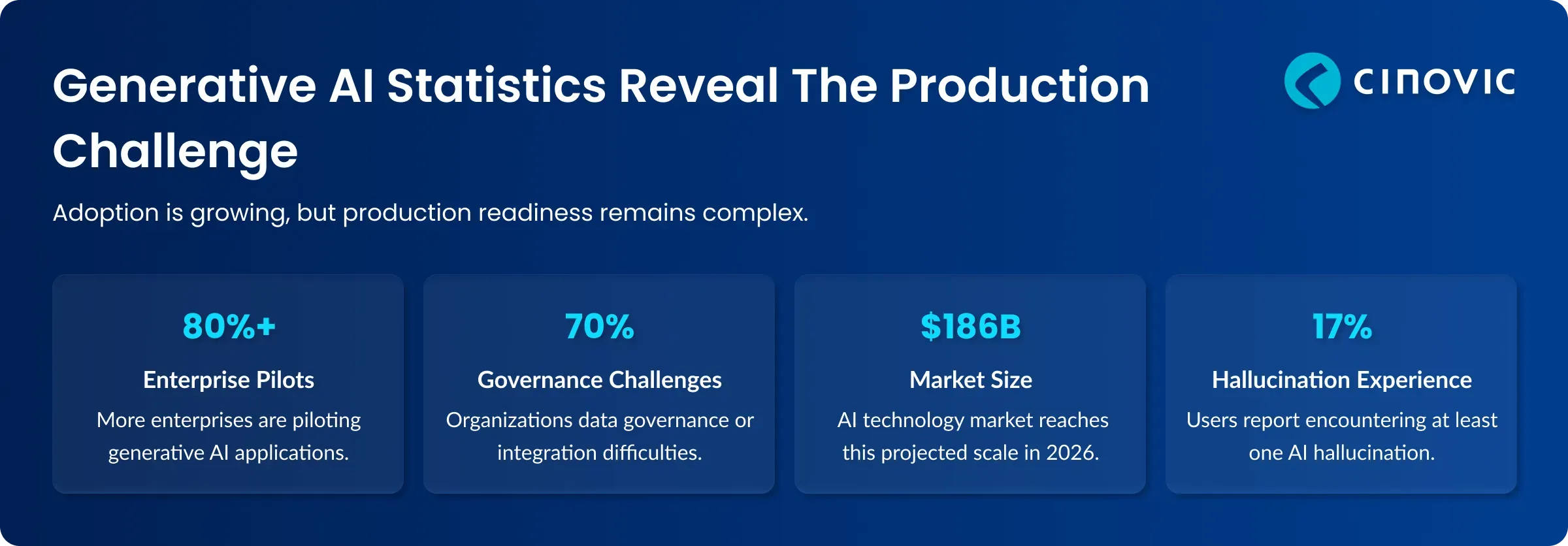
KEY STATISTICS
Of enterprises have piloted generative AI applications, up from 65% in 2024
|
Of organizations report data governance or integration difficulties building AI applications
|
Global generative AI technology market size in 2026
|
Of users have encountered at least one AI hallucination
|
What Generative AI Application Development Actually Involves
Generative AI application development is a systems engineering challenge, not a single API call. A working application needs a data layer you can reliably retrieve from, an orchestration layer that manages prompting and constraints, an evaluation layer that catches quality problems before users do, and a deployment layer that handles cost, latency, and scale.
Treating the model as the whole product is the most common reason prototypes stall before production. The model is one component in a stack, and usually not the one that determines whether the application succeeds.
A generative AI application isn't a wrapper around a model. It's a data pipeline, an evaluation framework, and a deployment system that happens to call a model somewhere in the middle. Cinovic AI Engineering Team
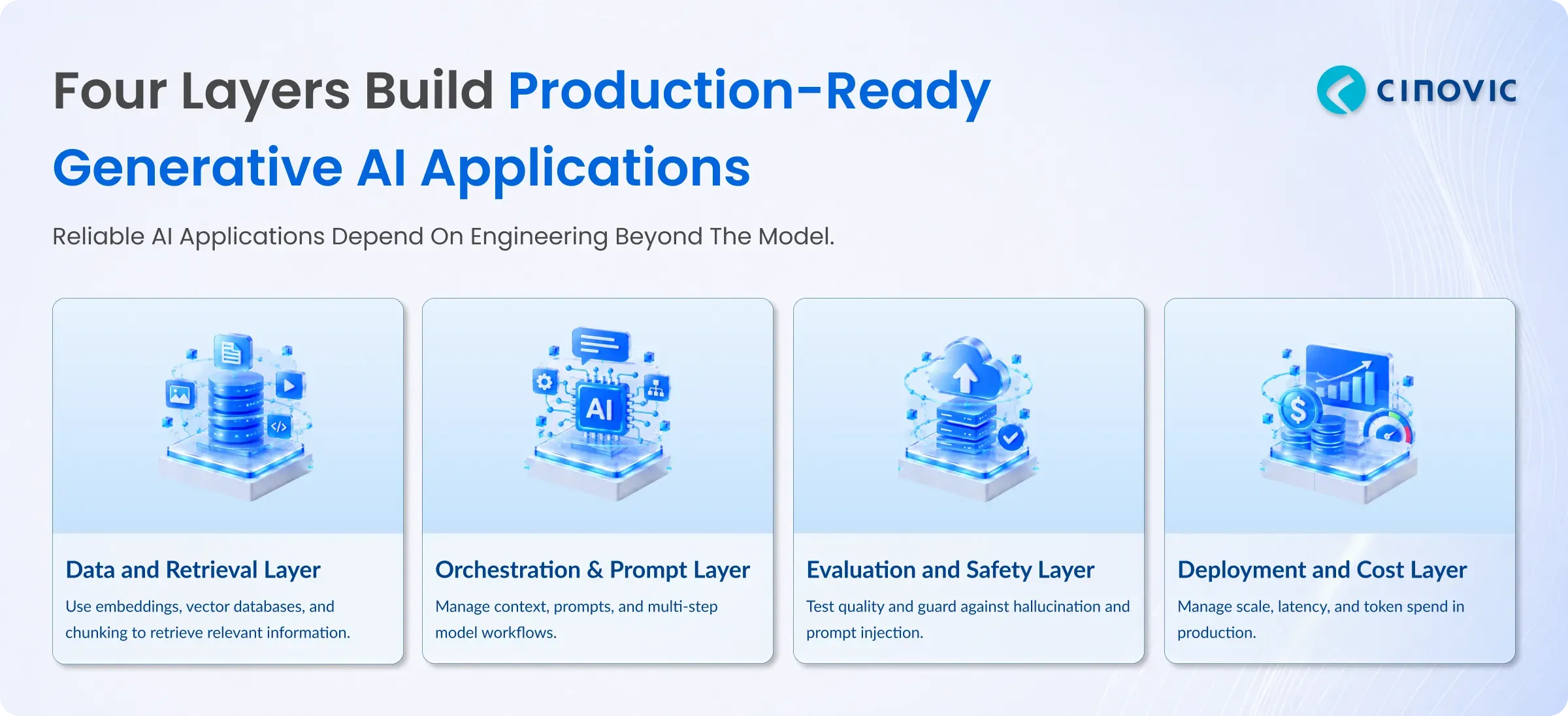
The Four Layers of a Production Generative AI Application
Every production-grade generative AI application needs these four layers working together.
|
|
Orchestration & Prompt Layer
Frameworks like LangChain or LlamaIndex that manage how context, prompts, and multi-step reasoning flow through the application.
|
Evaluation & Safety Layer
Systematic testing for hallucination, bias, and quality drift, plus guardrails against prompt injection and other model-specific security risks.
|
Deployment & Cost Management Layer
|
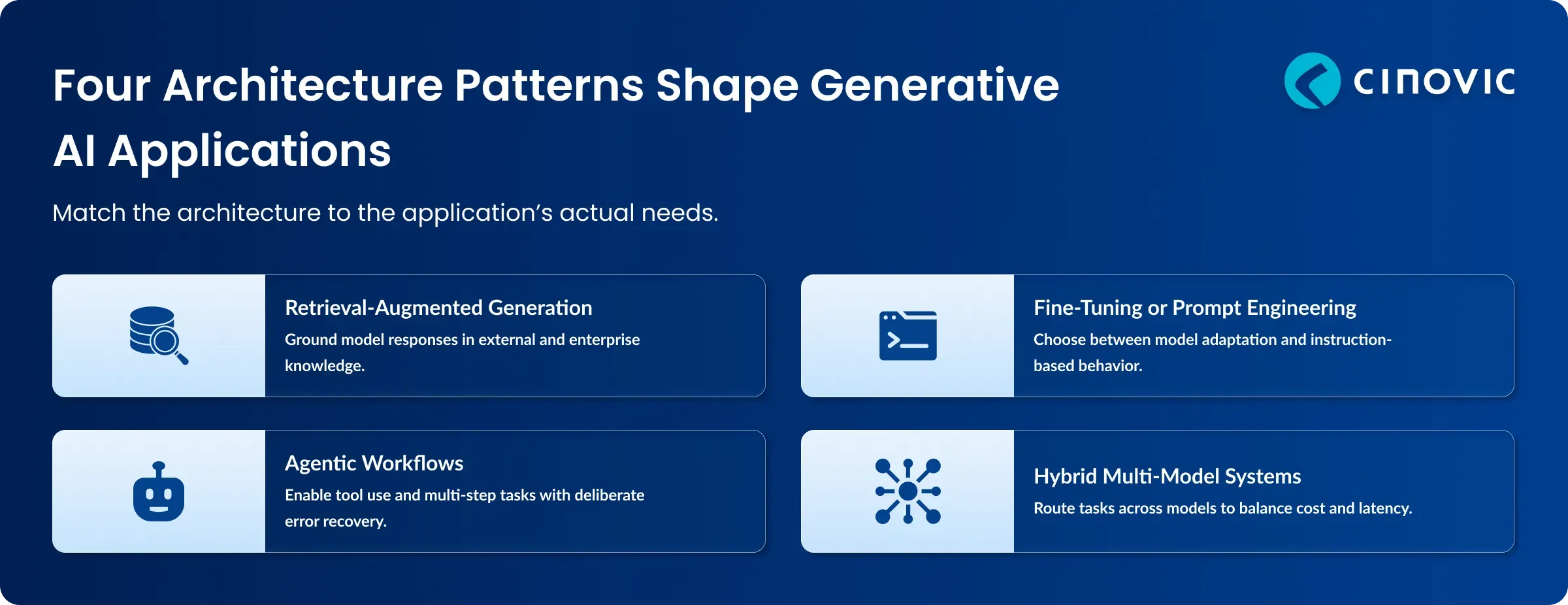
Core Architecture Patterns to Choose From
The right architecture depends on your use case, not on what's trending. These are the patterns worth understanding.
1. Retrieval-Augmented Generation (RAG)
RAG combines a language model with an external knowledge base, retrieving relevant context at query time instead of relying on what the model memorized during training. It's the default starting point for most enterprise applications — best for prototypes, internal knowledge tools, and anything where answers need to be grounded in your own data. Our online notary booking and document workflow platform case study shows the kind of document-heavy workflow where this pattern fits.
2. Fine-Tuning vs. Prompt Engineering
Fine-tuning adjusts the model's weights on your own data, while prompt engineering shapes behavior through instructions at inference time. Prompt engineering is faster, cheaper, and usually sufficient; fine-tuning earns its cost only when a narrow, repeatable task needs consistent behavior that prompt engineering can't reliably achieve.
Agent-based architectures let the model use tools, browse data sources, and complete multi-step tasks with limited human supervision. This is where the most complex engineering lives; planning, tool use, and error recovery all need to be designed deliberately, not assumed to work. See our AI agent development services.
4. Hybrid Multi-Model Systems
Many production applications route different tasks to different models: a smaller, cheaper model for simple classification, a larger model for complex reasoning, optimizing for cost and latency rather than using one model for everything.
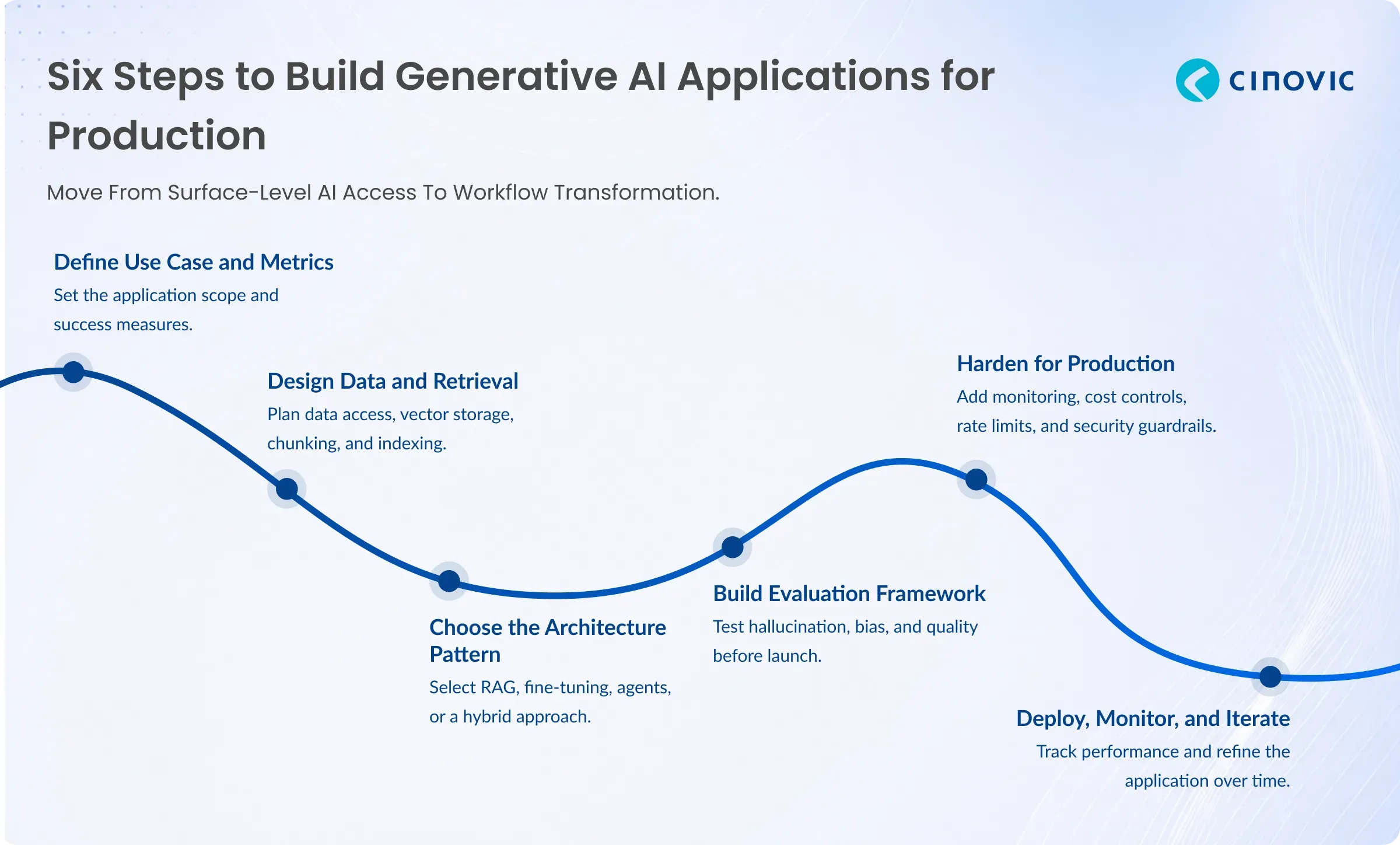
A Practical 6-Step Generative AI Application Development Process
Theory without execution is just wishful thinking. Here is a battle-tested process from concept to a production-ready application.
-
Design the Data and Retrieval Architecture: Decide what data the application needs access to, and build the vector database, chunking, and indexing strategy around it.
-
Choose the Right Architecture Pattern: Match RAG, fine-tuning, agentic workflows, or a hybrid approach to the specific use case, rather than defaulting to whichever is most discussed.
-
Harden for Production: Add monitoring, cost controls, rate limiting, and security guardrails against prompt injection and other LLM-specific risks.
-
Deploy, Monitor, and Iterate: Launch with observability in place, and treat the application as a living system that needs ongoing tuning as usage patterns evolve. Our financial services client operations platform case study shows a production platform built for ongoing use.
Where Development Effort Should Be Concentrated
Where the Engineering Effort Actually Goes — Contrary to expectations, most production challenges live outside the model call itself
|
Retrieval Architecture — The quality of what gets retrieved matters more to output quality than which model is called.
|
Evaluation Infrastructure — Systematic testing that catches quality regressions before users experience them.
|
Token Economics — Poor prompt design and unoptimized context windows can double inference costs without anyone noticing.
|
Security Guardrails — Prompt injection and data leakage are LLM-specific risks that traditional application security doesn't cover.
|
Data Governance — Structuring and cleaning the data an application depends on, often the least glamorous and most important part of the build. See our data modernisation services.
|
Latency Management — Streaming responses, caching, and model routing to keep the application feeling fast at scale.
|
Common Generative AI Development Mistakes to Avoid
-
Choosing architecture based on trends, not fit: Defaulting to the most-discussed pattern, agentic workflows, fine-tuning, instead of matching the pattern to the actual use case adds unnecessary complexity.
How Cinovic Builds Generative AI Applications That Reach Production
At Cinovic, we treat generative AI application development as a systems engineering discipline, with discovery workshops to align the build with measurable business outcomes, architecture design focused on cost and scalability, and production hardening with proper monitoring, not just a working demo.
Our team combines hands-on development across RAG architecture, agentic workflows, and model integration with deep experience in data infrastructure and system integrations, including MuleSoft, plus platform expertise across Magento, Shopify, and Power BI. We build the full stack, data, orchestration, evaluation, and deployment- so what launches is a product designed to hold up under real usage.
See this approach in action in our financial services client operations platform, online notary booking and document workflow platform, and full accounting integration platform case studies, or browse all of our case studies.
Conclusion: The Model Is the Easy Part
Every team building generative AI applications in 2026 has access to capable models. What determines whether an application actually reaches production and stays reliable is the engineering around it, retrieval, evaluation, cost management, and security.
A generative AI application isn't finished when the demo works. It's finished when it holds up in front of real users, under real load, for months at a time.