Generative AI applications don't behave like traditional software. Outputs are probabilistic, not deterministic; the same input can produce different results, and quality depends heavily on data, prompt design, and retrieval architecture as much as on the underlying model.
This is part of why organizations that build generative AI internally, without specialized development expertise, see solutions fail at a notably higher rate than those built with the right technical partner . It's rarely the model that's the problem; it's the engineering discipline around evaluation, integration, and reliability that a general software team hasn't had to build before.
“A generative AI feature that looks impressive in a demo and one that survives real users asking real questions are two very different pieces of engineering.” Cinovic AI Development Team
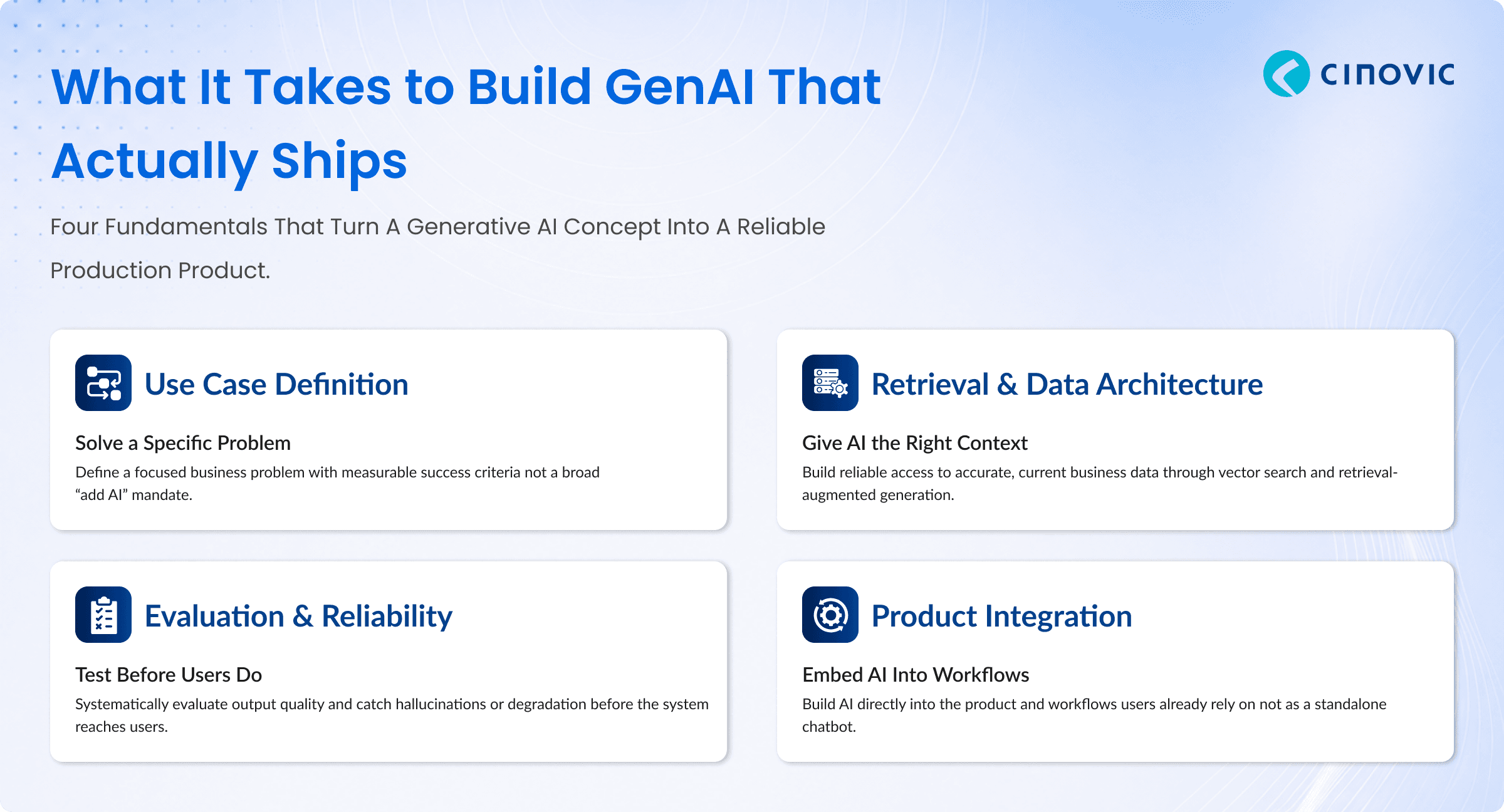
The Four Pillars of Generative AI Development Done Right
Building a generative AI product that actually ships and holds up in production rests on four things.
A specific, well-scoped problem the AI needs to solve, not a general-purpose “add AI to the product” mandate.
|
Retrieval & Data Architecture
The pipeline that gives the model accurate, current context, usually built on vector search and retrieval-augmented generation, not the model's training data alone. This is where LLM development and integration and data engineering work together.
|
Systematic testing that catches quality degradation and hallucination before users do, not just a one-time demo check. MLOps practices keep that testing running after launch.
|
|
Where Generative AI Development Delivers the Clearest ROI
Not every generative AI use case is equally mature. These are the categories with the most consistently proven returns.
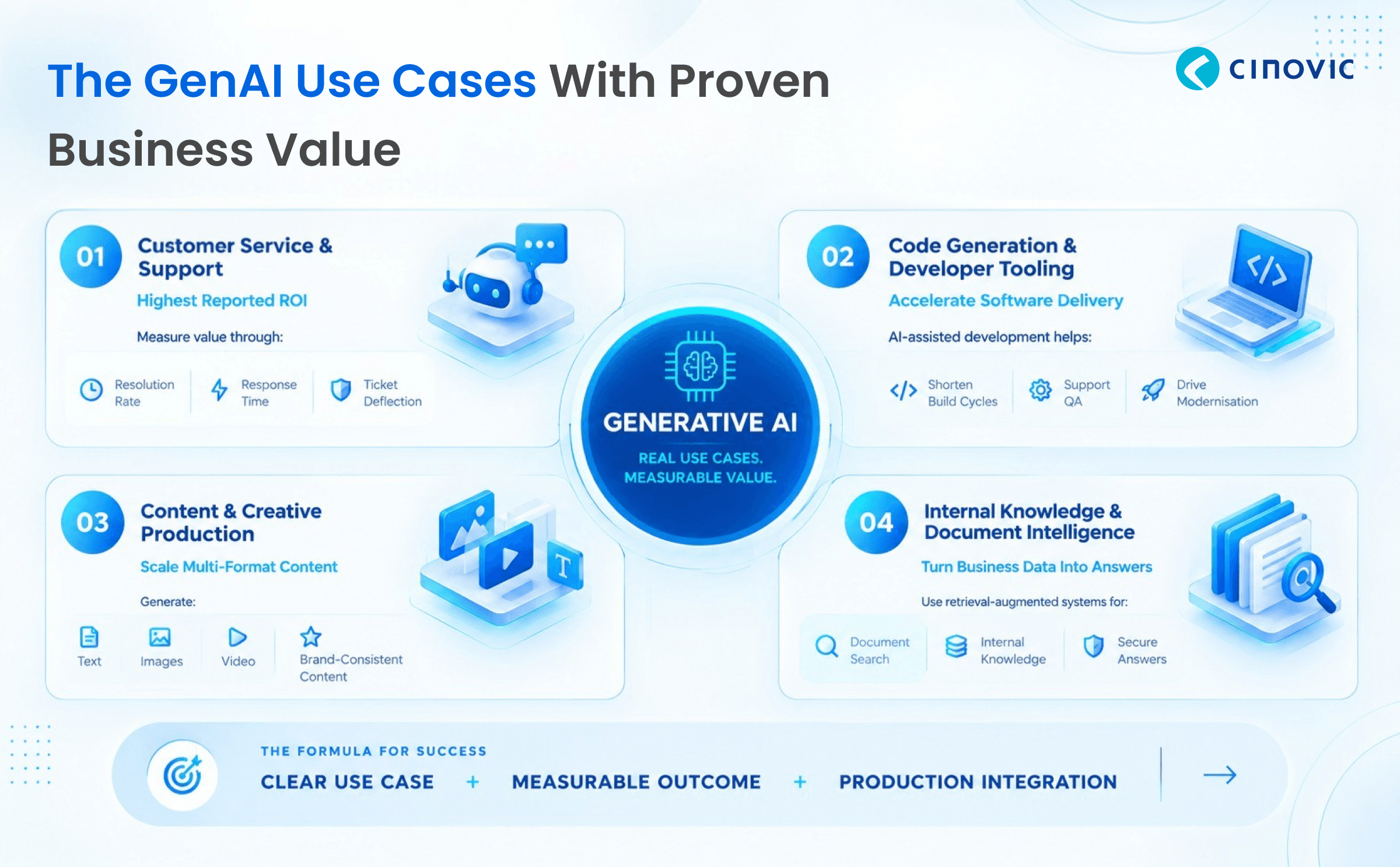
1. Customer Service & Support Automation
Customer service automation is the highest-reported-ROI generative AI use case, largely because success is easy to measure: resolution rate, response time, ticket deflection, against a clear before-and-after baseline. Our AI agent development work covers this, and our financial services client operations platform case study shows a client-facing workflow rebuilt on a unified platform.
2. Code Generation & Developer Tooling
Coding is one of the largest and fastest-maturing enterprise use cases, reflecting how directly AI-assisted development shortens build cycles and supports broader modernization efforts.
3. Content & Creative Production
Text, image, and increasingly video generation are becoming full-stack production tools for marketing and internal content, moving well past simple drafting assistance into brand-consistent, multi-format output.
4. Internal Knowledge & Document Intelligence
Retrieval-augmented systems built over a company's own documents and data are one of the most reliable ways to give employees fast, accurate answers without exposing sensitive data to a general-purpose model. Our online notary booking and document workflow platform case study shows what a fully digital document workflow looks like.
A Practical 6-Step Generative AI Development Roadmap
Theory without execution is just wishful thinking. Here is a battle-tested roadmap from concept to a product people rely on.
-
Develop With Production Constraints From Day One: Build against real data, real integrations, and real latency requirements, not a simplified demo environment.
-
Monitor, Evaluate, and Iterate Continuously: Track output quality and user feedback after launch, since generative AI systems need ongoing tuning as usage patterns evolve.
Where Generative AI Development Investment Is Concentrated
High-ROI Generative AI Development Areas, where businesses are seeing the strongest returns from custom-built solutions in 2026
|
→ Customer Service Automation, the highest reported ROI category, with fast, well-documented payback.
|
→ Code Generation & Developer Tools, the largest enterprise use case by investment, shortening build and QA cycles.
|
→ Document & Knowledge Retrieval, Fast to build, high adoption, low risk relative to customer-facing use cases.
|
→ Content & Creative Production, Brand-consistent text, image, and video generation at reduced production cost.
|
→ Sales & Marketing Personalisation, Tailored recommendations and messaging generated at a scale manual work can't match.
|
→ Financial & Operational Analysis: Natural-language interfaces over structured business data for faster decision-making.
|
Common Generative AI Development Mistakes to Avoid
How Cinovic Builds Generative AI That Actually Ships
At Cinovic, we build generative AI applications designed to survive contact with real users, not demos that impress once and quietly fail in production. Our team combines hands-on generative AI development with deep experience across machine learning, data infrastructure, and integrations including MuleSoft, plus platform expertise across Magento, Shopify, and Power BI.
Every business now has access to capable foundation models. What separates the companies shipping real generative AI products from the ones stuck experimenting is development discipline, retrieval architecture, evaluation, and integration into the actual product.
Generative AI development isn't about picking the right model. It's about building the engineering discipline around it that turns a demo into something your users depend on.