AI/ML CONSULTING | AI WORKFLOW AUTOMATION
How to Implement AI Solutions in Your Business
A Practical Guide to Moving From Pilot to Production Without Losing the Budget
Read More


KEY STATISTICS
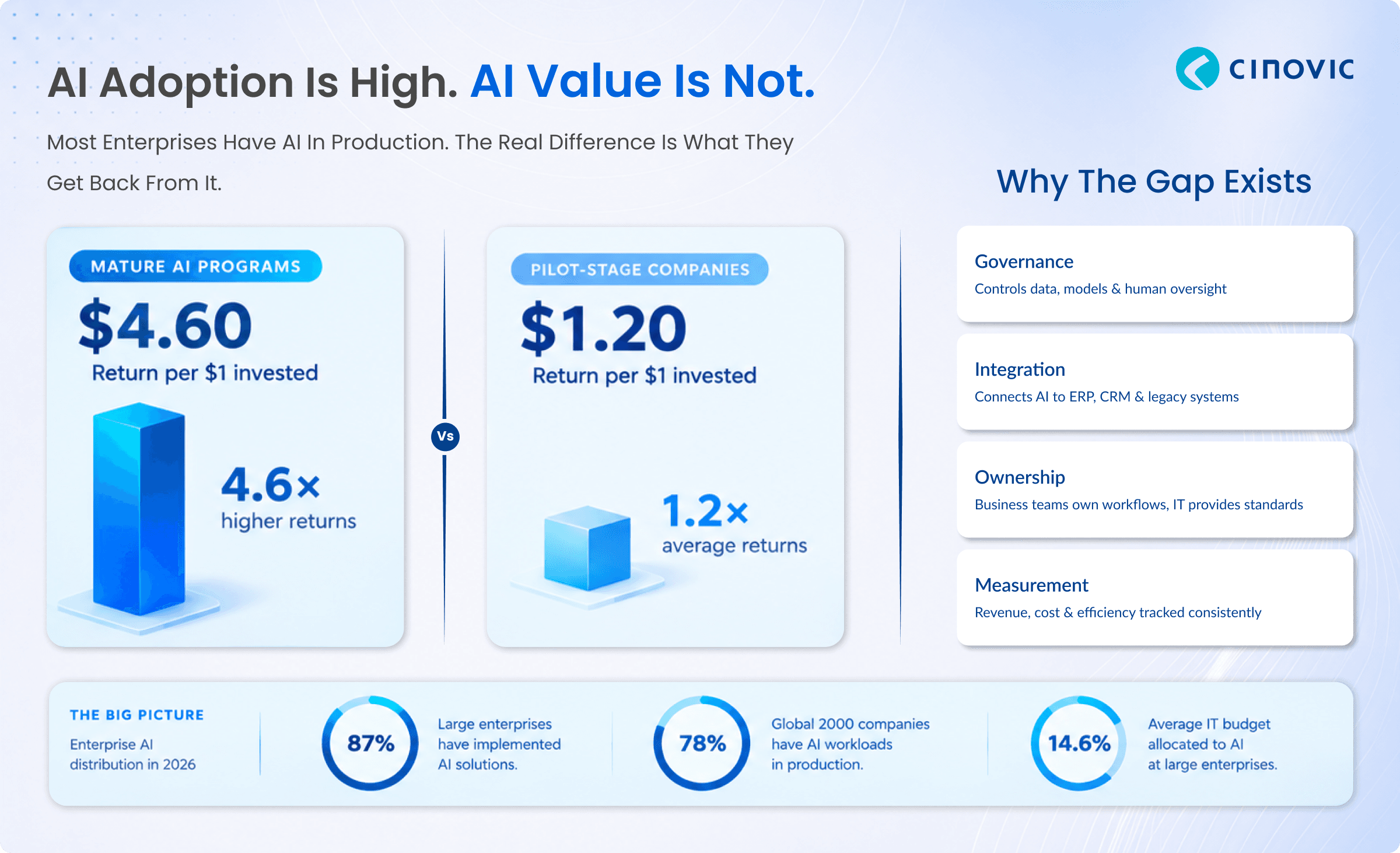
Enterprise AI adoption is effectively universal now; the interesting question isn't whether large companies use AI, but which ones are actually capturing value from it. Enterprises with mature AI programs report an average return of $4.60 for every dollar invested, while that figure drops to just $1.20 for companies still stuck in the pilot phase.
That gap isn't about which enterprise has access to better models; every large company has access to roughly the same technology. It's about governance, data infrastructure, and whether AI initiatives are tied to specific business outcomes instead of scattered across a dozen disconnected pilots.
At enterprise scale, the AI model was never the differentiator. The differentiator is whether the organization can govern, integrate, and scale it across every team that touches it. Cinovic Enterprise Advisory Team
Enterprise AI carries requirements that pilot-stage projects can skip. These four are non-negotiable at scale.
|
Governance & Risk Control Clear policies on data handling, model usage, and human oversight, with senior leadership actively involved, not delegated entirely to technical teams. |
Enterprise-Grade Integration AI systems that connect cleanly into existing ERP, CRM, and legacy infrastructure, rather than operating as disconnected point solutions. |
|
Cross-Functional Ownership Business teams with direct ownership of their AI workflows, paired with centralized IT oversight, not AI locked inside a single technical silo. |
Measurable Business Outcomes Revenue, cost, and efficiency metrics tracked against each AI initiative, so leadership can tell which investments are actually working. |
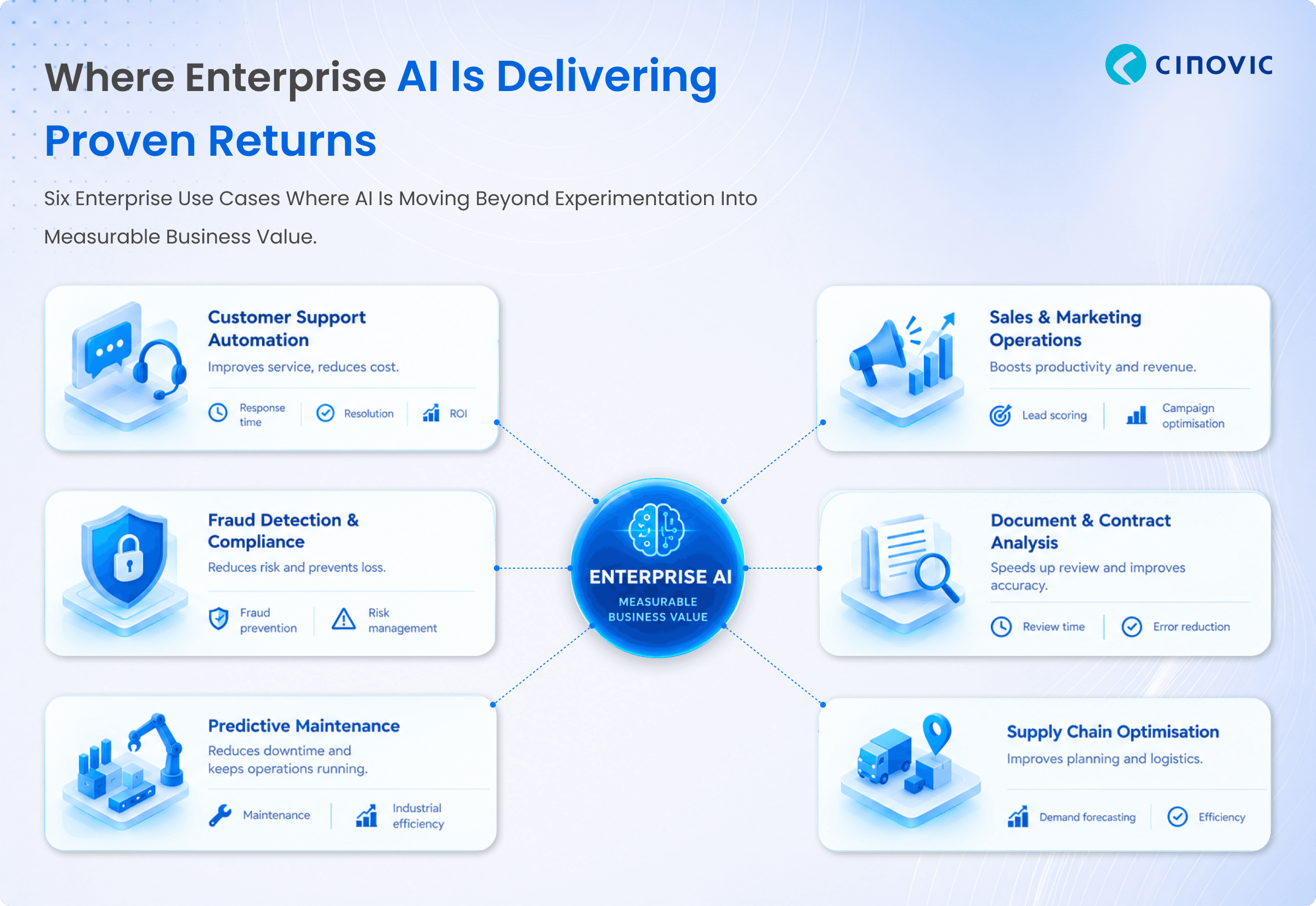
Not every use case delivers equal value. These are the areas with the clearest, most consistently reported ROI at enterprise scale.
1. Customer Support Automation
Customer support automation is one of the most widely deployed enterprise AI use cases, and consistently ranks among the highest in reported ROI. Our own AI-Powered Customer Support Automation case study shows this in practice: an LLM + RAG support platform that cut response times, deflected repetitive tickets, and gave agents an AI co-pilot.
2. Fraud Detection & Risk Management
Fraud detection delivers some of the strongest measured cost reductions of any enterprise AI use case, which is a large part of why financial services leads enterprise AI ROI among all industries.
3. Document & Contract Analysis
Structured, rules-based document review is one of the fastest categories to move from pilot to full deployment, since success can be measured directly against manual review time and error rates.
4. Predictive Maintenance & Supply Chain Optimisation
Manufacturing and logistics enterprises are seeing meaningful reductions in downtime and efficiency gains from AI-driven forecasting, proof that enterprise AI value isn't limited to office-based, white-collar workflows.
Theory without execution is just wishful thinking. Here is a battle-tested roadmap for deploying AI at enterprise scale.
Establish Governance Before Scaling: Define data handling policy, model usage guidelines, and human oversight requirements before AI initiatives multiply across the business.
Audit Enterprise Data Infrastructure: Assess whether core systems can reliably feed AI initiatives at the data quality and volume enterprise deployment requires.
Assign Business Ownership, Not Just IT Ownership: Give business teams direct accountability for their AI workflows, with centralized IT maintaining oversight and standards.
Prioritise by Measurable Business Outcome: Rank AI initiatives by revenue, cost, or efficiency impact, not by technical novelty or internal enthusiasm.
Integrate Deeply, Not Superficially: Connect AI systems into the ERP, CRM, and legacy infrastructure your teams already rely on daily. Our Financial Services Client Operations Platform case study shows what deep integration looks like in practice, unifying mailboxes, client, and team management into one operational system.
Track ROI Consistently Across Initiatives: Measure results the same way across every AI project, so leadership can compare performance and reallocate budget toward what's actually working.
|
High-ROI Enterprise AI Use Cases: Where large companies are seeing the clearest, most consistently reported returns in 2026 |
|
→ Customer Support Automation: Among the most widely deployed use cases, with strong, well-documented ROI. |
|
→ Fraud Detection & Compliance: Leading cost-reduction category, concentrated heavily in financial services. |
|
→ Document & Contract Analysis: Fast to deploy, easy to measure against manual review baselines. |
|
→ Software Engineering Assistance: Widely adopted for measurable developer productivity gains. |
|
→ Predictive Maintenance: Meaningful downtime reduction in manufacturing and industrial operations. |
|
→ Supply Chain Optimisation: Efficiency gains from AI-driven demand forecasting and logistics planning. |
Running AI initiatives in silos: Locking AI inside a single technical team creates bottlenecks that prevent value from reaching the rest of the organization.
No consistent ROI measurement: Without a standard way to measure results across projects, leadership can't tell which AI investments deserve more budget and which need to be cut.
Treating governance as an afterthought: Enterprises where senior leadership actively shapes AI governance consistently achieve greater business value than those that delegate it entirely to technical teams.
Scattering investment across too many pilots: Running more AI projects doesn't mean more value; most enterprises run far more pilots than they can actually scale to production.
Underinvesting in integration: AI tools that don't connect to the systems teams already use daily struggle to get adopted, regardless of how capable the model is.
At Cinovic, we build enterprise AI solutions designed for governance, integration, and measurable outcomes from day one, not disconnected pilots that never make it past a single department.
Our team combines deep experience across generative AI, LLM development and integration, MLOps, and enterprise system integration, including MuleSoft, with platform expertise across Magento, Shopify, and Power BI–driven analytics, so AI initiatives connect cleanly into the infrastructure your enterprise already runs on. Our AI Consulting practice helps enterprise teams prioritise by business outcome, establish governance before scale becomes a liability, and track ROI consistently so leadership always knows what’s working.
Every large enterprise now has access to capable AI models. What separates the organizations capturing real, compounding value is governance, integration discipline, and consistent measurement, not which vendor they chose.
The enterprises pulling ahead in 2027 aren't running the most AI pilots. They're the ones who built the governance and infrastructure to turn a handful of pilots into enterprise-wide, measurable value.
Talk to a Cinovic enterprise AI expert. No obligation, just a focused conversation about where governance or integration gaps may be holding your AI initiatives back.
contact-usExplore our latest articles, insights, and technology trends.
A Practical Guide to Moving From Pilot to Production Without Losing the Budget
AI workflow automation is now an operational default. In 2026, leading businesses are rebuilding approvals, data entry, and customer workflows around AI.

How artificial intelligence and modern UX design are rewriting how shoppers discover, decide, and buy, and what ecommerce brands need to do now to keep pace.
Talk to a Cinovic enterprise AI expert. No obligation, just a focused conversation about where governance or integration gaps may be holding your AI initiatives back.
Most failures trace back to governance gaps, inconsistent data quality, and a lack of standardised ROI measurement across projects, not the underlying AI technology.
Enterprise AI carries additional requirements around governance, cross-system integration, and organization-wide oversight that smaller, single-team deployments can often skip.
Customer support automation, fraud detection, and document or contract analysis consistently report some of the clearest, most well-documented returns across large enterprises.
Both the enterprises seeing the most value give business teams direct ownership of their AI workflows while IT maintains centralized governance and standards.
There's no universal number, but large enterprises now allocate a meaningfully growing share of IT budget to AI, and top-quartile performers invest significantly more than the median.
We start with governance and data infrastructure readiness, then prioritise initiatives by measurable business outcome, building integrations into your existing enterprise systems so results can be tracked consistently and scaled with confidence.