Almost every business has run an AI pilot by now. Far fewer have one running in production, delivering measurable value. The gap between the two isn’t the technology; it’s implementation discipline, and that’s the part most businesses skip.
KEY STATISTICS
Why Most AI Implementations Stall at the Pilot Stage
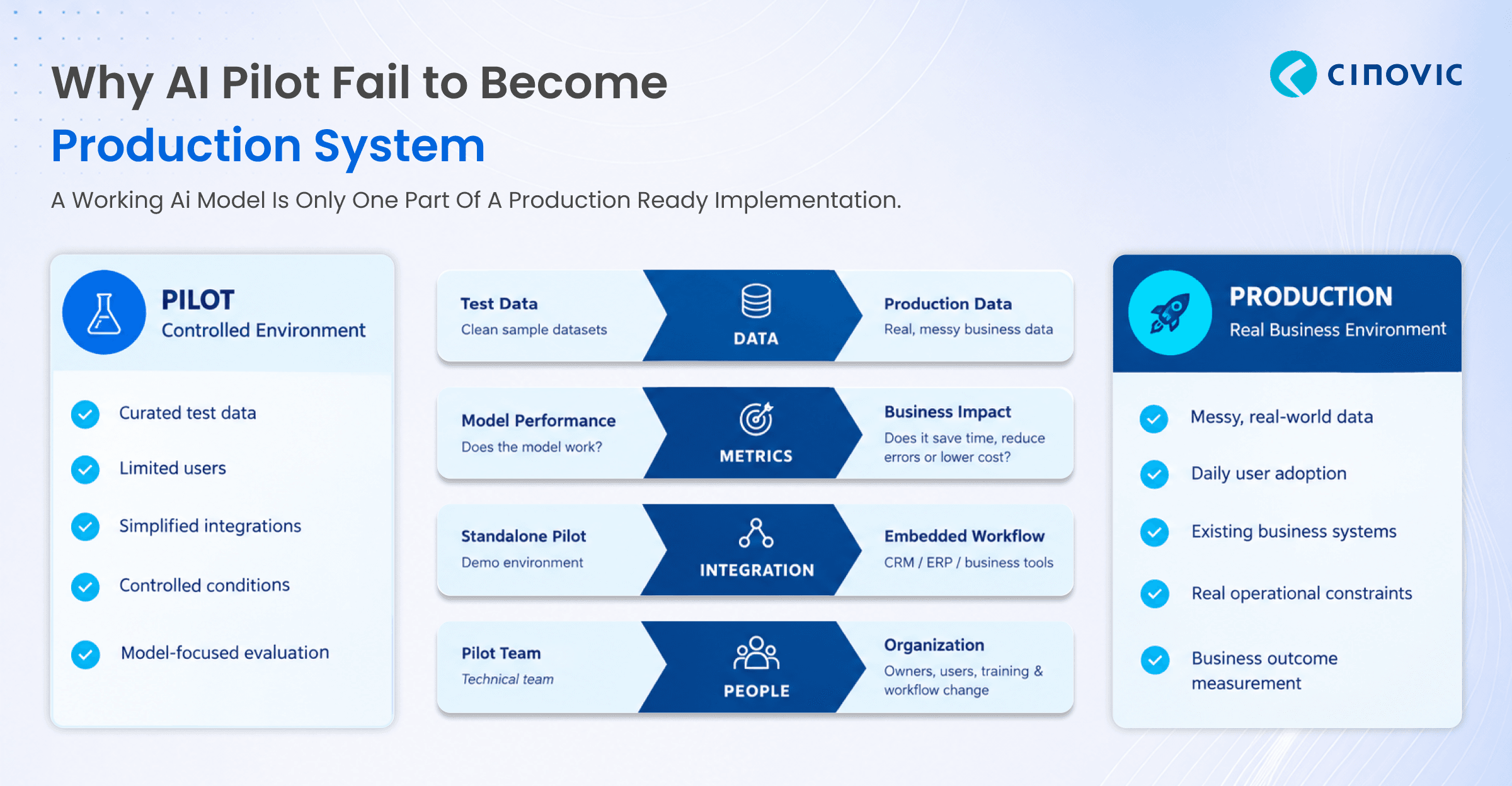
The pattern is consistent across industries: a pilot works well in a controlled environment, gets a round of executive applause, and then never makes it into daily operations. It’s rarely the model’s fault.
The top causes of AI projects failing to deliver on their expected return aren’t weak models or insufficient computing power; they’re preventable organizational failures, starting with poor data quality and unclear success criteria. Production runs on the real, messy data a business actually has, evaluated by the people who use it every day, not the team that built the demo.
“A pilot proves the model works. Production proves the organization can run it. Those are two different problems, and most implementations only solve the first one.” — Cinovic Engineering Team.
The Four Pillars of a Successful AI Implementation
Getting past the pilot stage consistently comes down to these four fundamentals.
Clean, accessible, well-governed data the AI system can actually run on reliably — not just in a curated test set.
|
Specific, measurable KPIs defined before the build starts, so “did this work?” has an objective answer.
|
The AI solution connects cleanly into the tools your team already uses, instead of requiring a separate workflow nobody adopts.
|
Training, ownership, and workflow redesign — since successful transformations put most of their effort here, not in the technology itself.
|
A Practical 6-Step AI Implementation Roadmap
Theory without execution is just wishful thinking. Here is a battle-tested roadmap to move from idea to production.
-
Audit Your Data Readiness: Assess whether the data needed for this use case is clean, accessible, and governed well enough to support a reliable system, before writing a line of code.
-
Define Success Metrics Upfront: Set the specific KPI time saved, error rate, cost per transaction- that will determine whether this implementation is working, before the pilot begins.
-
Build With Production in Mind From Day One: Design the pilot using the same data, integrations, and constraints it will face in production, not a simplified sandbox version.
Where AI Implementation Delivers the Fastest Payback
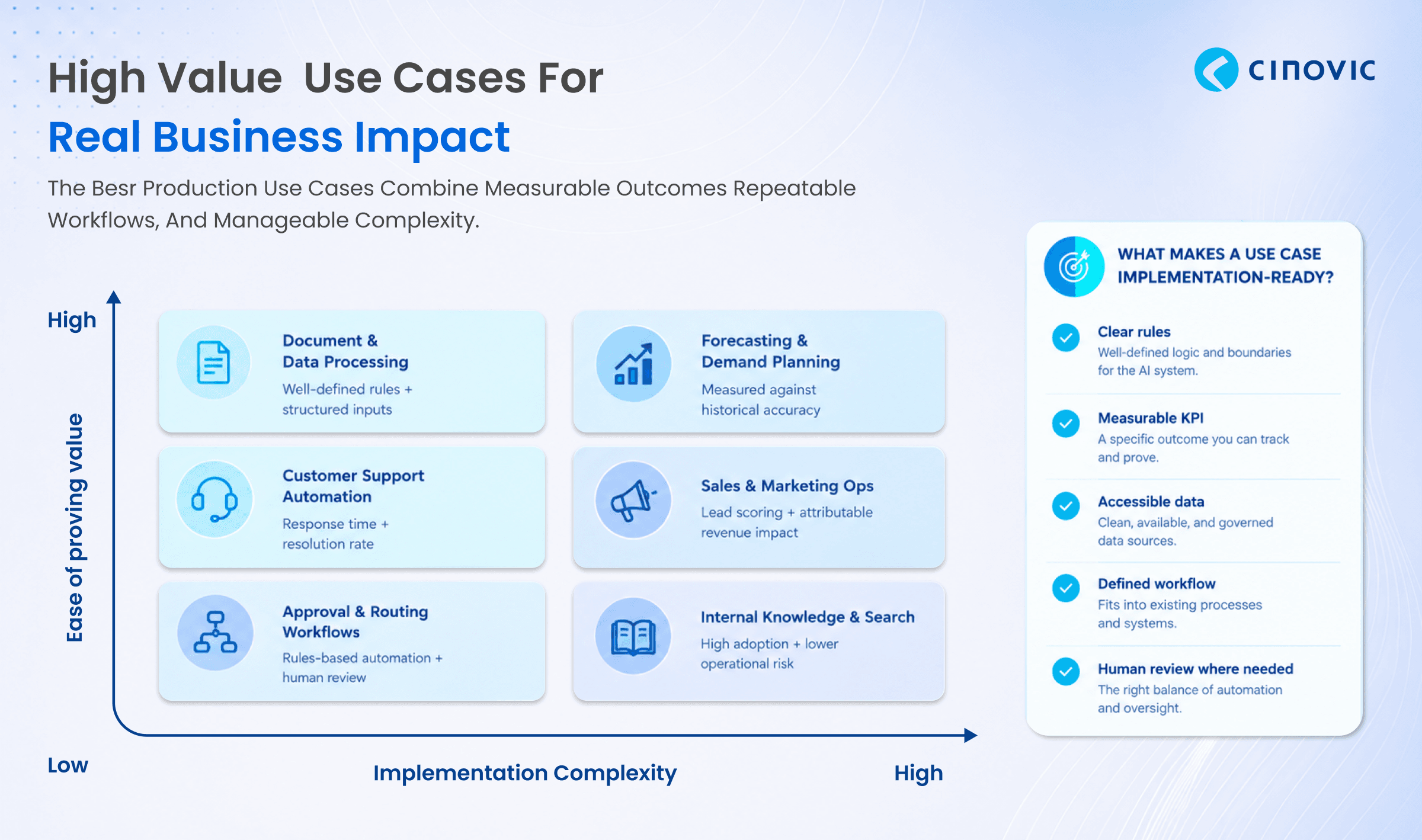
High-Payback Implementation Areas: Where businesses are converting pilots into production most consistently in 2026
- Document & Data Processing: Well-defined rules and structured inputs make this one of the most reliable areas to move past pilot.
- Customer Support Automation: Clear success metrics (response time, resolution rate) make ROI easy to prove and defend. See how this plays out in practice in our AI-Powered Customer Support Automation case study, where an LLM + RAG platform cut first-response times and deflected repetitive tickets before they reached a human agent.
- Internal Knowledge & Search: Lower-risk, high-adoption use case that builds organizational trust in AI before tackling harder problems.
- Forecasting & Demand Planning: Measurable against historical accuracy, making the business case straightforward to build.
- Approval & Routing Workflows: Rules-based enough to automate confidently, with exceptions easy to flag for human review.
- Sales & Marketing Ops: Lead scoring and campaign optimisation with revenue impact that’s directly attributable.
Common AI Implementation Mistakes to Avoid
How Cinovic Helps You Implement AI That Actually Reaches Production
At Cinovic, we treat implementation as the hard part, because it is. Our team combines hands-on delivery across generative AI, machine learning infrastructure via our MLOps services, and integrations including MuleSoft, alongside deep experience with the platforms your business already runs on, from Magento and Shopify to Power BI–driven analytics.
We start every engagement with a data readiness audit and a specific, measurable use case, not a broad AI strategy deck — so the pilot we build is designed to reach production from day one, with the ownership and success metrics needed to prove it’s working. Our AI-Powered Customer Support Automation case study shows what that looks like end to end: a scoped use case, production-grade data, and measurable results from launch.
Conclusion: Implementation Discipline Is the Real Competitive Advantage
Every business now has access to capable AI models. What separates the ones seeing real returns from those stuck in pilot purgatory is implementation discipline, clean data, clear metrics, real ownership, and the change management to make people actually use it.
The businesses winning with AI in 2026 aren't the ones who adopted it first. They're the ones who implemented it like it needed to survive contact with production, because it does.