Why Most Enterprises Don't Actually Have a Software Problem
The instinct when a workflow feels clunky is to buy another tool. That instinct is exactly why the average enterprise ends up running 106 separate SaaS applications, nearly half of which sit unused while still costing real money every month. The underlying issue usually isn't a missing capability, it's a mismatch between generic, off-the-shelf tools and the specific way a business actually operates.
Custom PHP development addresses that mismatch directly rather than adding to it. Instead of forcing teams to adapt their workflow around a third-party product's assumptions, a custom-built system is designed around the business's actual processes from the start, and with mature frameworks like
Laravel and
Symfony, that customization no longer comes with the cost or risk premium it once did.
Every enterprise we talk to has a drawer full of software licenses nobody remembers signing up for. Custom development isn't about building more; it's about building the one system that finally fits, so the other ninety don't need to exist. Cinovic PHP Development Team
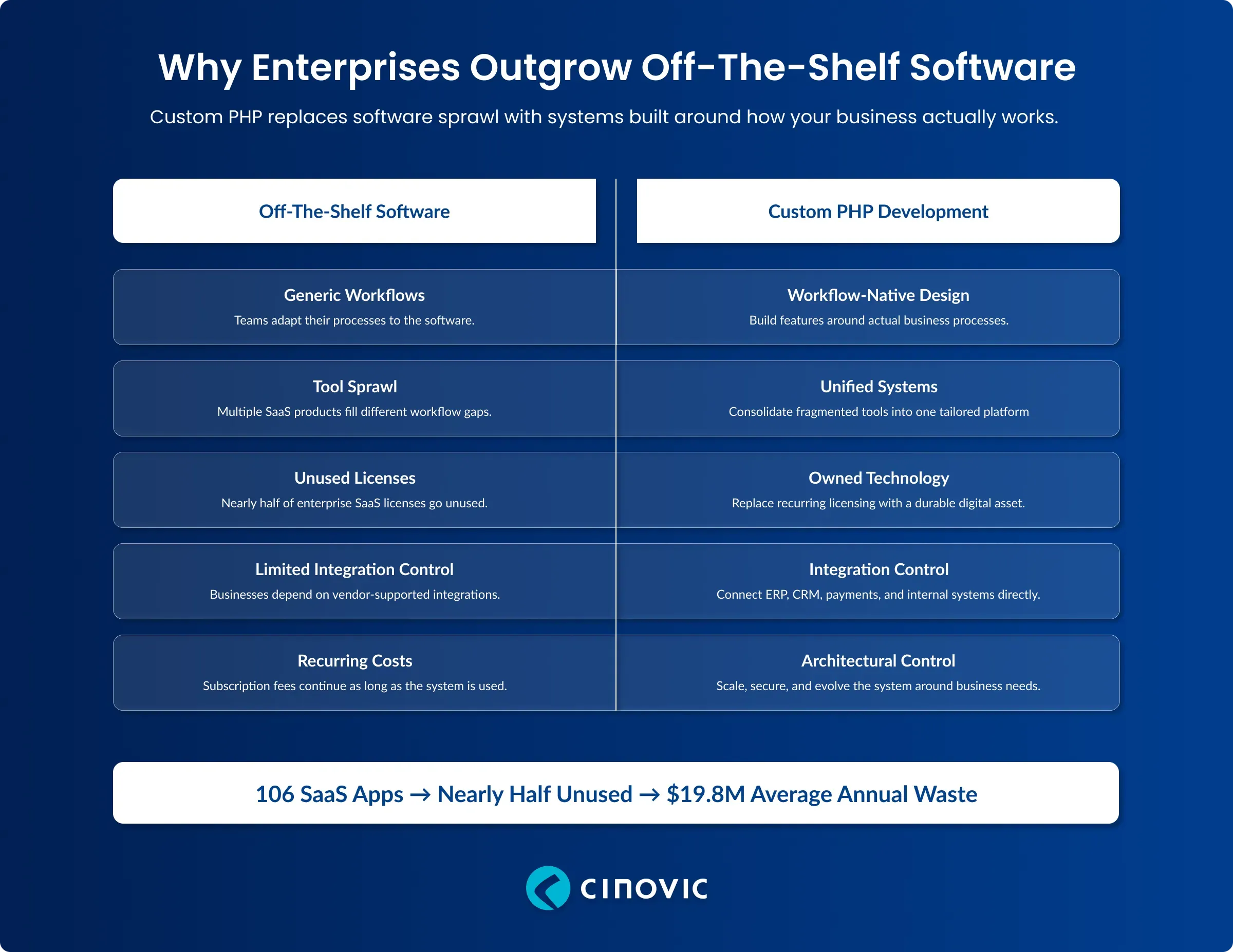
The Four Enterprise Benefits Custom PHP Development Actually Delivers
These four advantages consistently justify the investment for enterprises evaluating custom development against off-the-shelf alternatives.
Features built around your actual processes rather than forcing your team to adapt to a generic tool's assumptions — the core advantage that makes everything else possible.
|
No Recurring Licensing Fees
Custom systems eliminate the perpetual subscription costs of off-the-shelf software, with the investment shifting from ongoing licensing to a durable, owned asset.
|
Full Architectural and Integration Control
Custom PHP applications connect directly with your existing ERP, CRM, and payment systems on your terms, rather than being limited to whatever integrations a vendor chose to support.
|
Security and Performance Built for Your Specific Risk Profile
Frameworks like Laravel and Symfony let enterprises implement security and performance requirements specific to their industry, rather than accepting a vendor's one-size-fits-all baseline.
|
Where Custom PHP Development Delivers the Clearest Enterprise Value
Not every system needs to be custom-built. These are the areas where the advantage is most consistently proven.
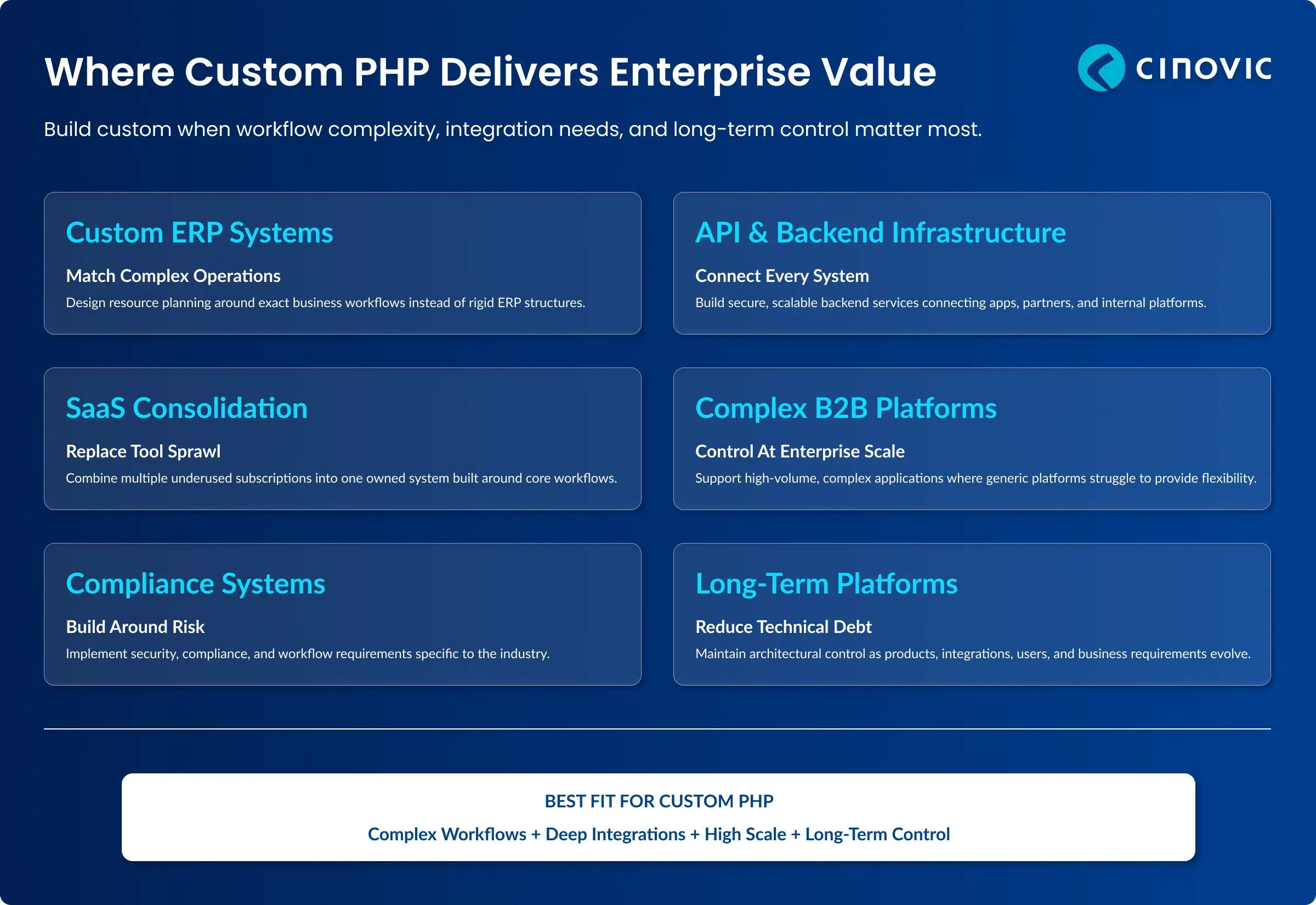
1. Enterprise Resource Planning Systems
Custom-built ERP systems developed in PHP let businesses design features that match their exact operational workflows rather than adapting to the rigid structure of off-the-shelf ERP software, with frameworks like Laravel supporting the scalability and security these systems require.
2. API-First Backend Infrastructure
PHP frameworks provide mature, ready-made structures for building APIs and backend services, letting enterprises create secure, scalable systems that connect cleanly with mobile apps, partner integrations, and internal tools alike.
3. Complex, High-Volume B2B Applications
Enterprise B2B applications, the projects requiring
1,000 to 3,000-plus development hours, are precisely where custom architecture pays for itself, since the complexity and scale involved would strain or exceed what generic software can flexibly support.
4. Systems Requiring Long-Term Architectural Control
For businesses building SaaS platforms, enterprise tools, or genuinely complex applications, custom development offers significantly greater long-term value through lower technical debt, superior scalability, and complete control over the system's architecture as requirements evolve.
A Practical 6-Step Path to Evaluating Custom PHP Development for Your Enterprise
Theory without execution is just wishful thinking. Here is a battle-tested path to deciding whether custom development is genuinely worth it.
- Audit Your Current Software License Sprawl: Identify how many of your existing SaaS tools are underused or redundant, since consolidating several into one custom system often changes the ROI calculation significantly.
- Map Where Off-the-Shelf Tools Force Workflow Compromises: Look specifically for processes where your team routinely works around a tool's limitations, since these are the clearest custom development candidates.
- Choose the Framework Based on Application Complexity: Symfony favors enterprise applications and complex domains prioritizing long-term maintainability; Laravel favors faster development for SaaS platforms and rapid iteration.
- Scope Integration Requirements Upfront: Since one of custom development's core advantages is connecting cleanly with existing ERP, CRM, and payment systems, defining these integration points early avoids costly rework later.
- Plan for Iterative Delivery, Not a Single Big-Bang Launch: Starting with an MVP and expanding functionality as needed keeps budget and scope controlled while still working toward the full custom system.
- Budget Realistically Based on Application Category: A custom CRM, an eCommerce platform, and a full enterprise B2B application sit in meaningfully different cost and timeline brackets; know which category your project actually falls into.
Where Custom PHP Investment Delivers the Clearest Return
Common Mistakes Enterprises Make When Considering Custom PHP Development
-
Choosing custom development without evaluating execution quality: ROI depends heavily on execution, not the concept of custom software itself, a poorly executed custom project can underperform a well-implemented off-the-shelf tool.
Case Study: A Custom PHP Integration Layer That Replaced Manual Finance Work
Cinovic's work for an auction house shows the workflow-fit problem in practice. After every sale, finance teams had to move buyer invoices, consignor settlements and payments between the auction platform and their accounting system by hand, re-entering the same details across different tools. Finance backlogs grew after busy sale periods, settlement errors strained consignor relationships, and month-end close needed heavy manual reconciliation.
Rather than adding another off-the-shelf connector, Cinovic built a custom integration module on the client's existing PHP and Phalcon platform, with bidirectional sync to the QuickBooks Online API. Accounting records are now created automatically from business events such as sale completion, settlement approval and payment receipt. The integration is modular, so a second provider such as Xero can be added later without rewriting the business logic, which removes the lock-in risk of a single-vendor connection.
- One unified accounting platform: Buyer invoicing, consignor settlements and bill payments now run through a single platform.
- Less duplicate entry: Invoices, settlements and payment records are created in QuickBooks automatically, with no re-keying from auction records.
- Real-time visibility: Finance teams can see which syncs have posted, failed or are pending, so errors surface before month-end close.
- Built to grow: The modular design leaves room for more accounting providers without a rebuild.
How Cinovic Delivers Custom PHP Development for Enterprises
At Cinovic, we build custom PHP systems specifically to solve the workflow-fit problem driving so much wasted enterprise software spend, designing around your actual processes rather than adapting your business to a generic tool's assumptions.
Our team brings hands-on expertise across
Laravel and Symfony, from enterprise ERP systems to complex API-first backend infrastructure, combined with our broader capabilities across
MuleSoft integration, generative AI, and Power BI. Whether you're consolidating a sprawl of underused SaaS licenses, building an integration-heavy backend, or scoping a full enterprise B2B platform, we help you evaluate whether custom development is genuinely the right investment before committing budget to it.
Conclusion: The Real Competitor to Custom Development Isn't Cost. It's Mismatch.
The businesses running 106 SaaS applications didn't get there because custom development is too expensive; they got there because generic tools kept almost fitting, requiring one more subscription to cover the gap. Custom PHP development breaks that pattern by building the one system actually designed around how the enterprise works.
The real cost of off-the-shelf software isn't the subscription fee. It's the $19.8 million a year enterprises spend on tools that almost, but don't quite, fit and the custom system that finally would.