Why PHP's 2026 Story Is About Infrastructure, Not the Language Itself
PHP's core language hasn't needed a dramatic reinvention; its 2026 story is really about the infrastructure running underneath it. Traditional PHP-FPM boots a fresh application instance on every request, and for a typical Laravel application, that boot process alone takes 10 to 30 milliseconds. At high concurrency, that invisible overhead becomes a real, measurable fraction of total processing time.
For most typical web applications- CRUD, APIs, dashboards- the bottleneck was never really PHP itself. It was the request bootstrapping overhead. Modern application servers just finally removed it. Cinovic PHP Development Team
The Four Trends Reshaping PHP Development in 2026
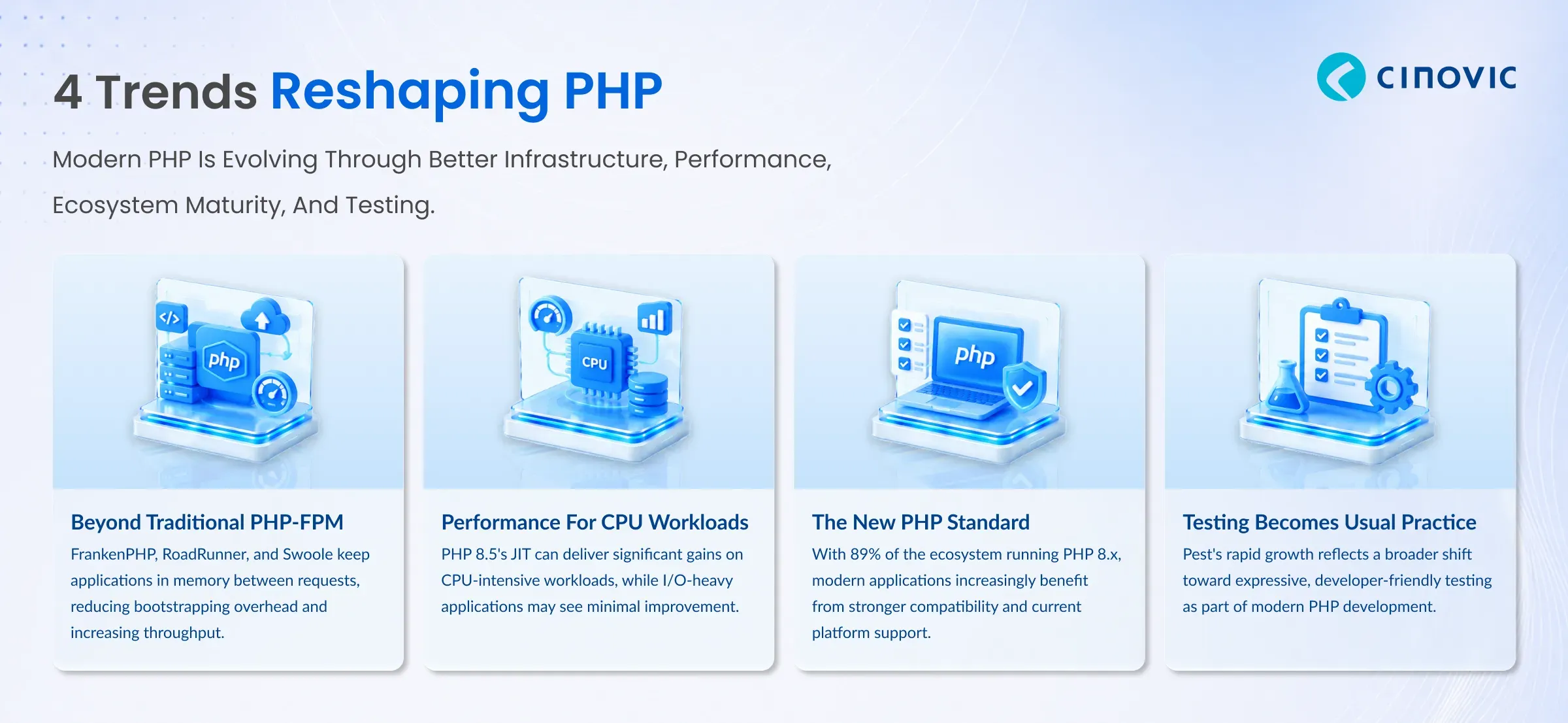
These four shifts are what businesses running or planning PHP applications need to actually understand this year.
Modern Application Servers Replacing PHP-FPM
FrankenPHP, RoadRunner, and Swoole keep applications resident in memory between requests, eliminating the bootstrapping overhead that's defined PHP performance for two decades.
|
JIT Compilation Maturing for CPU-Heavy Workloads
|
The Ecosystem Consolidating Around PHP 8.x
With 89% of the PHP ecosystem now on PHP 8.x, legacy version support is increasingly a minority concern rather than a majority compatibility requirement.
|
Modern Testing Tooling Going Mainstream
Pest's install base has more than doubled since 2024, reflecting a broader shift toward expressive, developer-friendly testing as a standard practice rather than an afterthought.
|
What Each Trend Actually Means for a Business Decision
Understanding the trend is one thing; knowing what it changes for infrastructure and hiring decisions is what actually matters.
1. Choosing the Right Application Server Depends on Your Workload
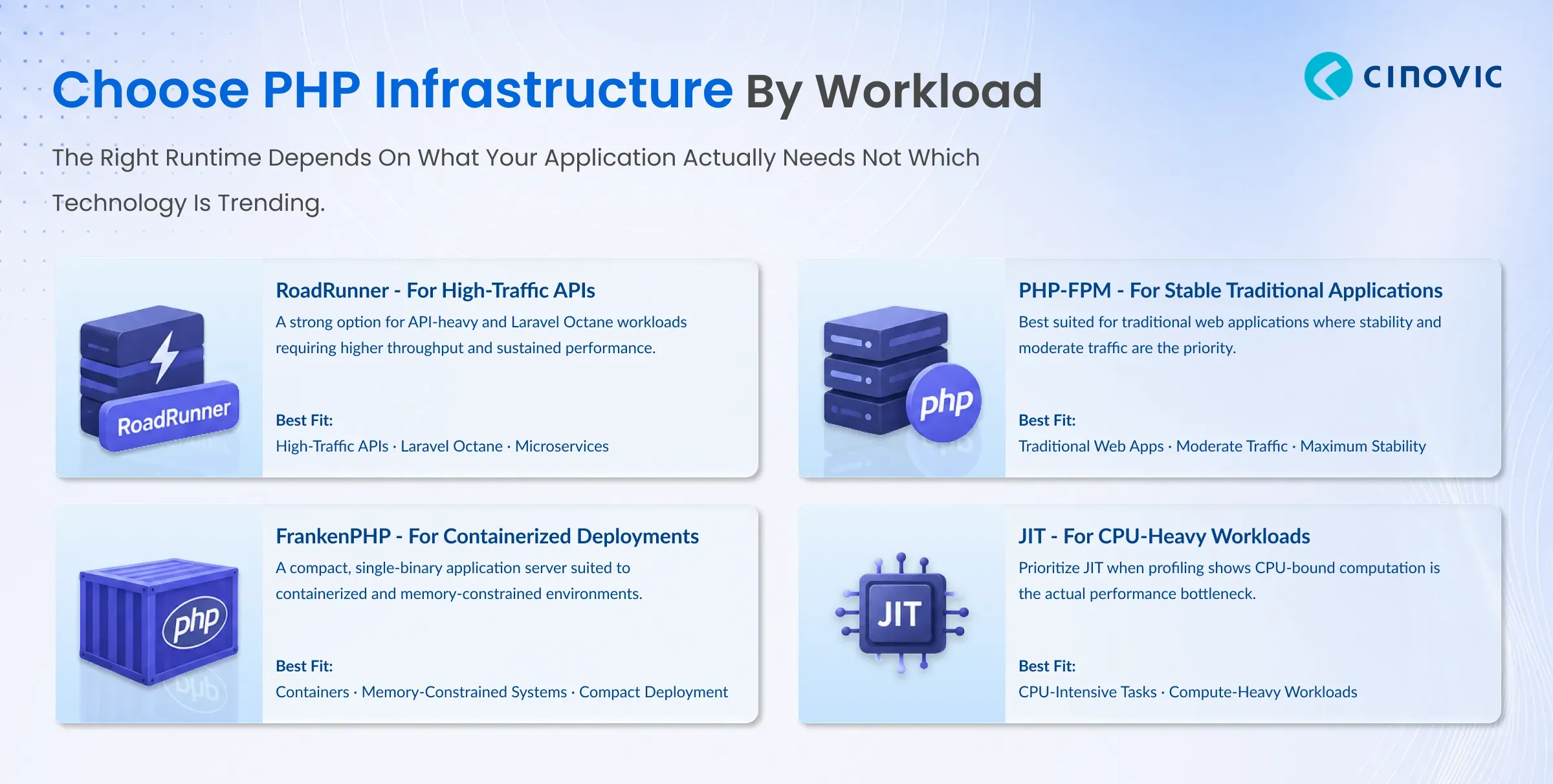
PHP-FPM remains the right call for traditional applications valuing maximum stability; RoadRunner suits high-traffic APIs and Laravel Octane projects with a substantial performance uplift; FrankenPHP fits containerized, memory-constrained deployments where its compact footprint and single-binary deployment matter most.
2. JIT's Value Depends Entirely on What Your Application Actually Does
JIT delivers an 82% performance boost on pure CPU-intensive tasks like recursive computation, but on I/O-heavy workloads like a typical WordPress homepage, the improvement is a negligible 0.6% — meaning the decision to prioritize JIT tuning should follow a genuine workload profile, not a blanket assumption.
3. Database and Network Latency Still Set the Real Ceiling
At 200 milliseconds of I/O latency, the performance differences between all these modern runtimes converge to nearly nothing, a reminder that no amount of PHP-level optimization compensates for a slow database query or an unoptimized network call.
4. Testing Maturity Is Becoming a Hiring and Quality Signal
As Pest's rapid install growth suggests, businesses evaluating PHP development partners increasingly should expect expressive, well-structured testing practices as standard, not a nice-to-have add-on late in a project.
A Practical 6-Step Path to Adopting Modern PHP Infrastructure
Theory without execution is just wishful thinking. Here is a battle-tested path to adopting the infrastructure changes that actually matter.
Profile Your Application's Actual Workload Before Choosing a Runtime: Determine whether your bottleneck is CPU-bound computation or I/O-bound waiting, since the right application server and JIT configuration depend entirely on this answer.
Evaluate FrankenPHP for Containerized, Memory-Constrained Deployments: Its compact memory footprint and single-binary deployment make it a strong fit specifically for container-based infrastructure, though dynamic thread scaling can struggle under heavy blocking I/O.
Consider RoadRunner for High-Traffic APIs and Octane Projects: Its Go-based scheduler and first-party Laravel integration deliver a substantial, well-supported performance uplift for API-heavy and microservice workloads.
Confirm Your Codebase and Dependencies Are Ready for PHP 8.x: With adoption now at 89%, staying on older versions increasingly means missing both performance gains and ecosystem compatibility. Recent critical PHP security fixes make this more urgent, so see our guide to the PHP2Shell vulnerability.
Don't Assume JIT Solves Every Performance Problem: Test the actual gain on your specific workload before treating JIT as a default optimization, since I/O-heavy applications see minimal benefit.
Fix Database and Network Latency Before Chasing Runtime Optimization: Since latency above roughly 200ms erases the differences between application servers, this is often the higher-leverage place to focus performance effort first.
Where Modern PHP Trends Deliver the Clearest Business Impact
High-Impact PHP Trends for 2026: Where these shifts translate most directly into measurable outcomes for businesses
|
Modern Application Servers: Meaningfully higher throughput without rewriting application code.
|
Workload-Matched JIT Configuration: Real CPU performance gains where the workload profile justifies it.
|
PHP 8.x Ecosystem Maturity: Broader compatibility and stronger long-term support as adoption consolidates.
|
Modern Testing Frameworks: More reliable, maintainable codebases as testing practices mature.
|
Container-Optimized Deployment: Lower memory footprint and simpler deployment via FrankenPHP.
|
Database and Latency Optimization: The often-overlooked bottleneck that limits every runtime equally.
|
Common Mistakes Businesses Make With These PHP Trends
-
Assuming JIT is an automatic win for every application: I/O-heavy applications, including typical WordPress sites, see negligible benefit from JIT — the gain is specific to genuinely CPU-intensive workloads.
Case Study: When the Database, Not PHP, Was the Bottleneck
The trends above share one lesson: match the fix to the real bottleneck. Cinovic's Magento 2 order migration rescue is a clear example. Magento runs on PHP, and the client needed to move 50 million orders from a legacy system into Magento 2 Open Source. The original script created every order programmatically through Magento code at just 5 orders per second, which would have taken about 100 days.
Rather than tuning the PHP layer, Cinovic bypassed the application layer with a script that inserts data directly from the old database into the new one, tuned the database for bulk migration, and hosted it on Amazon Aurora. The migration ran at 1,000 orders per second and finished in 24 hours. Cinovic then fixed the post-migration bottlenecks at the root: aggregated dashboard reporting, correct indexing on the order tables, and a diagnosis of inefficient third-party plugin queries behind the slow sales grid.
● 100 days cut to 24 hours: 50 million orders migrated in 24 hours instead of about 100 days.
● 200x faster throughput: Migration speed rose from 5 to 1,000 orders per second.
● About 50 hours of development: The rescue solution took roughly 50 hours to build.
● Faster admin and storefront: Aggregated reporting and correct indexing kept the dashboard and order history responsive at 50-million-order scale.
Read the full story: Migrating 50 Million Orders to Magento 2.
How Cinovic Helps Businesses Adopt Modern PHP Infrastructure
At Cinovic, we help businesses evaluate which of 2026's PHP infrastructure developments actually apply to their specific applications, profiling real workloads before recommending a runtime, rather than defaulting to whichever technology is trending.
Our team brings hands-on expertise across Laravel, Symfony, and modern PHP application servers including FrankenPHP and RoadRunner, combined with our broader capabilities across MuleSoft integration, generative AI, and Power BI. Whether you're evaluating a move away from traditional PHP-FPM, deciding if JIT tuning genuinely benefits your workload, or planning a PHP 8.x migration, we scope the specific changes that will actually improve performance for your application.
Conclusion: PHP in 2026 Isn't Exciting, And That's Exactly Why It Still Works
PHP's evolution in 2026 isn't a dramatic reinvention of the language. It's a steady accumulation of infrastructure improvements, modern application servers, mature JIT compilation, ecosystem-wide version consolidation, and better testing tooling that together deliver real performance gains without requiring businesses to rewrite their applications from scratch.
The businesses getting the most out of PHP in 2026 aren't chasing hype. They're matching the right application server and configuration to their actual workload, and that discipline is worth more than any single trend on its own.