The Difference Between Using Generative AI and Being Transformed by It
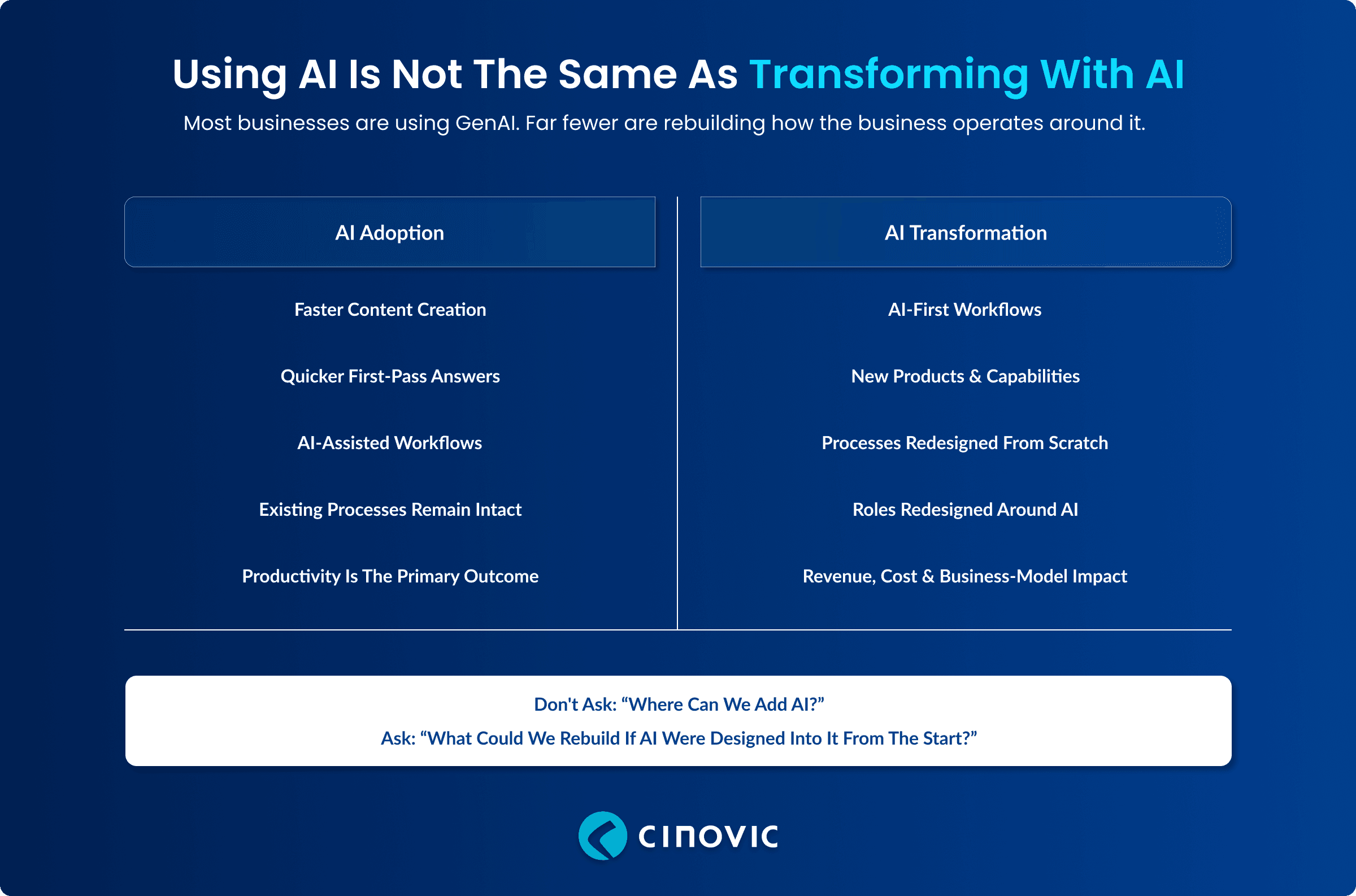
Most businesses have crossed the adoption threshold; generative AI shows up somewhere in their workflow. But a much smaller group has gone further, using it to create new products, reinvent core processes, or rethink the business model itself, rather than simply speeding up what already existed.
That distinction matters because it changes where the value shows up. Surface-level use captures efficiency gains — faster drafts, quicker first-pass answers. Deep transformation captures something larger: new revenue streams, restructured cost bases, and capabilities that didn't exist in the business before. Both are legitimate outcomes, but only one changes the competitive picture.
“Most companies are using generative AI to do the same work faster. The ones actually being transformed are asking what work wouldn't need to exist at all if they rebuilt the process around AI from scratch.” — Cinovic AI Strategy Team
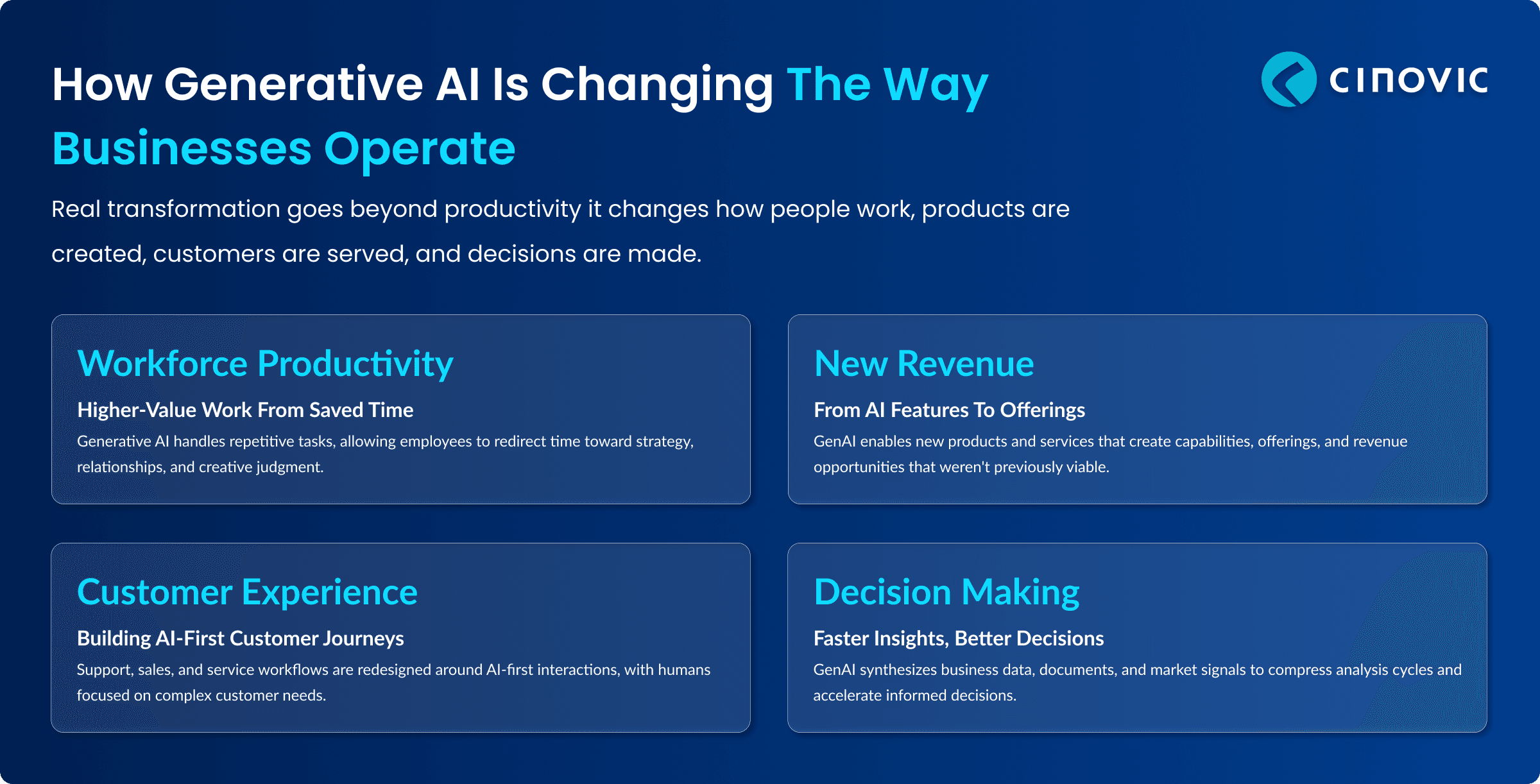
The Four Ways Generative AI Is Reshaping How Businesses Operate
Transformation shows up in a handful of consistent, measurable patterns across industries.
Workforce Productivity Redistribution
Time saved on repetitive tasks gets reinvested into higher-value work, strategy, relationship-building, creative judgment, rather than simply eliminated.
|
New Product & Revenue Streams
AI-native features and offerings that wouldn't have been commercially viable without generative AI's cost structure and speed.
|
Customer Experience Redesign
Support, sales, and service workflows rebuilt around AI-first interaction, not just AI-assisted human interaction.
|
Decision-Making Acceleration
Faster access to synthesized insight across data, documents, and market signals, compressing analysis cycles that used to take days into hours.
|
Where Transformation Is Happening Fastest
Some functions are further along the transformation curve than others. These are the areas showing the clearest structural change, not just incremental efficiency.
1. Customer Support Becoming Customer Experience Infrastructure
Support functions are shifting from AI-assisted human agents toward AI-first resolution, with human involvement reserved for genuinely complex cases- a structural change in how the function operates, not just a speed boost. Our financial services client operations platform case study shows what rebuilding client-facing workflows around a unified platform looks like.
2. Software Development Compressing Build Cycles
Generative AI has measurably boosted developer productivity, changing not just how fast code gets written but how teams scope what's feasible to build in a given quarter. It's also reshaping application modernisation and development, where AI-assisted teams can take on larger rebuilds than before.
3. Content and Marketing Becoming Production Systems
What used to be a linear content calendar is becoming a production system capable of generating and adapting content across formats and channels at a pace manual workflows couldn't sustain. LLM development and integration is what connects those systems to your existing content and brand tools.
4. Strategic Planning Compressed by Faster Synthesis
Executives increasingly use generative AI directly to evaluate scenarios, synthesize research, and pressure-test decisions, shrinking analysis timelines that used to require dedicated teams and weeks of work.
A Practical 6-Step Path From Adoption to Transformation
Theory without execution is just wishful thinking. Here is a battle-tested path from scattered AI usage to real structural change.
- Separate Efficiency Wins From Transformation Opportunities: Efficiency gains are valuable but limited; transformation requires identifying where AI changes what's possible, not just what's faster. An enterprise AI consulting engagement is often the fastest way to make that distinction.
- Pick One High-Value Workflow to Rebuild, Not Patch: Rather than adding AI to an existing process, ask what the process would look like if it were designed around AI from the start. Our online notary booking and document workflow platform case study is an example of a workflow rebuilt end to end rather than patched.
- Secure Top-Down Sponsorship, Not Just Grassroots Adoption: Enterprise-wide crowdsourced AI initiatives tend to produce impressive usage numbers without meaningful business outcomes; real transformation needs leadership backing specific, high-value bets.
- Redesign Roles Around Redistributed Time: Plan explicitly for what employees will do with the hours generative AI frees up, rather than leaving that time undefined.
- Measure Business Outcomes, Not Just Usage: Track revenue, cost, and cycle-time impact tied to the specific initiative, not adoption or engagement metrics alone. Business intelligence dashboards make this tracking consistent across initiatives.
- Scale the Proven Pattern, Don't Just Add More Pilots: Once a workflow shows real transformation, replicate the pattern deliberately across adjacent functions rather than starting a new disconnected pilot each time. MLOps practices help keep that scaling reliable.
Where Generative AI Transformation Is Delivering the Clearest Impact
Customer Support & Service: Shifting from AI-assisted agents to AI-first resolution for the majority of routine interactions.
|
Software Engineering: Compressed build cycles changing what teams can realistically ship per quarter.
|
Content & Marketing Operations: Moving from a content calendar to a scalable production system.
|
Strategic & Financial Planning: Faster scenario synthesis, compressing what used to be multi-week analysis cycles.
|
Product Development: New AI-native features and offerings that weren't commercially viable before.
|
Product Development: New AI-native features and offerings that weren't commercially viable before.
|
Internal Knowledge Work: Employees redirecting saved time toward higher-judgment, higher-value tasks.
|
Common Mistakes That Keep Businesses at the Adoption Stage
How Cinovic Helps Businesses Move From Adoption to Transformation
At Cinovic, we help businesses go past the productivity-tool stage of generative AI and into structural change, rebuilding specific, high-value workflows around AI rather than layering it on top of what already exists.
Our team combines generative AI development expertise with deep experience in machine learning, data infrastructure, and system integrations including MuleSoft, along with platform knowledge across Magento, Shopify, and Power BI. We help leadership identify the handful of workflows worth rebuilding from scratch, then deliver the engineering and change management needed to make that transformation stick.
See this approach in action in our financial services client operations platform, online notary booking and document workflow platform, and full accounting integration platform case studies, or browse all of our case studies.
Conclusion: Adoption Is the Starting Line, Not the Finish Line
Nearly every business now uses generative AI somewhere. That's no longer a differentiator. What separates the businesses genuinely being transformed by it is the willingness to rebuild specific workflows around AI, rather than simply making the old ones faster.
The companies pulling ahead in 2026 aren't the ones with the most AI tools deployed. They're the ones who picked the right workflow to rebuild completely, and did it.