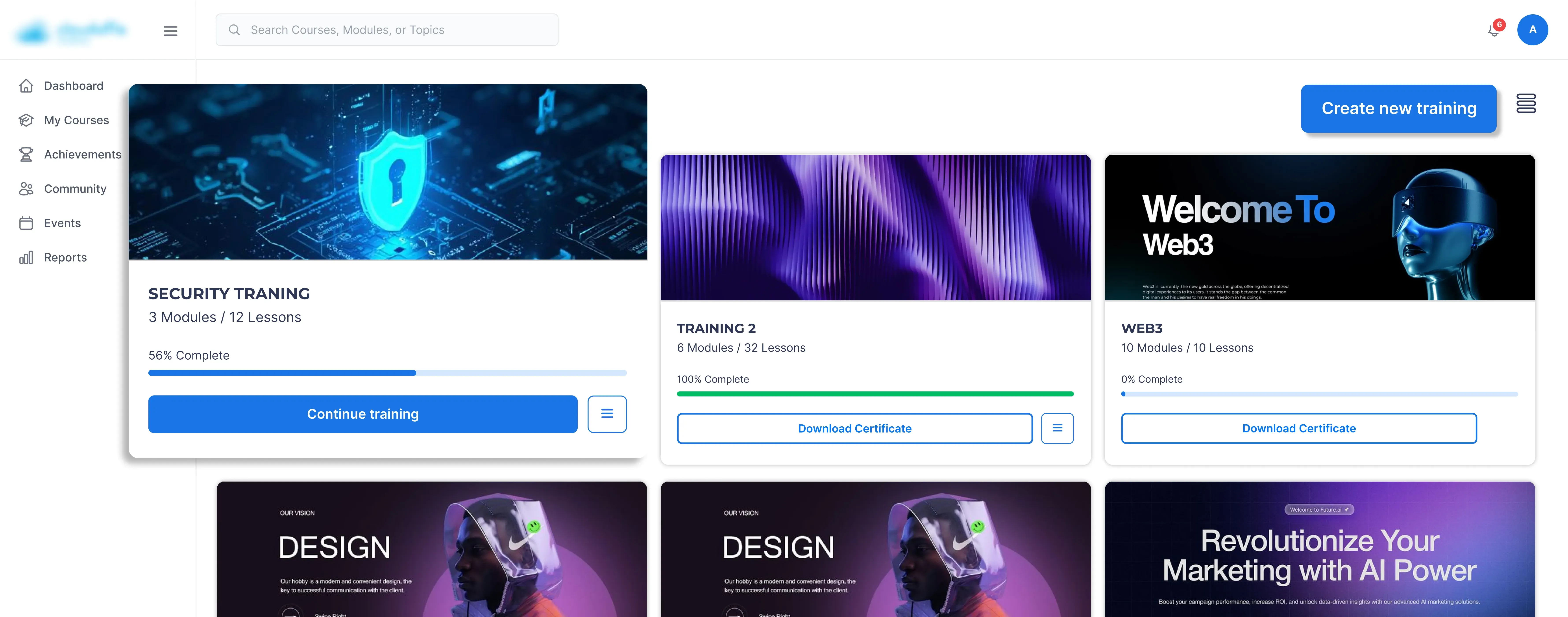
Public Course Catalogue - Fully public or registration-gated course browsing with product category filters, course overviews, and one-click self-enrollment. External users discover and enroll without any admin intervention
LMS For Product Training & User Awareness

- Home
- /Case study
- /LMS For Product Training & User Awareness
Industry
Product LMS
Core Platform
Opigno LMS
Delivery Model
Self-Enroll + Assigned
Content Standards
SCORM / xAPI / H5P / Video
Project Type
Custom Branded LMS Build
Outcomes
Outcomes
Single platform for product training and learning content.
Courses, assessments, progress tracking, and structured learning journeys.
Centralized enrollment, access, and personalized training experiences.
Access product training and awareness content anytime, anywhere.
BUSINESS CHALLENGES
No Dedicated Training Channel for Users
Root Cause:-
Product training was scattered across PDFs, email chains, one-off webinars, and YouTube videos, all disconnected from each other, impossible to track, and inconsistent in quality and coverage
Business Impact:-
Users received different levels of product understanding depending on how they were onboarded; no data existed on what was consumed or whether training correlated with product adoption
Support Overload from Undertrained Users
Root Cause:-
Users who lacked structured product training generated disproportionate support volume; the same basic questions repeated across tickets because there was no reliable, self-serve place to learn
Business Impact:-
Support teams spent time on repetitive, avoidable queries; cost per resolution increased while customer satisfaction suffered from slow response times caused by preventable ticket volume
No Certification or Recognition System
Root Cause
Partners and resellers had no structured way to demonstrate product knowledge to their own clients; customers had no formal learning path to product proficiency or a shareable credential to show for it
Business Impact
Partners sold less confidently without verifiable product credentials; product companies had no visibility into which partners were genuinely trained and which were not
Recurring Cost of Third-Party Training Platforms
Root Cause:
Per-seat licensing on customer education platforms scaled poorly, as the user base grew, so did the bill, for a platform the company didn't own, couldn't fully customise, and had no control over
Business Impact:
Training costs grew proportionally with user base growth; organisations had no data ownership, no ability to customise the experience, and were exposed to vendor price increases and platform changes
No Data on How Users Engage With Training
Root Cause
Product teams had no visibility into which training content was consumed, which modules users struggled with most, where they dropped off, or whether completions actually correlated with feature adoption
Business Impact
Content improvement decisions were made without evidence; support patterns and adoption gaps couldn't be traced back to training gaps because no engagement data existed
SOLUTION APPROACH
Pillar
Public Course Catalogue & Self-Enrollment
What We Built
Courses can be published publicly or gated behind registration. External users browse the catalogue, discover relevant product training, and enroll with a single click, no admin approval required, no account needed to get started
Why It Matters
Friction at the entry point kills adoption; by removing the enrollment barrier entirely for public courses, users reach training the moment they need it, reducing time-to-value and removing the most common reason users don't complete onboarding
Branded Learning Portal
What We Built
The entire platform carries the product company's branding, logo, colours, domain, tone, and content structure. Users experience the learning environment as a natural extension of the product itself, not a disconnected third-party tool
Why It Matters
Brand consistency builds trust and increases course completion; users who feel they are still inside the product ecosystem are more likely to engage deeply, complete certification, and return for future training as the product evolves
Rich Product Content — H5P, SCORM & Video
What We Built
Training modules combine product walkthrough videos, interactive H5P assessments, scenario-based quizzes, drag-and-drop activities, and imported SCORM packages, all tracked and scored automatically without any manual data entry
Why It Matters
Rich, interactive content delivers higher knowledge retention than static documentation; by supporting all major content standards, the platform preserves investment in existing training assets and enables content teams to build engaging modules without rebuilding from scratch
Branded Certification on Completion
What We Built
Users who complete a course receive a branded PDF certificate with a unique verifiable ID, their name, the course title, and the completion date. Partners and resellers gain a credential they can reference and share with their own clients
Why It Matters
Certification creates a tangible incentive for completion and a social proof mechanism that extends the product's reach; certified partners sell more confidently, and product companies gain visibility into which partners and resellers are genuinely trained
Product Adoption Analytics
What We Built
Track per-module completion rates, average scores, time spent, and drop-off points across every course and learner segment. Use the data to identify which content is working, which modules need improvement, and where support needs are concentrated
Why It Matters
For the first time, product and content teams can make evidence-based decisions about training; correlation between training completion and feature adoption becomes measurable, and support patterns can be traced directly back to specific content gaps
Owned Infrastructure, Zero Per-Seat Cost
What We Built
The platform runs on the organisation's own servers or cloud environment. As the user base scales from hundreds to tens of thousands, training infrastructure costs remain completely flat, no per-seat fees, no renewal negotiations, no vendor dependency
Why It Matters
The economics of the platform improve as the user base grows rather than deteriorating; product companies own their learner data, their training content, and their certification records outright, with full freedom to customise, extend, and evolve the platform
PLATFORM FEATURES
Self-Enrollment - Any user can self-enroll in public product courses instantly. The system logs the date, time, and user profile automatically; no admin step required, no approval queue
External User Registration - Non-account users register directly on the learning portal. Includes business email validation, terms consent capture, and optional admin approval flow before access is granted
Product Learning Paths - Structured product journeys from beginner to advanced with score-gated progression, ensuring users build product knowledge step by step rather than jumping between unrelated modules
Video + H5P Modules - Product walkthrough videos, interactive H5P assessments, quizzes, drag-and-drop activities, and scenario simulations, all combined in a single training module with automatic score tracking
SCORM / xAPI Support - Import existing SCORM or xAPI product content packages directly. Full tracking, time spent, completion status, and scores, recorded automatically into the analytics dashboard
Branded Certificates - Auto-generated branded PDF certificates on course completion. Unique certificate IDs for verification. Downloadable anytime from the learner's profile and shareable externally
Leaderboard & Badges - Gamification layer with module badges, points, and a public leaderboard. Motivates users through certification programmes and encourages completion through social recognition
Training Analytics - Per-module completion rates, average scores, time spent, and drop-off points. Identify which training content drives adoption and which needs improvement, based on real learner data
Announcements - Broadcast product updates, new course launches, feature releases, or training deadlines directly to learner dashboards and in-app notifications — keeping users informed and engaged
TECHNOLOGY STACK
LMS Core
Content Standards
Interactive Content
Authentication
Public Portal
Interface & Branding
BUSINESS OUTCOMES
Recurring Platform Costs Eliminated
The organisation owns the platform outright, as the user base scales from hundreds to tens of thousands, training infrastructure costs remain completely flat. No per-seat licensing, no renewal fees, no vendor price increases
Finance, Product, Leadership
Learner Data Secure and Fully Owned
All user data, training records, completion logs, and certificate evidence sits on the organisation's own infrastructure. No third-party vendor has access to learner data or can restrict, monetise, or export it
IT Security, Product, Legal
Support Volume Reduced
Users who complete structured product training generate significantly fewer repetitive support tickets. Course-linked discussion forums create peer-to-peer support that scales organically as the user community grows
Support Teams, Product
Product Adoption Accelerated
Structured learning paths guide users from initial awareness to full product proficiency faster than unguided discovery. Users who complete onboarding training activate features earlier and retain them longer
Product, Growth, Customer Success
Certified Partner & Reseller Network
Partners and resellers gain verifiable product credentials they can reference with their own clients. Certified partners sell more confidently and accurately, and the product company gains full visibility into who is genuinely trained
Sales, Partnerships, Marketing
Platform Evolves as the Product Evolves
Add new courses, restructure learning paths, update content, launch new certification tracks, and expand to new user segments, all without rebuilding from scratch or negotiating scope changes with a vendor
Product, Content Teams, IT
See Cinovic's Expertise in Action Book Your Free 15-Minute Development Demo
Join 100+ teams scaling with Cinovic. Fill out the form below to get personalised tour of the platform.
Frequently Asked Questions About LMS for Product Training & User Awareness
An LMS for product training and user awareness is a centralized digital learning platform designed to educate employees, customers, partners, and other users about products, services, features, processes, and best practices. It helps organizations deliver consistent training while making learning content easily accessible.
An LMS provides structured courses, product demonstrations, tutorials, training materials, quizzes, and assessments. Users can learn at their own pace while organizations can ensure that important product information is delivered consistently across different audiences.
A product training LMS can support multiple user groups, including employees, customers, channel partners, distributors, sales teams, support teams, and other stakeholders. Each group can be provided with relevant courses, content, and access permissions based on their specific training requirements.
Yes. Learning paths can be created based on user roles, departments, products, experience levels, or training requirements. This allows each user to access the courses and resources that are most relevant to them.
Yes. Administrators can update course materials, product documentation, videos, quizzes, and other learning resources as products and processes evolve. This helps ensure users always have access to current and accurate information.