B2B eCommerce | eCommerce Platforms | E - Commerce
Adobe Commerce vs Magento Open Source: Complete Comparison
Compare Adobe Commerce and Magento Open Source on licensing, B2B features, and total cost of ownership to pick the right edition
Read More

The global B2B eCommerce market is projected to hit $36 trillion in 2027, roughly six times the size of B2C. And yet most eCommerce platforms, themes, and best-practice guides are still written with B2C assumptions baked in: instant checkout, fixed pricing, single-buyer decisions. B2B businesses that bolt that model onto their operations end up fighting their platform instead of using it.
|
Larger global market size for B2B eCommerce vs. B2C by transaction value |
Higher average order values for B2B compared to B2C |
Of B2B buyers now place orders over $500,000 through self-service eCommerce, up from 28% two years ago |
Median B2B sales cycle (SaaS), vs. minutes to days for typical B2C purchases |
The instinct to treat B2B eCommerce as “B2C but for businesses” is exactly why so many B2B platform implementations fall short. B2C sells to one person making a fast, often emotional decision, with public pricing and instant checkout; the entire experience is optimised for volume and speed. B2B sells to a buying committee of three to ten stakeholders working through a sales cycle that averages 84 days for SaaS and stretches well beyond that for complex industrial purchases, with quote-based, negotiated pricing that varies by account.
That's not a smaller version of the same problem; it's a genuinely different one, and it shows up in platform architecture at every level: how pricing is displayed, how accounts are structured, how checkout works, and how conversion itself is measured. A B2B buyer converting at 2% isn't underperforming a B2C store converting at 4%—they're operating in a completely different purchase pattern, and building or evaluating a platform against B2C benchmarks misreads the situation.
“The businesses that get B2B eCommerce wrong usually aren't bad at eCommerce. They're applying a B2C mental model fast, individual, price-driven, to a market that runs on committees, negotiated terms, and month-long buying cycles. The platform needs to be built for that reality, not retrofitted from a consumer template.” — Cinovic eCommerce Team
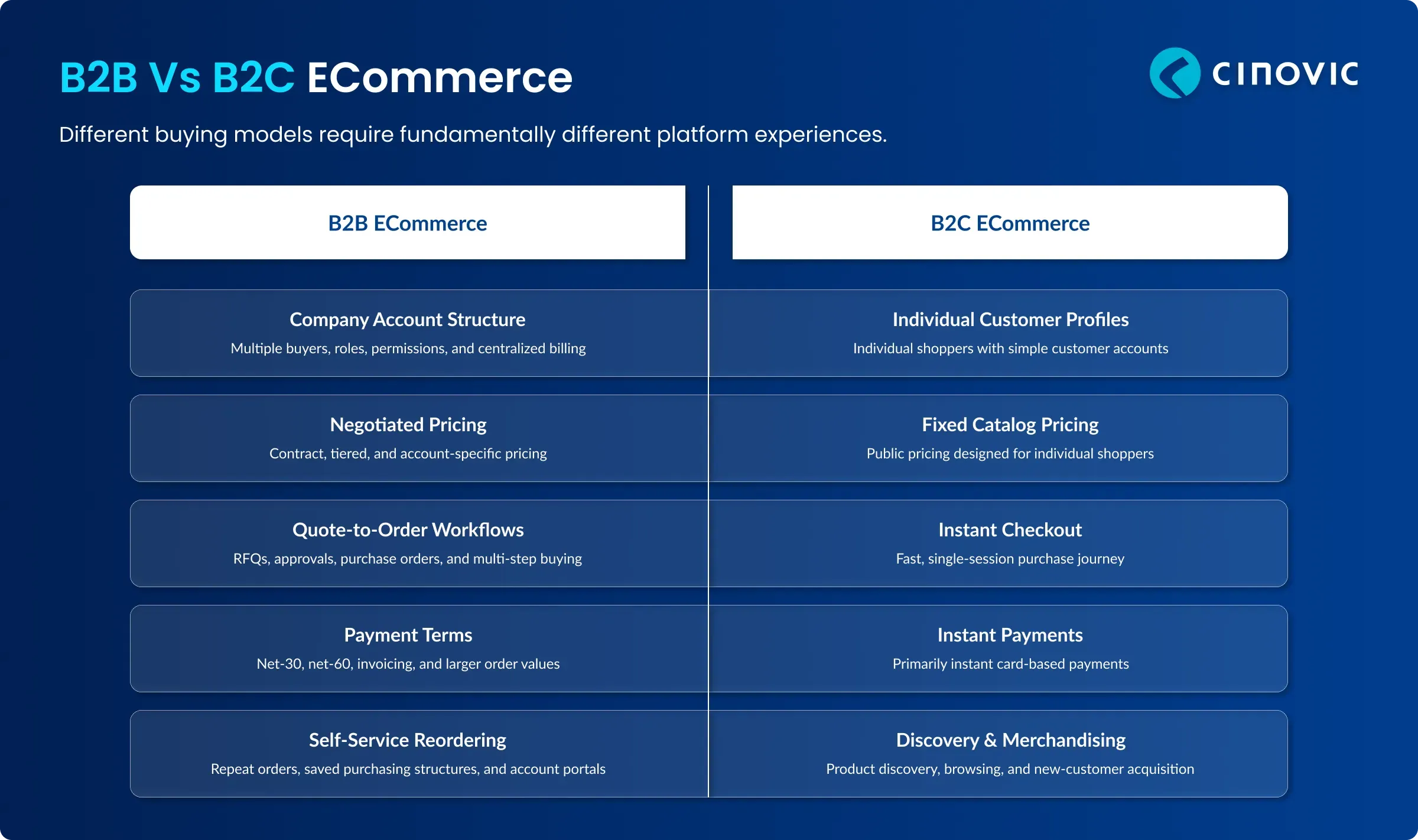
These four areas are where B2B and B2C platform requirements diverge most fundamentally.
|
Pricing and Account Structure B2B requires negotiated, tiered, or contract-specific pricing tied to company accounts with multiple authorized buyers; B2C runs on fixed, publicly listed pricing for individual shoppers. |
Buying Process and Checkout Complexity B2B checkout often requires quote requests, purchase order support, and approval workflows across a buying committee; B2C checkout is built for a single person to complete a purchase in one session. |
|
Payment Terms and Order Volume B2B commonly requires net-30 or net-60 invoicing and handles average order values 5 to 10 times higher than B2C; B2C runs almost entirely on instant card payment at consumer price points. |
Self-Service vs. Relationship-Driven Sales A majority of B2B buyers now prefer a rep-free buying experience for standard reorders, but still expect direct sales support for complex or high-value purchases — a hybrid B2C platforms rarely need to support. |
Beyond structural differences, these capabilities determine whether a platform fits a B2B or B2C business model.
1. Company Account Hierarchies vs. Individual Customer Profiles
B2B platforms need to support company accounts with multiple authorised buyers, role-based permissions, and centralised billing, a structure B2C platforms, built around individual customer profiles, don't natively provide.
2. Negotiated Pricing Logic vs. Fixed Catalogue Pricing
With B2B buyers increasingly comfortable placing large orders online, 39% now place orders over $500,000 through self-service channels; the platform needs pricing logic sophisticated enough to reflect contract terms without requiring a sales call for every transaction.
3. Quote-to-Order Workflows vs. Instant Checkout
Because B2B conversion happens over a longer cycle involving quote requests and approval chains, platforms need structured workflows that connect an initial inquiry to a finalised order, a fundamentally different flow than B2C's single-session checkout. Our restaurant procurement for multi-site operations case study shows how structured purchasing workflows hold up across multiple locations.
4. Reorder and Self-Service Portals vs. Discovery-Driven Browsing
Since logged-in B2B reorder buyers convert at meaningfully higher rates than anonymous traffic, B2B platforms benefit disproportionately from strong self-service reorder tools, while B2C platforms invest more heavily in discovery and merchandising for new-customer acquisition.
Identify Whether You're Actually B2B, B2C, or Hybrid: Some businesses sell to both individual consumers and business accounts; know which model dominates before evaluating platform fit.
Prioritise Account and Pricing Structure Early: If company hierarchies and negotiated pricing are core to your sales model, confirm the platform supports this natively rather than through workarounds.
Build Quote-to-Order Workflows for Long Sales Cycles: For businesses with complex, multi-stakeholder purchases, a structured RFQ-to-order flow matters more than checkout speed.
Invest in Self-Service Reorder Tools for Repeat B2B Buyers: Given how much better logged-in reorder buyers convert, this is often a higher-leverage investment than broad top-of-funnel marketing.
Support Net Terms and Purchase Order Payment Flows: B2B buyers frequently expect invoicing and payment terms that standard B2C checkout doesn't accommodate by default. See how we connected invoicing and settlements in our full accounting integration platform case study.
Measure Conversion Against the Right Benchmark: Don't judge B2B conversion rates against B2C standards; a 2–3% rate for anonymous B2B traffic is considered strong, while best-in-class quote-to-order flows reach 45–55%.
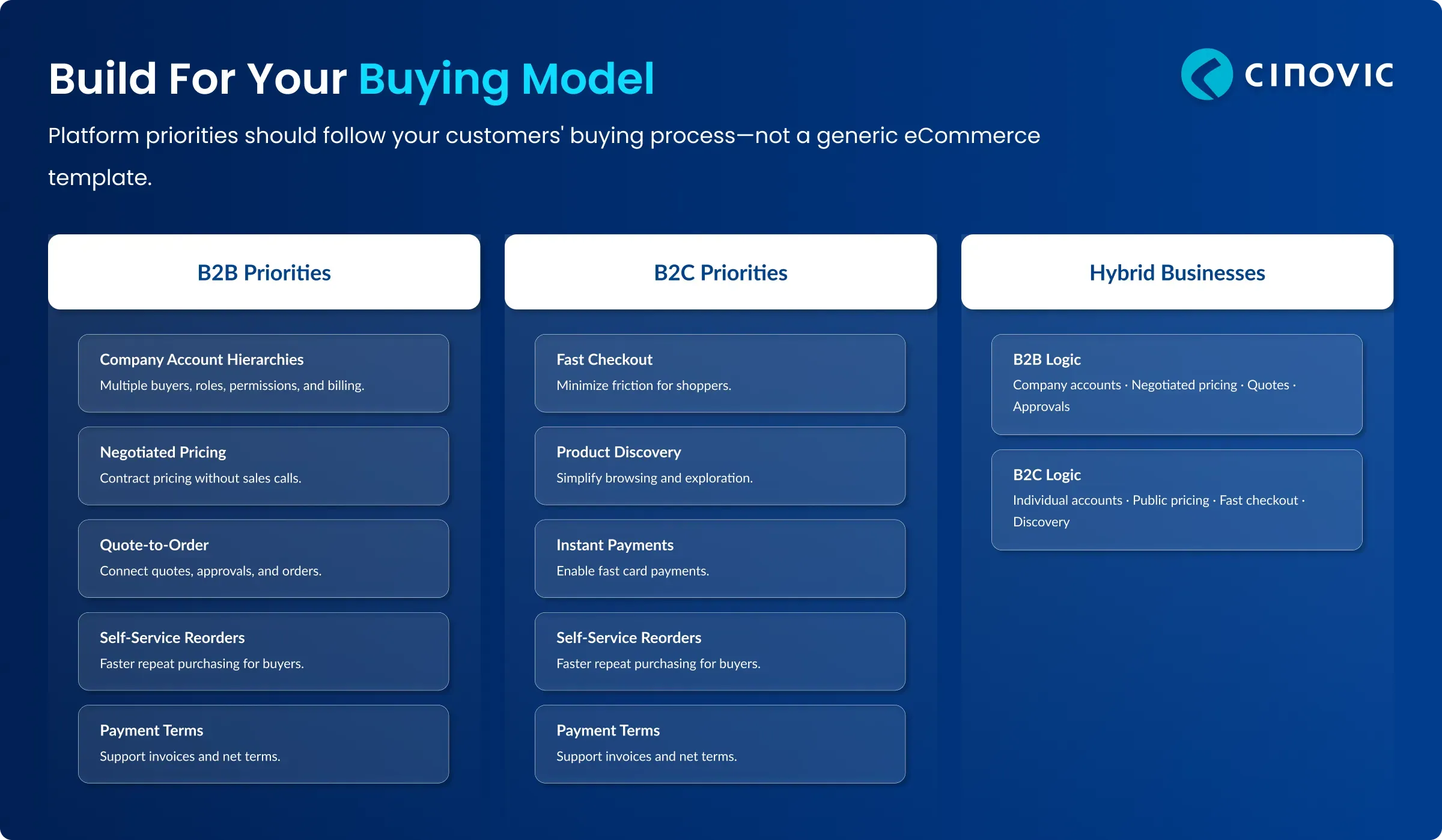
Where B2B and B2C Platform Priorities Diverge
Matching investment to the model that actually drives your revenue.
B2B: Company Account Hierarchies — Multi-buyer accounts with role-based permissions and centralised billing.
B2B: Negotiated Pricing Engines — Contract-specific pricing without a sales call for every order.
B2B: Self-Service Reorder Portals — Capturing the meaningfully higher conversion of logged-in repeat buyers.
B2C: Fast, Single-Session Checkout — Optimised for speed and minimal friction for an individual buyer.
B2C: Discovery and Merchandising — Strong product discovery for consumers still deciding what to buy.
B2C: Instant Payment Processing — Card-based checkout built for immediate, low-friction transactions.
Applying B2C conversion benchmarks to a B2B business: A 2% B2B conversion rate isn't underperformance — it reflects a fundamentally different, longer buying process than B2C's fast, individual purchase pattern.
Building B2B checkout as a copy of B2C checkout: Skipping quote workflows, purchase order support, and approval chains forces B2B buyers into a process that doesn't match how their organisations actually buy.
Underinvesting in self-service tools for repeat B2B buyers: Given how much higher logged-in reorder conversion runs compared to anonymous traffic, this is often a more valuable investment than broader B2C-style marketing spend.
Ignoring payment term requirements B2B buyers expect: A platform built only for instant card payment misses a significant share of B2B buyers who require net-30 or net-60 invoicing.
Treating a hybrid B2B/B2C business as one undifferentiated model: Businesses selling to both segments need platform logic that serves each appropriately, rather than forcing one model onto both audiences.
At Cinovic, we architect eCommerce platforms around how your customers actually buy: company account hierarchies and negotiated pricing for B2B, fast single-session checkout for B2C, or the right hybrid structure for businesses serving both.
Our team brings hands-on experience across Magento, Adobe Commerce, and Shopify Plus, including native and custom-built B2B functionality, company accounts, quote workflows, and negotiated pricing — alongside our broader capabilities in MuleSoft integration and Power BI. Whether you're building a self-service B2B portal, a fast-converting B2C storefront, or a platform that needs to serve both audiences well, we architect around your actual buying process, not a generic template.
See how we apply this in practice in our restaurant procurement for multi-site operations, full accounting integration platform, and gift voucher management platform case studies, or browse all of our case studies.
B2B and B2C eCommerce aren't variations of the same challenge; they're different markets with different buyer behaviour, sales cycles, and platform requirements. The businesses that succeed aren't the ones squeezing a B2C template onto a B2B sales model. They're the ones who built the platform around their customers' actual buying process.
B2B eCommerce is six times larger than B2C globally, and growing faster. The businesses capturing that growth aren't the ones with the fastest checkout; they're the ones whose platform actually matches how a buying committee makes a $500,000 decision.
Talk to a Cinovic eCommerce expert. No obligation, just a focused conversation about whether your current platform fits your real buying process.
Explore our latest articles, insights, and technology trends.
Talk to a Cinovic eCommerce expert. No obligation, just a focused conversation about whether your current platform fits your real buying process.
Account and pricing structure — B2B requires company accounts with multiple authorized buyers and negotiated, contract-specific pricing, while B2C runs on individual customer profiles with fixed, publicly listed pricing.
It reflects a fundamentally different buying process, not underperformance — B2B involves longer sales cycles, buying committees, and often a request-for-quote step, so a 2–3% conversion rate for anonymous B2B traffic is actually considered strong, especially compared to the 45–55% rates seen in best-in-class quote-to-order flows.
Often, yes — many B2B buyers expect net-30 or net-60 invoicing rather than instant card payment, and a platform built only for consumer-style checkout misses a meaningful share of B2B purchasing behavior.
Yes, with the right architecture, modern platforms like Adobe Commerce and Shopify Plus support B2B and B2C functionality from a single instance, but you still need to build pricing, account, and checkout logic to serve each model appropriately, not treat them as identical.
A majority of B2B buyers now prefer a rep-free experience for standard purchases, especially reorders, and self-service tools let them move faster on routine transactions while reserving direct sales support for complex or high-value decisions.
We start by mapping your customers' actual buying process, whether it's a fast individual purchase or a multi-stakeholder committee decision, then architect the account structure, pricing logic, and checkout flow to match that reality rather than defaulting to a generic template.