
E - Commerce
Beyond Chatbots: Preparing Your Ecommerce Store for the Era of Agentic AI
Discover how to prepare your ecommerce store for agentic AI, from AI-powered shopping experiences to automation, personalization, and smarter commerce.
Read More

Adobe Commerce and Magento Open Source run on exactly the same core codebase, share the same admin panel, and use the same developer talent pool. That shared foundation is exactly why this decision is so easy to get wrong; the meaningful differences aren't architectural; they sit in a defined layer of enterprise features and a license fee that starts at roughly $22,000 a year.
KEY STATISTICS
Both editions share the same module architecture, checkout system, template engine, and upgrade schedule; a developer experienced on one can work on the other without retraining. That's why the decision gets confusing: merchants assume the differences are architectural when they're actually a defined layer of commercial features on top of an identical core.
Magento Open Source is the free, self-hosted edition: full commerce functionality, but you bring your own hosting, security, and any feature Adobe gates behind the commercial license. Adobe Commerce adds native B2B tools, Page Builder, customer segmentation, content staging, advanced reporting, and Adobe's support, either self-hosted or through Adobe Commerce Cloud, which bundles managed AWS or Azure infrastructure on top.
"The decision rarely comes down to features. It comes down to whether your business will genuinely use what the license includes or pay for capabilities that sit unused while a leaner build on Open Source would have served you just as well." Cinovic Magento Development Team.
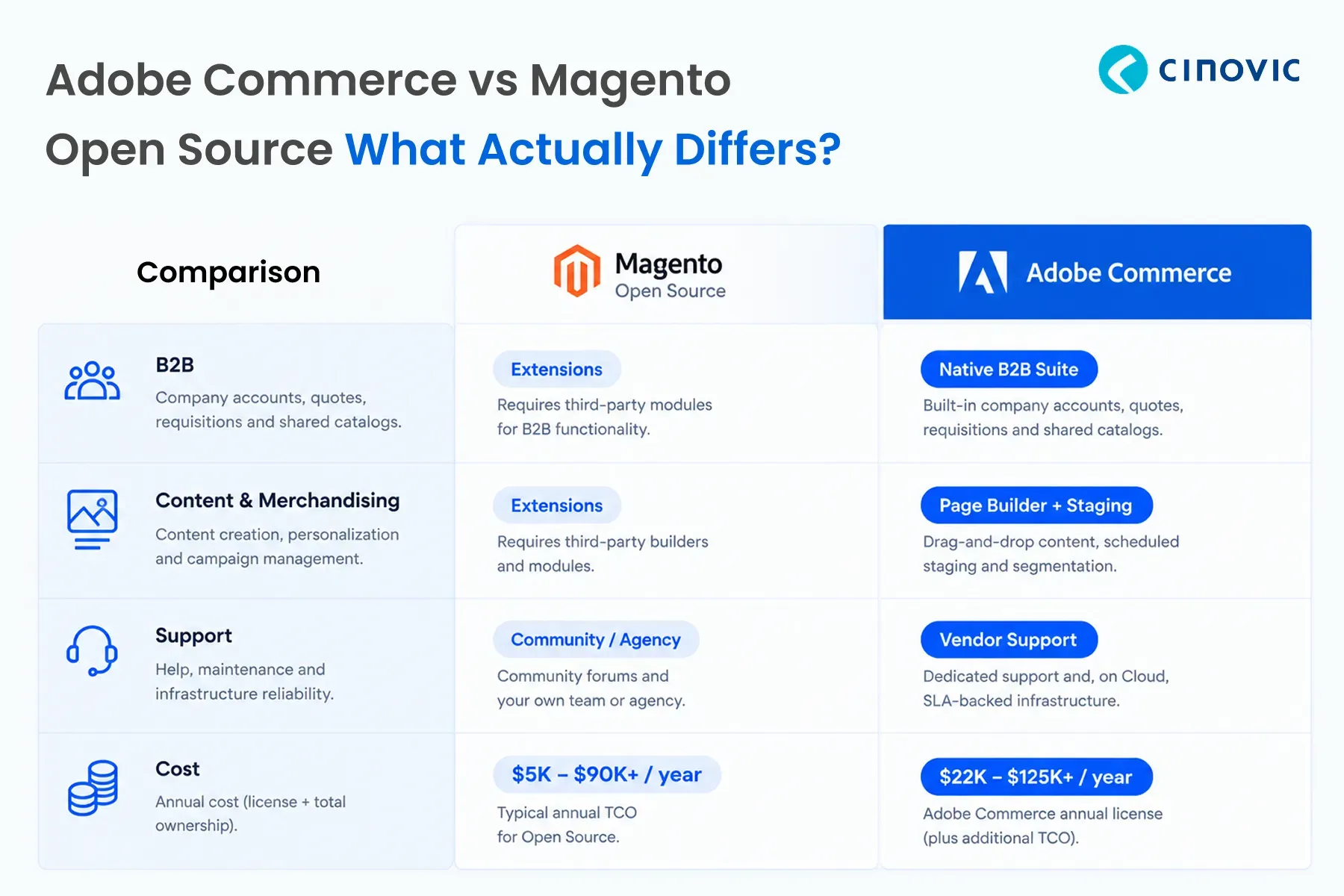
B2B Suite: Company accounts with unlimited sub-accounts, negotiable quotes, requisition lists, and shared catalogs, Adobe Commerce's most substantial exclusive functionality. Explore our Adobe Commerce B2B development services.
Content & Merchandising Tools: Drag-and-drop Page Builder, content staging with scheduled changes, and customer segmentation paired with Adobe Sensei's AI-driven recommendations.
Support & Infrastructure: Adobe Commerce includes vendor support and, on Cloud, SLA-backed managed infrastructure; Open Source relies entirely on community forums and your own team or agency.
Total Cost of Ownership: Open Source has no license fee, but real hosting, extension, and development costs; Adobe Commerce's license typically represents only 20–40% of total annual spend.
Revenue alone is a poor filter for this decision; scalability is a function of infrastructure and implementation quality, not which edition you choose.
1. Magento Open-Source Wins on Budget Efficiency and Control: For merchants below roughly mid-seven-figure annual revenue with no serious B2B requirements, Open Source wins the math; you keep full control over hosting and architecture, and the license savings can be redirected into UX, AI-powered sales tools, or marketing instead of a platform subscription.
2. Adobe Commerce Wins When B2B Requirements Are Real: Company account hierarchies, negotiable quotes, and shared catalogs are Adobe Commerce's most substantial exclusive capability. A B2B merchant who instead assembles this functionality from third-party extensions on Open Source often ends up spending as much or more once module licenses and integration work are counted.
3. Content-Heavy Brands Benefit from Page Builder and Staging: For brands shipping marketing campaigns weekly, native drag-and-drop content composition and scheduled content staging save real agency hours every month; Open Source has no native equivalent, though third-party builders fill the gap reasonably well.
4. High-GMV Stores Benefit from Support and Infrastructure Guarantees: For stores processing tens of millions in annual GMV, Adobe's support contract and Cloud's SLA-backed infrastructure carry genuine risk-reduction value during peak season that an unsupported Open-Source deployment can't match on its own.
Theory without execution is just wishful thinking. Here is a battle-tested framework for making this decision correctly the first time.
Total Cost of Ownership by Category
As a Magento development agency and Adobe Commerce development company, Cinovic has delivered eCommerce projects across both Magento Open Source and Adobe Commerce, alongside Shopify and Shopware, so our recommendation starts from your actual B2B requirements, content workflow, and growth trajectory, not from which edition pays a bigger commission.
Our Magento 2 development services cover the full engagement: platform selection, implementation, extension development, and ongoing maintenance across Magento, alongside our broader capabilities in MuleSoft integration, Power BI, and generative AI. Whether you're evaluating a fresh build, planning Adobe Commerce B2B development services for a company-account rollout, or considering Magento migration services from Open Source to Adobe Commerce as your B2B needs mature, we help you calculate the true total cost of ownership before you commit, not after.
Adobe Commerce isn't automatically "better" than Magento Open Source, and Open Source isn't automatically the budget compromise; they're built for genuinely different requirements sitting on the exact same technical foundation. The businesses that choose well are the ones who map their actual B2B, content, and support needs before pricing anything.
The most expensive mistake in this decision isn't picking the "wrong" edition. It's picking either one without first calculating what your business will actually use, and what it will actually cost either way.
Explore our latest articles, insights, and technology trends.
Discover how to prepare your ecommerce store for agentic AI, from AI-powered shopping experiences to automation, personalization, and smarter commerce.

A 2026 enterprise guide to building high-performance Power BI data models, from star schema design to DAX time intelligence, predictive analytics, and row-level security.

Hyvä migration delivers measurable ROI: Magento stores see LCP drop from 4.8s to 1.2s, and 50%+ achieve green Core Web Vitals. See how Cinovic turns performance into profit.
Join 100+ teams scaling with Cinovic. Fill out the form below to get personalised tour of the platform.
Both run on the same core codebase, admin panel, and extension ecosystem. Adobe Commerce adds a defined layer of commercial features, native B2B tools, Page Builder, content staging, and customer segmentation on top of that shared foundation.
The license itself has no cost, but hosting, premium extensions, security work, and a development retainer typically bring real annual costs into the $5,000–$90,000+ range depending on store complexity.
When you need company account hierarchies with sub-accounts, negotiable quotes, requisition lists, or shared catalogs, assembling equivalent functionality from third-party extensions on Open Source often costs as much or more once module fees and integration work are counted.
Yes. The migration path between editions is well established; many stores start on Open Source and move to Adobe Commerce as B2B needs mature, and existing data transfers with the migration.
No. Scalability is a function of infrastructure and implementation quality, not which edition you choose; large, high-volume stores run successfully on Open Source.
We start with your actual B2B, content, and support requirements, then calculate the true total cost of ownership on both sides, including hosting, extensions, and development.
Yes. Magento 1 reached end-of-life in 2020 and no longer receives security patches, so migrating is a security necessity. As a Magento 1 to Magento 2 migration agency, Cinovic re-platforms legacy Magento 1 stores onto either edition, carrying over product, customer, and order data while rebuilding customizations on current architecture.
Yes, both editions support headless commerce. If you need a fully decoupled front end, our headless Magento PWA development team can keep either edition's backend while building a custom, app-like storefront on top.