Architectural Patterns That Support Growth, AI Workloads, and Enterprise Demands Without Breaking
Most SaaS products don't fail because of a missing feature; they fail because the architecture underneath was never built to handle AI workloads, multi-tenant scale, or the unpredictable cost curve that comes with both. The products winning in 2026 treated architecture as a growth decision from day one, not a fix applied after things broke.
What Does "AI-First" Actually Change in SaaS Architecture?
Traditional SaaS architecture is built around structured, transactional data: a request comes in, a database is queried, a response goes out. AI-first products break that assumption. They need to serve unstructured data, embeddings, and real-time retrieval alongside the transactional core, not instead of it.
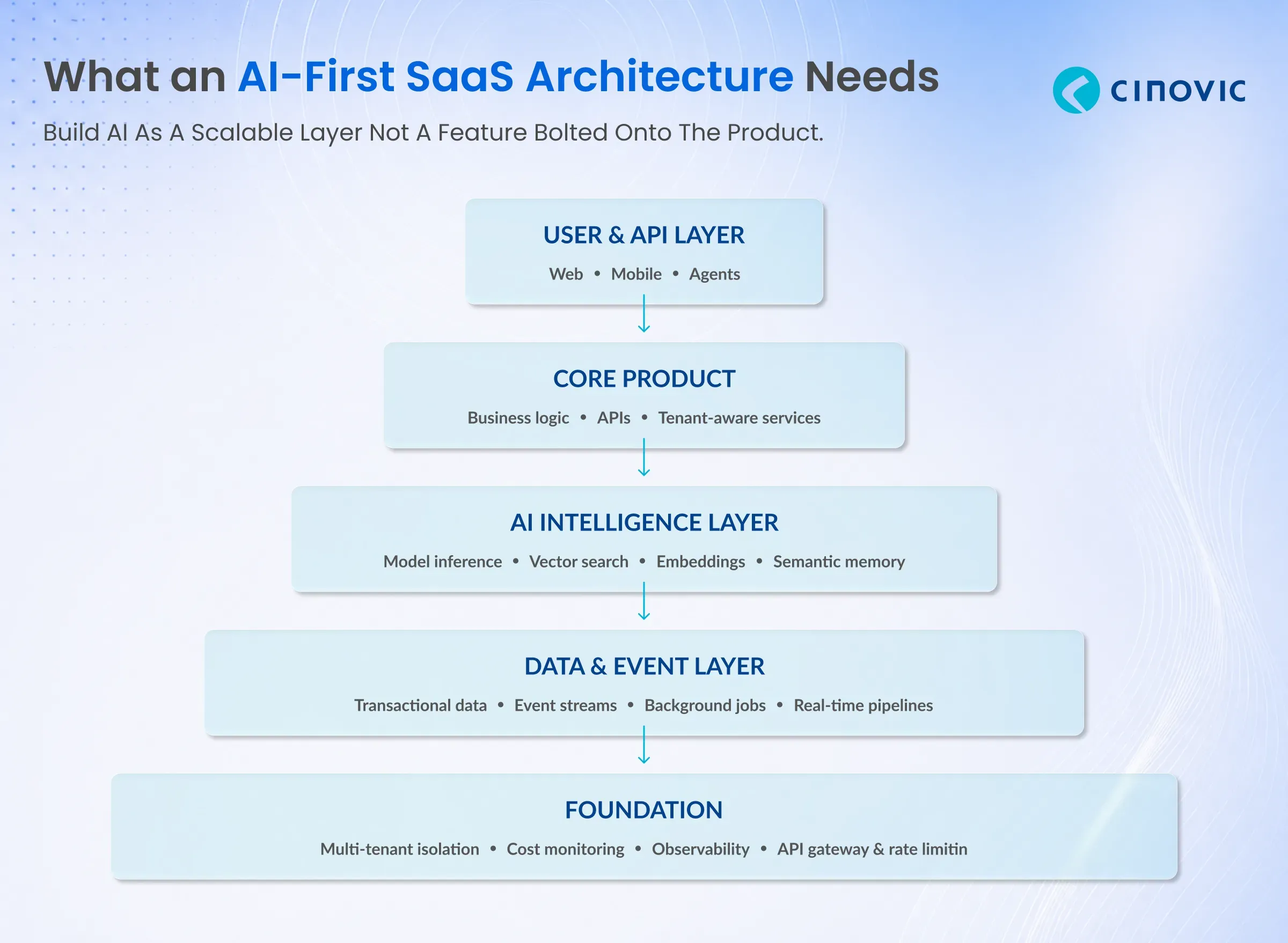
This isn't a bolt-on. AI workloads bring their own infrastructure requirements, model inference services, vector databases, workflow orchestration, and real-time data pipelines that sit alongside, not inside, your existing application logic. Treating AI as a feature added late is what creates architectural debt that shows up as latency, runaway inference cost, and reliability problems six months after launch.
"The products that scale aren't the ones with the most AI features. They're the ones where the AI layer was designed to fail safely, scale independently, and stay out of the way of the core product." Cinovic Engineering Team.
The Four Pillars of Scalable AI-First SaaS Architecture
Before choosing frameworks or cloud providers, these four fundamentals need to be settled.
Modular, API-First Design: Services built as independently deployable units connected through well-defined APIs, so the AI layer can evolve without redeploying the whole product.
Multi-Tenant Isolation: A shared-base, isolated-layer model: shared infrastructure for cost efficiency, with tenant-specific configuration and data kept cleanly separated.
AI Inference & Data Layer: Dedicated infrastructure for model inference, vector search, and embeddings, decoupled from the transactional database so AI load never degrades core product performance.
Cost-Aware Scaling: Usage-based cost visibility built in from the start, since AI inference costs scale with consumption in a way flat per-seat pricing was never designed to absorb.
Architectural Patterns Worth Building On
Not every pattern fits every product stage. These are the ones consistently proving out at scale in 2026.
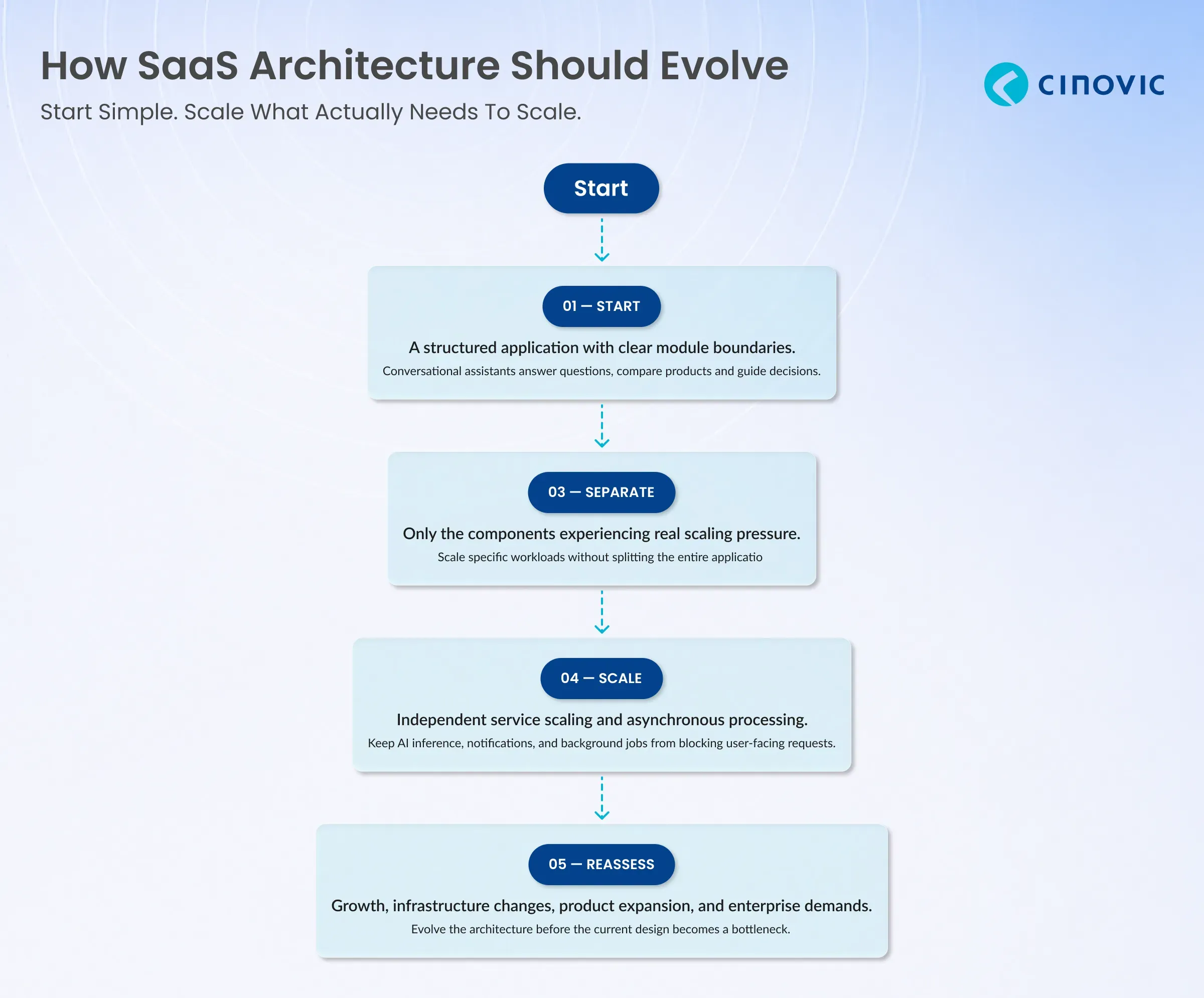
1. Modular Monolith Microservices, in That Order. Most successful SaaS products don't start with microservices; they start with a well-structured modular monolith and split services out as specific parts of the system hit real scaling pressure. Splitting too early adds distributed-systems complexity before there's a reason to carry it.
2. Shared-Base, Isolated-Layer AI Infrastructure: For AI-first products, the recommended pattern is a shared base model and inference infrastructure across all tenants for cost efficiency, with a tenant-specific layer handling fine-tuning weights, configuration, and version pinning. It gives you the cost efficiency of shared infrastructure with the isolation enterprise customers expect.
3. Event-Driven, Asynchronous Processing: Event-driven architecture decouples services, so they communicate through events rather than direct calls, which is what lets AI inference, notifications, and background processing scale independently of the request-response path users actually wait on.
4. Semantic Memory via Vector Retrieval: Giving an LLM long-term context increasingly means pairing it with a vector database for retrieval-augmented generation, rather than stuffing everything into the prompt. This is now treated as a core architectural layer, not an experimental add-on.
A Practical 6-Step Path to Scalable AI-First Architecture
Theory without execution is just wishful thinking. Here is a battle-tested path to move from idea to a system that scales.
- Start With a Simple, Scalable Foundation: Build the MVP on a modular structure even with a limited budget. The goal isn't to predict every future feature; it's to avoid painting yourself into a corner.
- Separate the AI Layer From the Core Product Early: Even before you need to scale them independently, keep inference and retrieval logic architecturally distinct from your transactional application.
- Design Multi-Tenancy Before You Need It: Retrofitting tenant isolation after customers are already on a shared schema is far more expensive than building it in from the start.
- Instrument Cost Visibility From Day One: Know what each customer, feature, and AI call costs to serve, since AI cost scales with usage in a way flat pricing doesn't.
- Adopt Event-Driven Patterns for Anything Asynchronous: Notifications, background jobs, and AI inference calls shouldn't block the primary user-facing request path.
- Revisit Architecture on a Fixed Cadence: Reassess at minimum every six months, or whenever growth, infrastructure changes, or product expansion make it necessary. Scalability problems are cheaper to prevent than to fix.
Case Study: Building Governed, Tenant-Ready Access Control From Day One
The "Tenant Data Isolation" pillar above is easiest to see in a real build. It's a smaller part of what Cinovic delivered in the Financial Services Client Operations Platform case study, worth a look at how role-based access control, JWT authentication with 2FA, and full audit logging were architected into the core system from the start, rather than added after a compliance review flagged the gap. That's the same "design it before you need it" principle this article applies to multi-tenancy: retrofitting access boundaries onto a system already in production is far more disruptive than building them in from day one.
A heads-up on this pick: that case study is a financial-services workflow platform, not a multi-tenant AI-inference product specifically, so it illustrates the access-control and governance pattern rather than the full AI-first architecture described above. If you have a more directly AI-first or multi-tenant SaaS case study you'd rather feature here, send it over and I'll swap it in.
Where Architecture Decisions Matter Most for AI-First Products
High-Impact Architecture Decisions, where the right call early saves the most rework later
- Inference Cost Control: Usage-based pricing architecture that aligns what customers pay with what AI features actually cost to run.
- Vector Database Selection: The retrieval layer underneath every RAG-based feature; hard to swap out once embeddings and pipelines are built around it.
- Tenant Data Isolation: Whether enterprise customers can be onboarded without a costly re-architecture for compliance and security.
- Model Versioning Strategy: How you roll out a new model or fine-tune without breaking every tenant relying on the previous version's behaviour.
- Observability Across Services: Whether a slow AI response can actually be traced back to its root cause, instead of just showing up as "the app is slow."
- API Gateway & Rate Limiting: Protecting core product performance from AI-agent traffic, which now makes up a large share of total API calls.
Common Mistakes That Undermine SaaS Scalability
- Splitting into microservices too early: Adding distributed-systems overhead before a single service has actually hit a scaling limit slows teams down rather than speeding them up.
- Treating AI infrastructure as an afterthought: Bolting inference and vector search onto an architecture designed only for transactional data creates latency and reliability problems that are expensive to unwind later.
- Flat per-seat pricing on AI features: Costs scale with usage while revenue scales with headcount, which quietly erodes margin as power users adopt AI features more heavily than casual ones.
- Sharing too much state across services: Loosely coupled services that secretly depend on each other's internal state lose most of the benefit microservices were meant to provide.
- No architecture review cadence: Treating architecture as a one-time decision instead of something revisited as the product and customer base grow.
How Cinovic Architects AI-First SaaS Products
At Cinovic, we design SaaS architecture as a growth layer, not just a technical foundation, with scalability, cost control, and AI capability considered from the first release, not retrofitted after launch.
Our approach combines hands-on delivery across custom software development, generative AI integration, and cloud-native infrastructure, so your product can add AI-driven features, onboard enterprise tenants, and scale usage without a ground-up rebuild. We help teams decide what to build now versus what to design room for later, so early architecture choices don't become the reason a later funding round or enterprise deal stalls.
Conclusion: Architecture Is a Product Decision, Not Just a Technical One
The SaaS companies pulling ahead in 2027 aren't necessarily shipping the most features; they're the ones whose systems evolve without breaking every time growth, AI adoption, or a new enterprise customer puts pressure on them.
Scalable architecture isn't something you add once you've outgrown the current system. It's the reason you're able to outgrow it at all.