Transaction Authorizations Service - Core service that validates and authorises transactions in real time. (Merchants, Customers, Core Processing)
Rust-Based High-Throughout Payment Processing Service
This case study is a real-world example of our work as a Rust development company rebuilding a payment gateway's transaction-processing core for a financial services client whose existing stack was slowing under peak load and becoming more expensive to scale. We rewrote the core in Rust, using its ownership model to rule out entire classes of concurrency bugs at compile time, and built it on an async runtime so a single instance could handle far more concurrent transactions.
Industry
Financial Services / Payments
Focus Area
Payment Processing Infrastructure
Core Technology
Rust Microservices
Frontend / Interface
Internal Admin Console
Deployment Model
Cloud (Containerised)
Outcomes
Outcomes
Lower Authorisation Latency
The async Rust core cut response times under peak load compared to the previous stack.
Consistent Performance Under Load
No garbage-collection-driven latency spikes during traffic surges.
Lower Infrastructure Cost per Transaction
Higher throughput per instance reduced the server footprint needed for the same volume.
Fewer Concurrency-Related Incidents
Compile-time safety checks eliminated a class of bugs common in the previous stack.
Business Challenges
Latency Under Load
Root Cause: The existing service slowed noticeably during peak transaction volume.
Business Impact: Slower authorisation responses risked timeouts and failed transactions at checkout.
Unpredictable Memory Behaviour
Root Cause: The previous stack occasionally suffered garbage-collection pauses under load.
Business Impact: Pauses at the wrong moment could delay time-sensitive payment authorisation calls.
Scaling Cost
Root Cause: Handling growth meant adding more server instances to compensate for inefficiency.
Business Impact: Infrastructure costs grew faster than transaction volume.
Strict Correctness Requirements
Root Cause: Payment logic can't tolerate race conditions or silent data corruption.
Business Impact: A single concurrency bug could mean duplicate charges or lost transactions.
Multiple Downstream Providers
Root Cause: Transactions needed to route to different processors and banks with different response formats.
Business Impact: Integration complexity risked inconsistent handling across providers.
Solution Approach
Memory-Safe Concurrency by Design
What We Did: Rebuilt the transaction-processing core in Rust, using its ownership model to rule out entire classes of concurrency bugs at compile time.
Why It Matters: Correctness issues like race conditions and use-after-free are caught before the code ever ships.
Async, Non-Blocking Service Architecture
What We Did: Built the service on an async runtime so a single instance can handle many concurrent transactions efficiently.
Why It Matters: Higher throughput per server reduces the number of instances needed to handle peak load — this is what Rust development for high-performance systems looks like in practice, not just a language swap.
Provider Abstraction Layer
What We Did: Implemented a common internal transaction interface with provider-specific adapters.
Why It Matters: New payment providers can be added without touching the core transaction logic.
Use Cases Delivered
Provider Routing Engine - Routes transactions to the correct processor or bank based on rules. (Operations, Core Processing)
Idempotency & Retry Handling - Ensures a retried request never results in a duplicate charge. (Merchants, Finance, Reliability)
Real-Time Transaction Monitoring - Live dashboard of authorisation rates, latency, and error codes. (Operations, Support)
Fraud Signal Hooks - Lightweight interface for passing transactions through fraud-scoring checks. (Risk & Compliance, Risk Management)
Audit Log Service - Immutable, append-only log of every transaction event for compliance. (Compliance, Finance)
Technologies and Tools
Core Backend
Rust, Tokio (async runtime), Actix / Axum (web framework)
Data
PostgreSQL (transaction records, idempotency keys), Redis (low-latency caching)
Messaging:
Message Queue (async event handling, audit logging)
Infrastructure
Docker / Kubernetes (containerised deployment, horizontal scaling)
Monitoring
Metrics & tracing pipeline (latency, throughput, error-rate observability)
Tools
Git, CI/CD pipeline
Business Outcomes
Lower Authorisation Latency: The async Rust core cut response times under peak load compared to the previous stack.
Consistent Performance Under Load: No garbage-collection-driven latency spikes during traffic surges.
Lower Infrastructure Cost per Transaction: Higher throughput per instance reduced the server footprint needed for the same volume.
Fewer Concurrency-Related Incidents: Compile-time safety checks eliminated a class of bugs common in the previous stack.
Faster Provider Onboarding: The provider abstraction layer cut the time to integrate a new payment processor.
Stronger Audit Trail: Immutable transaction logs simplified compliance reporting.
Recent Case Studies
Optimize your cloud infrastructure, implement robust solutions, and stay ahead of trends with our resource hub.
Financial Services
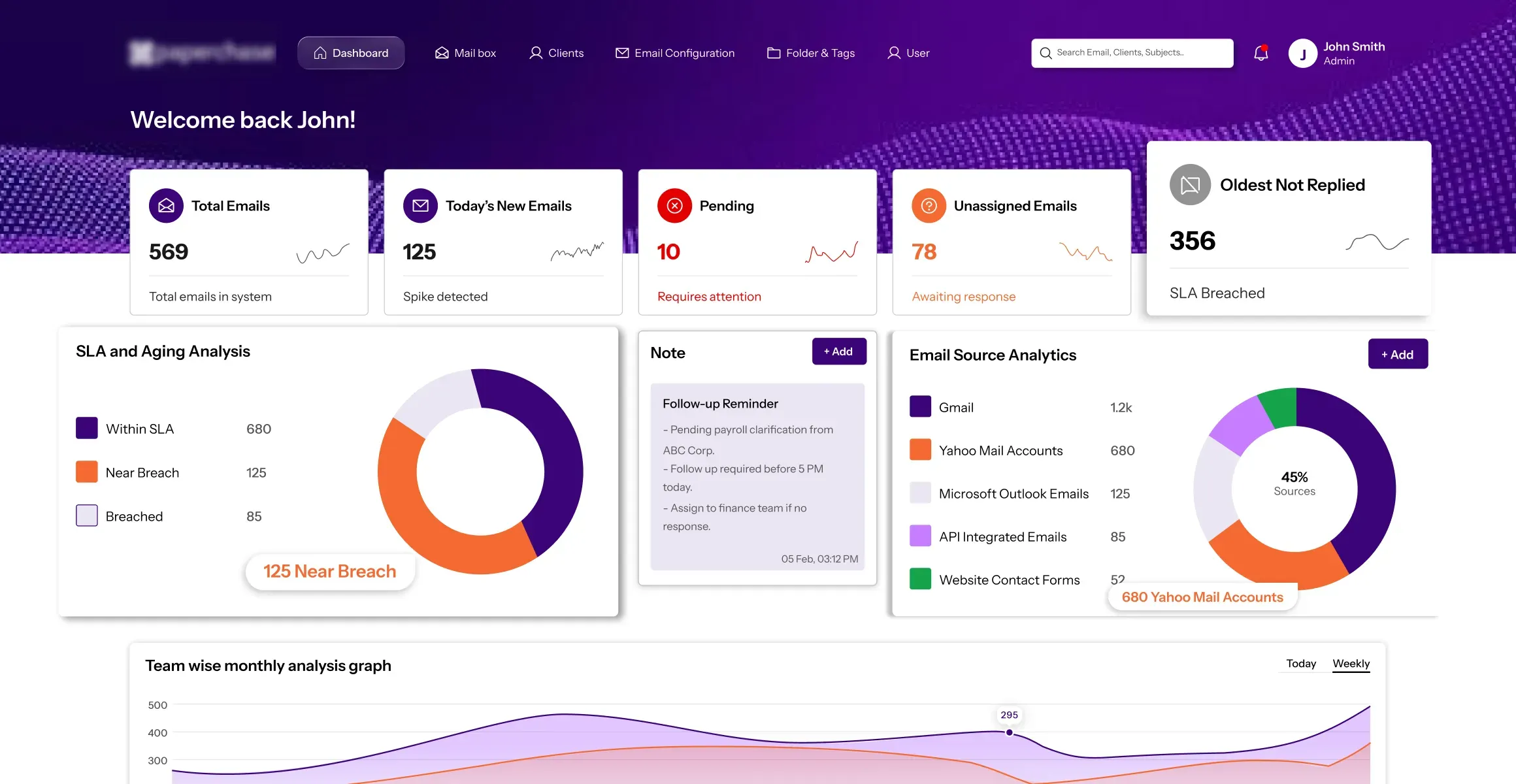
Financial Services & Client Operation Platform
A smarter shared inbox for financial services teams that need speed, clarity, and control
View Case Study

Financial Services
Full Accounting Integration Platform
Provider-agnostic accounting layer for QuickBooks, Xero-ready workflows, and full auction finance control
View Case Study
Let's Talk
See Cinovic's Expertise in Action Book Your Free 15-Minute Development Demo
Join 100+ teams scaling with Cinovic. Fill out the form below to get personalised tour of the platform.
Frequently Asked Questions About Rust Payment Processing
The previous stack slowed under peak load and suffered garbage-collection pauses that could delay time-sensitive authorisation calls. Rust’s ownership model rules out entire classes of concurrency bugs at compile time, which suits a backend platform rebuild where correctness matters as much as speed.
An async, non-blocking runtime lets a single service instance handle many concurrent transactions instead of blocking on I/O for each one, which means higher throughput per server and fewer instances needed to handle the same peak load.
Idempotency keys are checked against stored transaction records before processing, so if a request is retried due to a network timeout or a client resending- the system recognizes it as a duplicate and returns the original result instead of charging twice.
Yes. A provider abstraction layer defines a common internal transaction interface with provider-specific adapters, so a new processor or bank can be integrated by adding an adapter rather than modifying the core transaction logic.
A common internal transaction interface with provider-specific adapters keeps the core logic separate from each processor’s response format. This kind of application and system integration approach means new providers can be added without touching the core transaction logic.
Typically, it covers the core transaction logic rewrite, the async service architecture, a provider abstraction layer for downstream integrations, and the observability tooling needed to monitor latency and error rates in production this case study is one example of what that looks like end-to-end.
Beyond writing Rust itself, it usually includes designing for compile-time safety around concurrency, choosing and configuring an async runtime, setting up CI/CD for a compiled-language workflow, and integrating with existing infrastructure like databases, caches, and message queues.
It tends to make sense when a system has hard latency requirements, can't tolerate garbage-collection pauses, or needs strict correctness guarantees around concurrency, payment processing, real-time infrastructure, and other systems where a single bug or pause has real cost are common cases.
It means designing the whole architecture, not just the code, around throughput and correctness: an async runtime instead of blocking I/O, compile-time concurrency checks instead of runtime debugging, and careful attention to what runs per-instance so infrastructure scales with actual demand rather than inefficiency.
Yes. Whether you’re modernising an existing gateway or building a new high-throughput service, talk to our team. You can also see how we handled scale in a different domain in our case study on migrating 50 million orders to Magento 2.