

Microservices & API-First Architecture: Building a Scalable 2026 Digital Strategy
A 2026 enterprise guide to microservices architecture and API-first design, the benefits, the challenges, and how to plan a migration that actually pays off.
Microservices architecture and API-first design have become the defining pillars of enterprise digital transformation in 2026. The global microservices market reached $7.45 billion in 2025 and is projected to nearly double to $15.97 billion by 2029, growing at a 21% CAGR, according to MarketsandMarkets and NovaArc research.
That growth isn't hype; it reflects a real shift in how enterprises build software. Monolithic applications that once shipped features on a quarterly cadence simply can't keep pace with a business that needs to launch a new channel, integrate a new vendor, or scale a single high-traffic feature independently of everything else. This guide breaks down what microservices and API-first architecture actually solve, where they get genuinely hard, and how to plan a migration that delivers ROI instead of just complexity.
$7.45B → $15.97B
The global microservices market is projected to grow from $7.45B in 2025 to $15.97B by 2029, at a 21% CAGR, per MarketsandMarkets and NovaArc.
Microservices vs Monolithic Architecture: The 2026 Landscape Shift
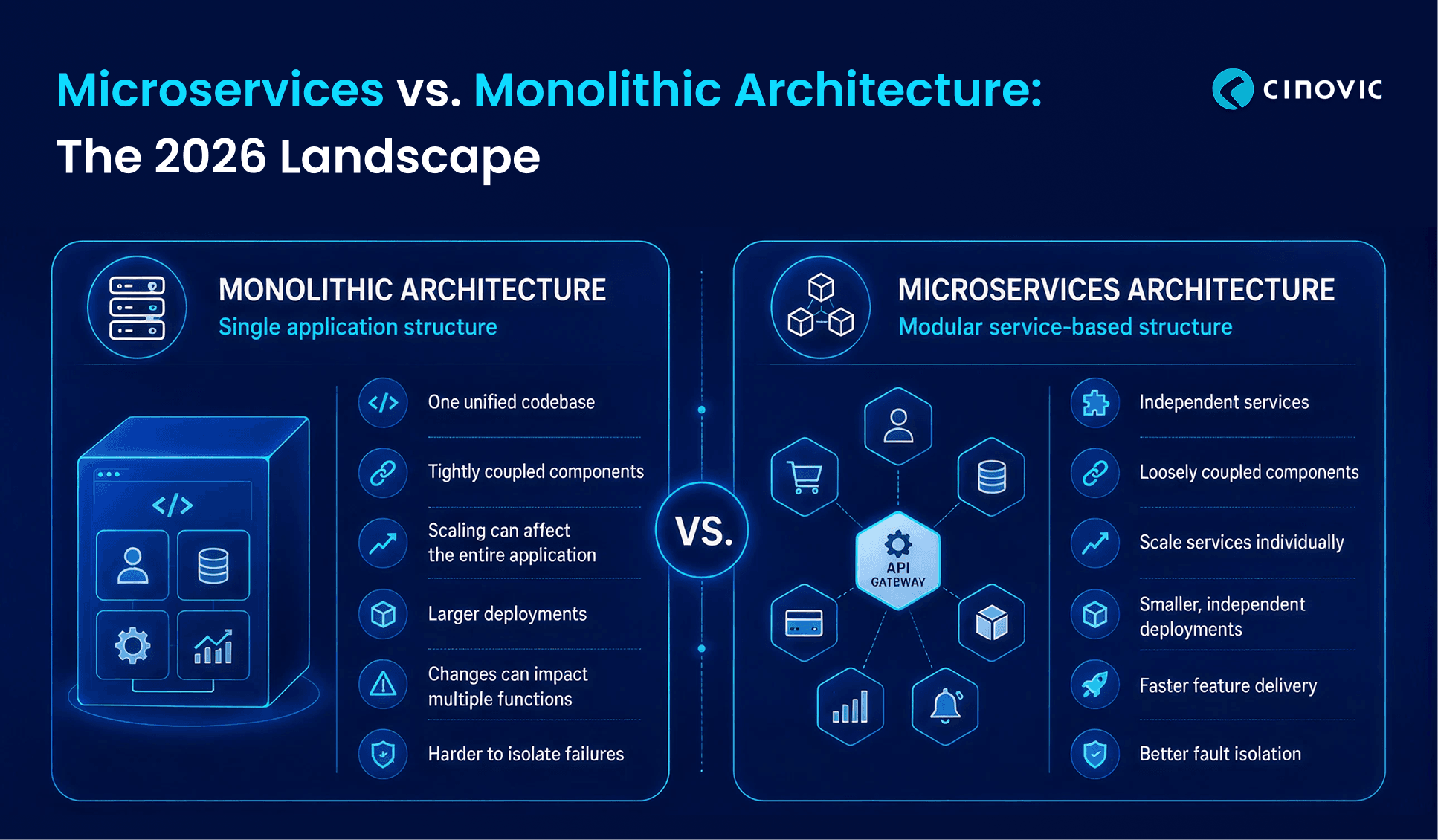
A monolithic application ships as a single, tightly coupled codebase, with every feature, service, and dependency deployed together. It's simple to start with, but as the codebase grows, even a small change requires testing and redeploying the entire application, and a bug in one module can take down the whole system.
Microservices architecture breaks that same application into independently deployable services, each owning a specific business capability- payments, inventory, notifications- communicating over well-defined APIs. The trade-off is real: microservices introduce distributed-systems complexity that a monolith never has to deal with. But for enterprises operating at scale, with multiple teams shipping independently, that complexity is usually the lesser cost compared to the deployment bottlenecks a monolith eventually creates.
Microservices Architecture Benefits: Scalability, Resilience & Technology Agility
The core argument for microservices architecture comes down to three benefits monoliths structurally can't match. Scalability: each service scales independently, so a traffic spike in checkout doesn't require scaling the entire application. Resilience: a failure in one service through proper fault isolation doesn't cascade into a full outage. And technology agility: teams can choose the best language or framework for each service rather than being locked into one stack for the entire application. AWS's 2024 analysis found enterprises adopting microservices see roughly 40% faster time-to-market on new features, a direct result of teams being able to ship independently rather than coordinating a single monolithic release. This is the same architectural shift underpinning most modern custom software development engagements today.
40% faster
time-to-market for enterprises using microservices architecture, compared to monolithic deployments, according to AWS's 2024 enterprise analysis.
API-First Architecture: The Foundation for Multi-Channel Integration & Faster Delivery
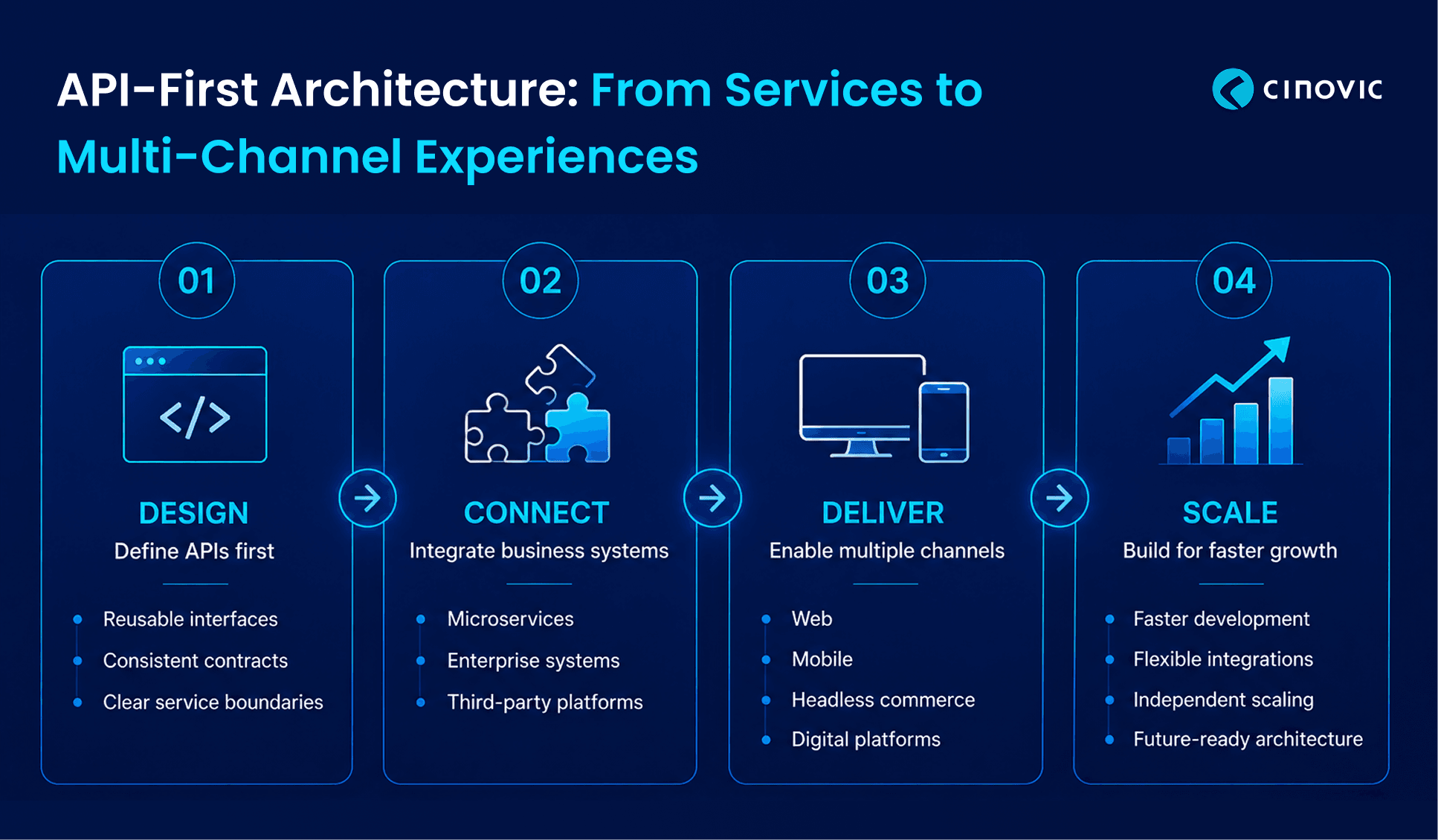
API-first design flips the traditional build order: instead of building an application and bolting on an API afterward, the API contract is designed first, and every client web, mobile, partner integrations, internal tools consumes the same well-documented interface. This is what makes true API and system integration possible at enterprise scale, rather than a patchwork of one-off connections built differently for every new consumer.
The payoff compounds over time. A new mobile app, a partner integration, or an internal automation tool can all consume the same stable API without waiting on custom backend work, turning what used to be a multi-week integration project into a matter of days once the API-first foundation is in place.
Headless Commerce & API-First Design: Accelerating Digital Transformation
Headless commerce is an API-first architecture applied directly to eCommerce: the storefront (the 'head') is decoupled from the backend commerce engine, connected only through APIs. That separation lets a business run a completely custom storefront experience or multiple storefronts across web, app, and in-store kiosks without being constrained by a monolithic platform's templating system. Cinovic's Magento 2 headless commerce development work is a direct application of this pattern, decoupling the frontend experience from Magento's backend commerce logic.
The result is a storefront that can be redesigned, A/B tested, or extended to new channels without touching the underlying commerce logic exactly the kind of flexibility a monolithic platform architecture makes slow and expensive.
Microservices Challenges: Kubernetes, Service Mesh & CI/CD Orchestration
Microservices don't eliminate complexity; they relocate it, from a single hard-to-change codebase to an orchestration problem across dozens of independently deployed services. Kubernetes has become the default answer for managing that orchestration: scheduling containers, handling failover, and scaling services independently based on demand. A service mesh adds a layer on top for handling service-to-service communication, retries, and observability without embedding that logic in every service's code.
CI/CD pipelines have to evolve alongside this shift too; testing and deploying dozens of independent services safely requires far more automation discipline than a single monolithic release process ever did. Enterprises that underestimate this operational overhead are the ones who end up with a 'distributed monolith': all the deployment complexity of microservices with none of the independence benefits. Getting the orchestration layer right from the start, sometimes as part of a dedicated project rescue engagement when a prior migration has stalled, is what determines whether microservices actually deliver the agility they promise.
ROI of Microservices Architecture: Time-to-Market, Agility & AI Readiness
The business case for microservices architecture ultimately comes down to three measurable outcomes: faster time-to-market from independent deployments, the agility to adapt individual services without a full application rewrite, and AI readiness the ability to plug machine learning services into a specific part of the system without re-architecting the whole platform. That last point matters more every year: enterprises trying to bolt AI features onto a rigid monolith consistently find it far harder than teams that already have clean, independently deployable service boundaries. For enterprises still running on legacy platforms, this ROI case is usually the strongest argument for pairing a microservices migration with a broader legacy product modernization initiative rather than treating them as separate projects.
Conclusion: Is Microservices Architecture Right for Your Business?
Microservices and API-first architecture aren't a default upgrade every business needs; they're the right fit when scale, team independence, and the need to plug in new channels or AI capabilities outweigh the operational overhead of managing distributed services. For a small, single-team application, a monolith may still be the faster, cheaper path.
But for enterprises already feeling the friction of a rigid platform, slow release cycles, a backend that can't support a new channel, or an AI initiative stalled by architecture that won't accommodate it, the shift toward microservices and API-first design is quickly becoming less of a competitive advantage and more of a baseline requirement for staying agile in 2026.
See Cinovic's Expertise in Action Book Your Free 15-Minute Development Demo
Join 100+ teams scaling with Cinovic. Fill out the form below to get personalised tour of the platform.
Frequently Asked Questions About Microservices & API-First Architecture
Microservices architecture structures an application as a collection of small, independently deployable services, each responsible for a specific business capability and communicating over well-defined APIs, rather than as one large, tightly coupled codebase.
A monolith ships all functionality as a single deployable unit, while microservices split functionality into independent services that can be developed, deployed, and scaled separately. Microservices offer more flexibility and resilience but introduce distributed-systems complexity a monolith doesn't have.
API-first architecture means designing the API contract before building the application itself, so every client — web, mobile, partner, or internal tool — consumes the same consistent, well-documented interface from day one.
MACH stands for Microservices, API-first, Cloud-native, and Headless, a composable architecture approach that combines these four principles to let enterprises assemble and replace individual technology components independently, rather than committing to one monolithic platform.
The biggest challenges are operational: orchestrating dozens of independent services (typically with Kubernetes), managing service-to-service communication (often via a service mesh), and building CI/CD pipelines robust enough to deploy many services safely and frequently.
Most successful migrations are incremental rather than a full rewrite, extracting one well-bounded capability at a time into its own service, validating it in production, and repeating, rather than attempting a single large-scale cutover.