Custom AI vs. off-the-shelf AI: build vs buy guide for enterprises
The custom AI vs. off-the-shelf AI debate is now the defining build vs buy decision for enterprise teams in 2026. According to Gartner, 91% of organizations are increasing their GenAI budgets, but the wrong AI model choice can burn millions…
Custom AI vs. off-the-shelf AI models: the build vs buy decision guide for enterprise teams
The custom AI vs. off-the-shelf AI debate is now the defining build vs buy decision for enterprise teams in 2026. According to Gartner, a large majority of organizations are increasing their GenAI budgets this year, but the wrong AI model choice can burn through millions in wasted infrastructure spend, stalled timelines, and rework. The real question isn't whether to adopt AI. It's whether to build a proprietary model, buy an off-the-shelf solution, or blend the two, and getting that decision wrong is one of the most expensive mistakes an enterprise can make in its AI roadmap.
This guide breaks down the real trade-offs between custom and off-the-shelf AI, where retrieval-augmented generation (RAG) fits in, and how to make the call for your organization.
What are off-the-shelf AI solutions? Speed, cost, and trade-offs explained
Off-the-shelf AI refers to pre-built models and platforms, from foundation model APIs to SaaS AI tools — that your team can deploy with little to no custom engineering. Providers handle the training, infrastructure, and ongoing model improvements, so your team plugs in and starts using the tool almost immediately.
Advantages:
Fast time-to-value. Deployment can happen in days or weeks instead of months.
Lower upfront cost. Subscription or usage-based pricing avoids large capital investment.
Continuous improvement. Vendors regularly update models, so you benefit from the latest capabilities without extra engineering work.
Lower technical barrier. Teams without dedicated ML engineers can still adopt AI.
Trade-offs:
Limited differentiation. Your competitors likely have access to the same underlying model.
Data privacy concerns. Sensitive data may need to leave your environment to reach a third-party API.
Vendor lock-in. Switching providers later can mean re-architecting workflows and retraining teams.
Generic outputs. Off-the-shelf models aren't trained on your proprietary data, so outputs may lack the nuance your business needs.
Off-the-shelf AI is often the right starting point for teams that need to move fast and validate use cases before committing to a larger build.
What is custom AI development? Benefits of building a proprietary AI model
Custom AI development means building or fine-tuning a model specifically around your organization's data, workflows, and business logic. This can range from fine-tuning an existing foundation model on proprietary data to building an entirely bespoke architecture.
Advantages:
Competitive differentiation. A model trained on your proprietary data produces outputs competitors can't replicate.
Full data control. Sensitive data stays inside your infrastructure, which matters heavily for regulated industries like healthcare, finance, and legal.
Tailored performance. The model is optimized for your specific tasks, terminology, and edge cases rather than generalized use.
Long-term IP value. A custom model becomes a durable business asset, not a recurring vendor expense.
Trade-offs:
Higher upfront investment. Custom builds require specialized ML talent, compute infrastructure, and longer development cycles.
Slower time-to-value. Meaningful results can take months, not weeks.
Ongoing maintenance burden. Your team owns retraining, monitoring, and infrastructure upkeep going forward.
Requires clear strategy. Without a well-defined use case, custom builds risk becoming expensive, unfocused experiments.
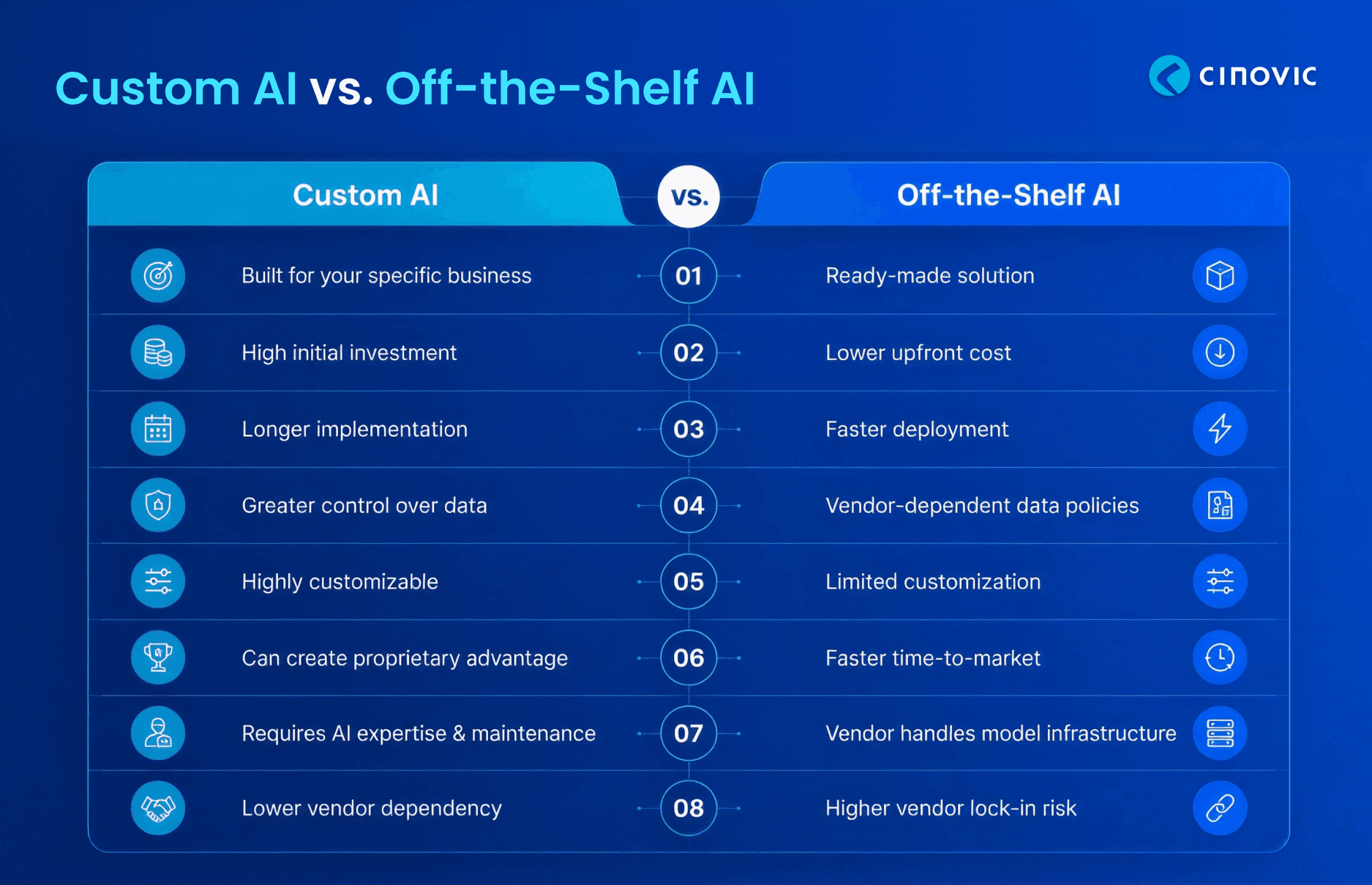
Custom AI vs. off-the-shelf AI: full feature and cost comparison
Factor Off-the-Shelf AI Custom AI
Time to deploy Days to weeks Months
Upfront cost Low High
Ongoing cost Subscription/usage-based Infrastructure + engineering team
Data privacy Depends on vendor Full control
Differentiation Low shared model High proprietary
Best for Fast validation, generalized tasks Regulated industries, unique workflows
Maintenance Handled by vendor Owned in-house
Neither option is universally "better" the right choice depends on your data sensitivity, timeline, budget, and how central AI is to your competitive strategy.
What is RAG (Retrieval-Augmented Generation) and why most enterprises choose it
For many enterprises, the real answer isn't "custom" or "off-the-shelf" it's a hybrid approach called retrieval-augmented generation (RAG).
RAG connects an existing foundation model to your organization's proprietary data at query time, without retraining the model itself. Instead of fine-tuning a model on your data (expensive and slow), RAG retrieves relevant information from your internal knowledge base and feeds it to the model as context when generating a response.
Why enterprises are choosing RAG in 2026:
Speed of off-the-shelf, relevance of custom. You get proprietary-feeling outputs without a full custom build.
Lower cost than fine-tuning. No need to retrain a model from scratch or maintain custom weights.
Easier to update. Refreshing your knowledge base is far simpler than retraining a model.
Reduced hallucination risk. Grounding responses in retrieved, verified data improves accuracy over relying on the model's training data alone.
RAG has become the default architecture for enterprises that want AI grounded in their own data without the cost and complexity of a fully custom build.
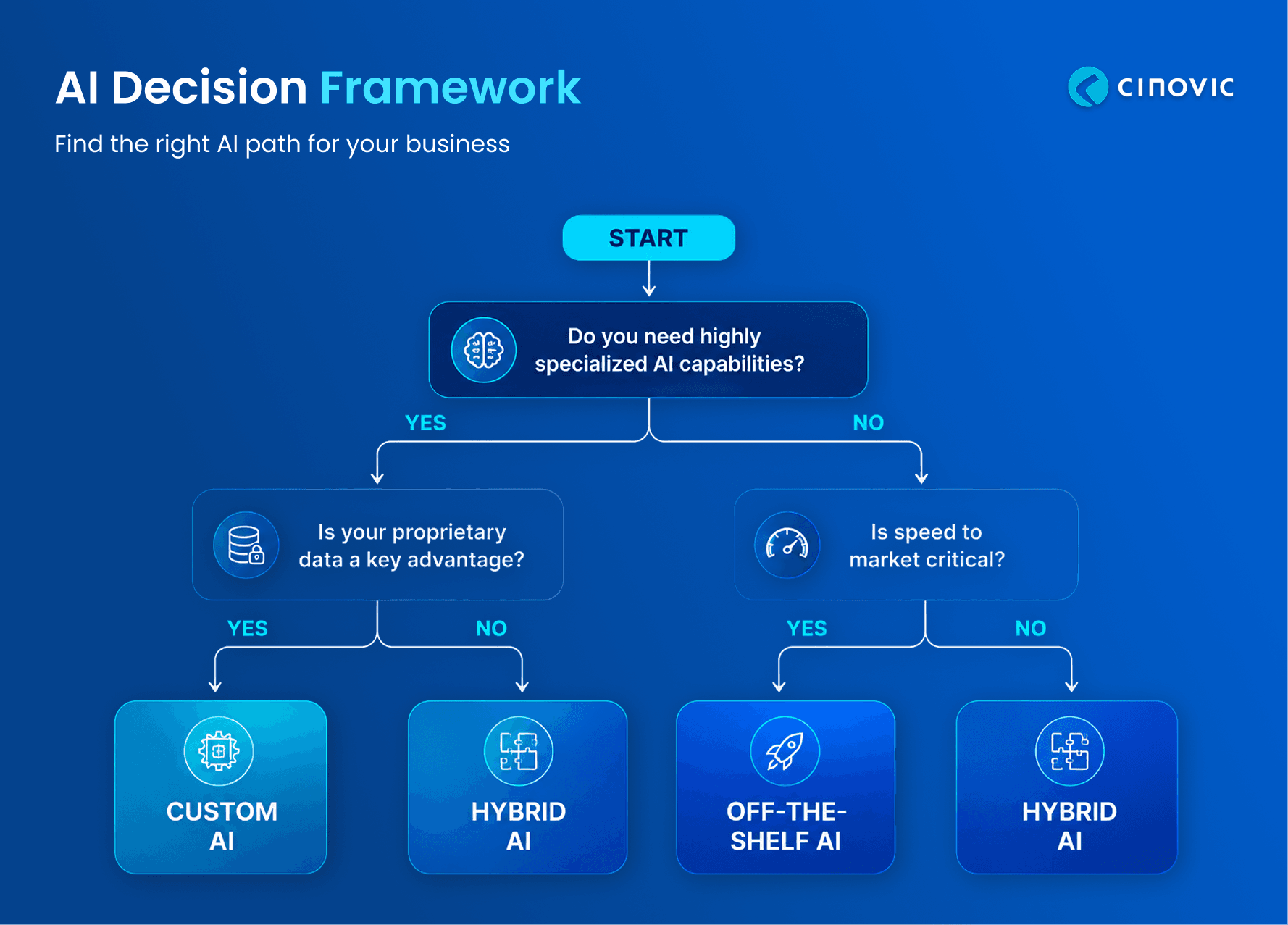
When to choose custom AI vs. SaaS AI: a practical decision framework
Use this framework to guide the decision:
Choose off-the-shelf AI (or SaaS AI) if:
- You need to validate a use case quickly with limited budget.
- Your data isn't highly sensitive or regulated.
- You lack in-house ML engineering resources.
- The task is generalized (drafting, summarization, customer support triage).
Choose RAG if:
You want AI grounded in proprietary data without a full custom build.
Speed and cost matter, but generic outputs won't cut it.
Your knowledge base changes frequently and needs to stay current.
Choose fully custom AI if:
You operate in a regulated industry with strict data residency requirements.
AI is core to your competitive advantage, not a support function.
You have (or plan to build) the internal ML talent to maintain it long-term.
Off-the-shelf and RAG solutions have been tested and don't meet your performance bar.
Most enterprises don't pick one path permanently they start with off-the-shelf or RAG to validate value, then invest in custom development for the specific workflows where it delivers the greatest ROI.
Conclusion: Choosing the Right AI Path for Your Enterpris
There's no universally right answer in the custom AI vs. off-the-shelf AI debate, only the right answer for your data maturity, budget, and how central AI is to your competitive edge. Off-the-shelf AI wins when you need speed and predictable cost for non-core workflows. Custom AI wins when AI is the differentiator, and you're playing a multi-year game. And for most enterprise teams in 2026, a RAG-based hybrid delivers the best of both, grounded, accurate answers without the full cost of a proprietary build.
Before you commit to either path, make sure your underlying data is actually ready. The biggest AI failures aren't model failures, they're data foundation failures. Get that right first, and the build vs buy decision becomes far easier to make with confidence.
See Cinovic's Expertise in Action Book Your Free 15-Minute Development Demo
Join 100+ teams scaling with Cinovic. Fill out the form below to get personalised tour of the platform.
Frequently Asked Questions About Custom AI vs. off-the-shelf AI
Not universally it depends on the use case. Custom AI outperforms off-the-shelf tools when accuracy on proprietary data, IP ownership, or long-term differentiation matters. Off-the-shelf AI wins on speed and cost for non-core workflows.
Enterprise custom AI builds typically range from tens of thousands to several hundred thousand dollars, depending on scope, data complexity, and whether you're fine-tuning an existing model or training from scratch. A scoping audit is the best way to get an accurate estimate for your specific use case.
RAG (Retrieval-Augmented Generation) connects an existing language model to your own data through a retrieval layer, so it can generate answers grounded in your business context without full model retraining.
Vendor lock-in happens when switching away from an AI platform later requires rebuilding integrations, retraining staff, or migrating data making the vendor's pricing and roadmap decisions costly to escape.
When AI capability is core to your competitive advantage, your data is highly regulated or sensitive, and you're planning for multi-year ROI rather than a short-term pilot
An SLM is a compact, task-specific AI model that requires far less compute than large frontier models, making tailored AI economically viable for companies that can't justify a full custom build.
Get Expert Guidance Before You Commit
Not sure whether to build custom AI or use an off-the-shelf model? Cinovic's AI/ML consulting team evaluates your data, infrastructure, and business goals to recommend the right path — no vendor bias, no guesswork.
Book your free AI Strategy Audit