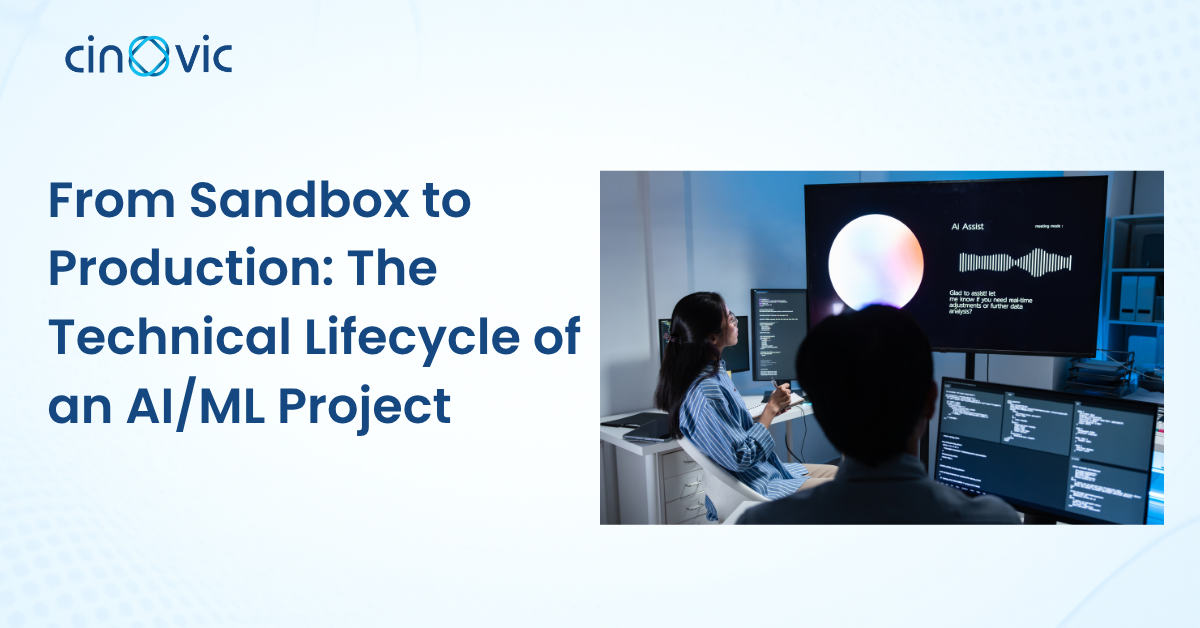
From Sandbox to Production: The Technical Lifecycle of an AI/ML Project

Table of Contents
In the current gold rush of Artificial Intelligence, many organizations find themselves stuck in “Pilot Purgatory.” According to recent industry benchmarks, nearly 80% of AI models never make it out of the experimental sandbox and into a live production environment.
The gap between a successful “Proof of Concept” (PoC) and a scalable, resilient enterprise application in Sandbox to Production is a chasm filled with technical hurdles—from data drift and latency issues to infrastructure costs. Navigating this transition requires more than just a data scientist; it requires a comprehensive AI/ML Consulting strategy that prioritizes MLOps (Machine Learning Operations).
1. Phase One: The Discovery and Feasibility Audit
Before a single line of code is written, a successful AI project begins with a “Problem-First” approach.
The Consulting Lens:
- Defining the Objective: Is this a classification problem, a regression problem, or a generative task?
- Data Availability: Do you have the volume and quality of data required to train a model?
- Success Metrics: Moving past “Accuracy” to business KPIs like “Reduced Churn” or “Increased Throughput.”
At Cinovic, our AI/ML consultation process begins by identifying if AI is even the right tool for the job. Sometimes, a well-structured Power BI Analytics model can solve a problem more efficiently than a complex neural network.
2. Phase Two: The Data Engineering Pipeline
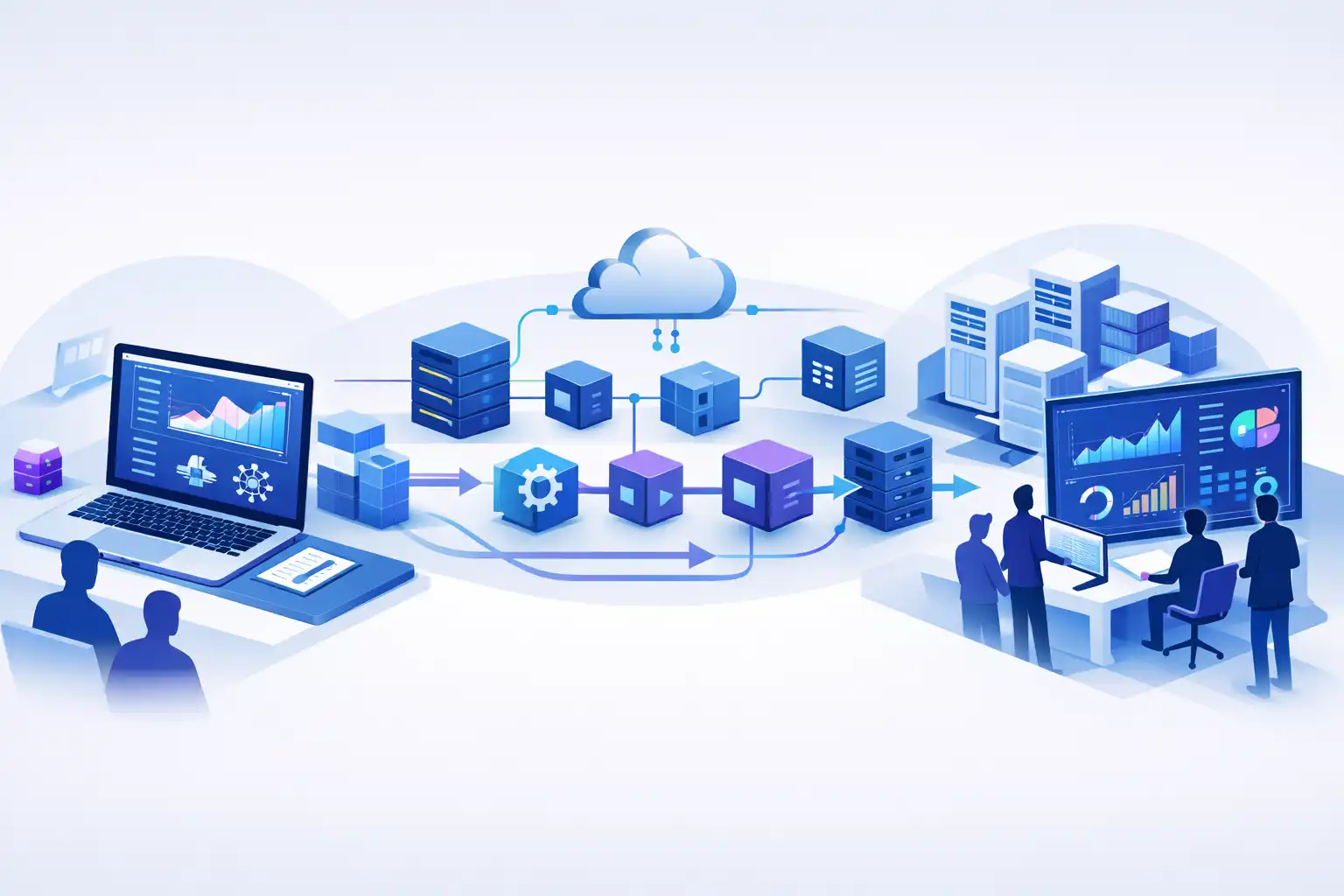
In the sandbox, data is often a static CSV file. In production, data is a living, breathing stream.
The Technical Hurdle:
“Garbage in, garbage out” is the golden rule of AI. Production-grade models require automated data pipelines that can handle:
- Data Cleaning & Normalization: Handling missing values and outliers in real-time.
- Feature Engineering: Extracting the “signals” from the “noise” of raw data.
- Data Labeling: Ensuring that the training data is accurately annotated, especially for supervised learning models.
For many enterprises, this phase involves complex API and system integrations to pull data from disparate legacy sources into a unified cloud environment.
3. Phase Three: Model Development and Training (The Sandbox)
This is where the magic happens. Data scientists experiment with different architectures—Random Forests, Gradient Boosting, or Transformer-based models like GPT-4 or Claude for generative tasks.
The Sandbox Goal:
The objective here is to build a “Minimal Viable Model.” We test hyperparameters, evaluate loss functions, and perform cross-validation to ensure the model isn’t just “memorizing” the training data (overfitting).
4. Phase Four: The Move to MLOps and Deployment
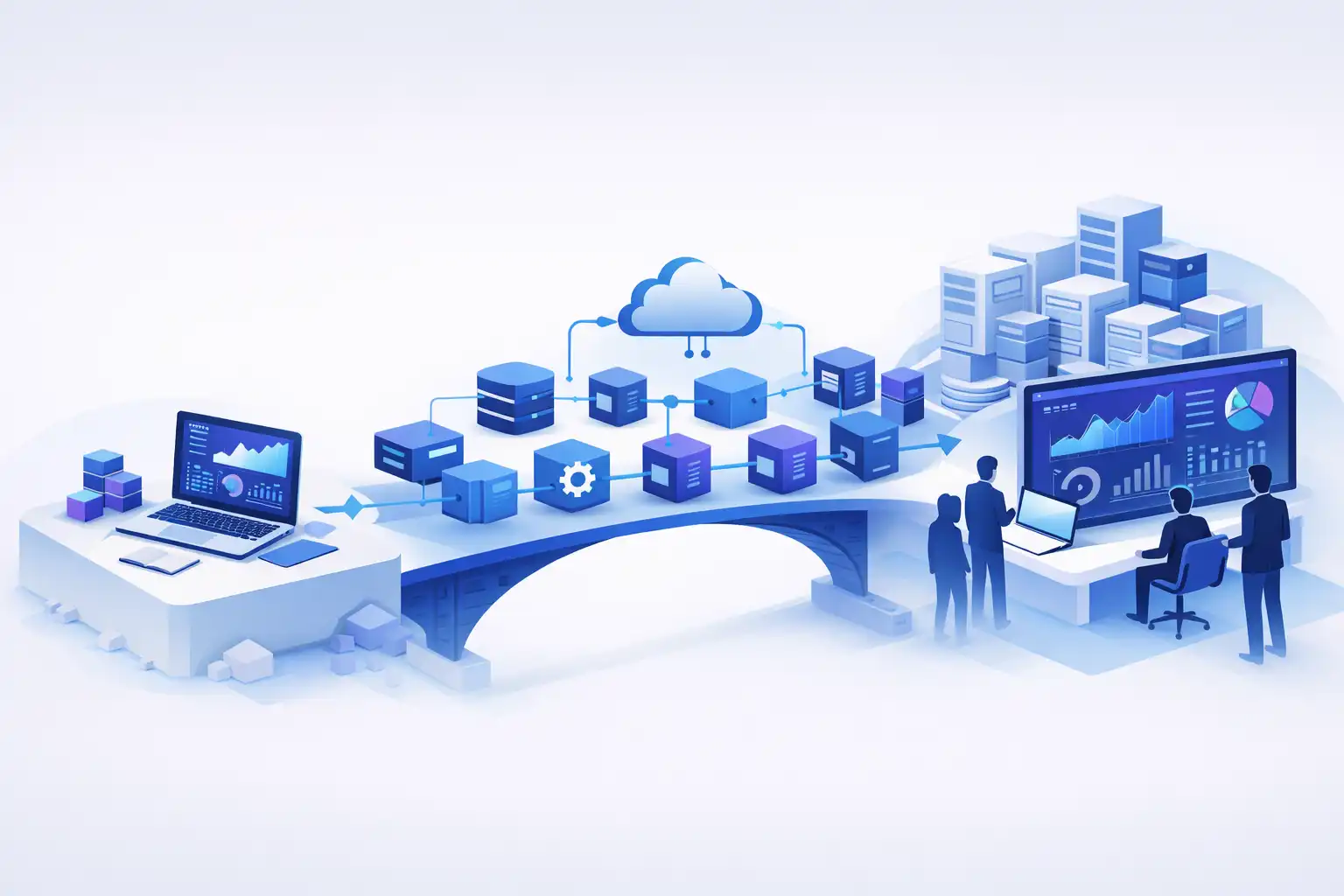
This is the stage where most projects fail. Transitioning a model from a local Jupyter notebook to a scalable cloud environment requires MLOps.
Key Production Components:
- Containerization (Docker/Kubernetes): Wrapping the model and its dependencies so it runs identically in any environment.
- API Exposure: Building high-performance REST or GraphQL endpoints so your web or mobile applications can call the model in real-time.
- Scalability: Ensuring the infrastructure can handle a spike in requests—moving from 10 test queries to 10,000 live users.
At Cinovic, we often build MVP developments that focus specifically on this deployment bridge, ensuring that the AI can actually communicate with your existing business infrastructure.
5. Phase Five: Monitoring, Retraining, and Data Drift
A model is not a “set it and forget it” asset. As the real world changes, the model’s performance will inevitably degrade—a phenomenon known as Model Decay or Data Drift.
The Lifecycle Loop:
- Drift Detection: If your AI predicts retail demand but a sudden economic shift occurs, the model’s accuracy will plummet. You need automated alerts to detect these shifts.
- Continuous Learning: Setting up pipelines that automatically retrain the model on fresh data without human intervention.
- A/B Testing: Running two versions of a model simultaneously to see which one performs better on live traffic.
6. The Ethical and Governance Layer
In a production environment, AI transparency is critical. If an AI rejects a loan application or a medical diagnosis, you must be able to explain why.
Our AI/ML Consulting methodology includes “Explainable AI” (XAI) frameworks. This ensures your digital transformation remains compliant with evolving regulations (like the EU AI Act) and maintains the trust of your end-users.
7. Scaling with Generative AI and Agents
In 2026, the lifecycle has expanded to include Agentic AI. These aren’t just models that answer questions; they are systems that can take actions.
For example, integrating Chatbots and Agentic AI into a customer service workflow requires the model to have access to real-time inventory and shipping data, moving far beyond a simple sandbox text generator.
Conclusion: Bridging the Gap Between Concept and Reality
In Sandbox to Production in AI/ML, moving from experimentation to live deployment is often the most challenging phase. It demands a strong combination of data science, DevOps, and business alignment to ensure models deliver real-world value.
At Cinovic, we specialize in the “Production” half of AI. We help you move past the hype and build resilient, scalable AI systems that solve real business problems. Whether you are building a predictive engine or a generative AI application, our technical lifecycle approach ensures your project is built for the long haul.
Is your AI project stuck in the sandbox? Contact Cinovic today for an AI/ML roadmap session. Let’s turn your data experiments into production-grade powerhouses.