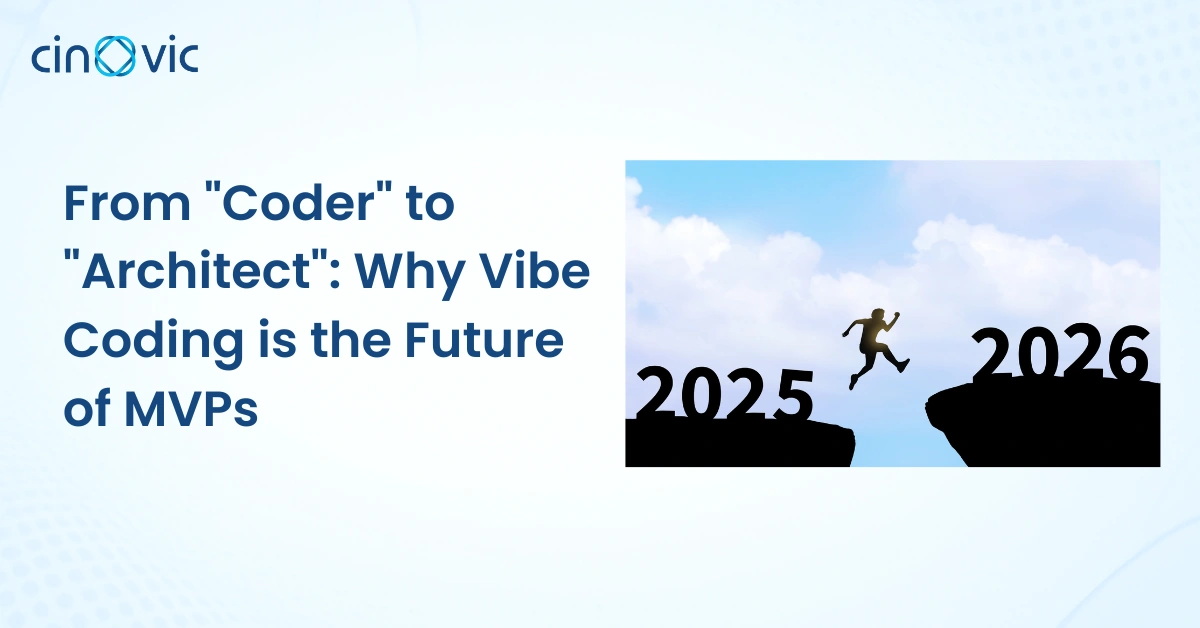
From “Coder” to “Architect”: Why Vibe Coding is the Future of MVPs

Table of Contents
There is a quiet revolution happening in the world of software development. If you spend time on “Tech Twitter” (or X), you might have heard the term thrown around: “Vibe Coding.”
It sounds casual. It sounds like a meme. But make no mistake: it is the most significant shift in how software is built since the invention of the compiler. This evolution is transforming developers from Coder to Architect, where the focus shifts from writing repetitive code to designing intelligent, scalable, and AI-driven digital products.
For the last 40 years, building a Minimum Viable Product (MVP) meant hiring a team of developers to manually type thousands of lines of cryptic syntax. It was slow. It was expensive. And 80% of the effort went into fighting semicolons and brackets rather than building business value.
In 2026, the game has changed. We are no longer just “Coders”—we are Architects.
What is "Vibe Coding"?
Coined jokingly by industry leaders but adopted seriously by top engineers, “Vibe Coding” refers to a new workflow where the developer focuses entirely on Intent, leaving the Implementation to Artificial Intelligence.
In the old world, if you wanted a login screen, you had to write the HTML, style the CSS, write the database query, and handle the error messages manually.
In the “Vibe Coding” world, the developer (now the Architect) writes a prompt:> “Create a secure, mobile-responsive login screen using Oauth 2.0. Style it with our brand’s ‘Midnight Blue’ theme and handle 2FA verification via SMS.”
The AI generates the code instantly. The human reviews it, tweaks the logic, and moves on. The focus shifts from “How do I write this function?” to “What should this function actually do for the user?”
The Death of the Syntax Error
The biggest bottleneck in traditional MVP development was the “Syntax Tax.” Developers spent hours debugging why a button was 2 pixels to the left, or why a server crashed because of a missing comma.
With AI-assisted development (Vibe Coding), the Syntax Tax is zero.
AI models (like Claude 3.5 Sonnet, GPT-5, or specialized coding agents) do not make syntax errors. They don’t forget semicolons. They know every library and every framework instantly.
This liberates the developer to become an Architect.
- The Coder: Worries about if/else statements and memory management.
- The Architect: Worries about Data Flow, User Experience (UX), Security Architecture, and Scalability.
When we build an MVP for a client at Cinovic, we aren’t bogged down in the weeds. We are flying at 30,000 feet, directing the AI to build the infrastructure that matches your business vision. This shift From Coder to Architect allows teams to focus more on strategy, innovation, and scalable product design rather than repetitive development tasks.

Speed to Market: The "Year 1" Product in "Week 4"
The primary reason startups fail is not bad technology; it is slow feedback loops. You spend 6 months building an MVP, launch it, and realize nobody wants it. By then, you are out of money.
Vibe Coding collapses this timeline.
Because we can generate boilerplate code, database structures, and API connections in seconds, we can reach a functional prototype in days, not months.
Traditional MVP Timeline:
- Weeks 1-4: Basic Setup & Database Design
- Weeks 5-8: Backend Logic
- Weeks 9-12: Frontend & UI
- Launch: Month 4
Cinovic “Vibe Coding” Timeline:
- Day 1-2: Architecture & AI Prompt Engineering
- Day 3-5: AI-Generated Core Logic & Database
- Day 6-10: Refinement, Security Audit, and UI Polish
- Launch: Week 2
This allows you to test your market assumption fast. If the product fails, you haven’t wasted a year. You pivot, re-prompt, and launch Version 2 next week.
If AI Writes the Code, Why Do I Need Cinovic?
This is the billion-dollar question. If ChatGPT can write code, why do I need an agency?
The answer is simple: AI is a fantastic bricklayer, but a terrible architect.
If you ask an AI to “build a house,” it will give you 4 walls and a roof. It won’t ask you about the foundation soil, the local zoning laws, the insulation rating, or the plumbing pressure. It will build a house that looks great but collapses in a storm. This is why the shift From Coder to Architect is so important — successful AI-driven development still requires strategic thinking, technical oversight, and architectural decision-making to build scalable and reliable products.
This is where the human Architect is indispensable.
The Architect’s Role in 2026:
- System Integrity: An AI will happily write insecure code if you don’t tell it not to. Our engineers know exactly how to prompt and audit the AI to ensure banking-grade security.
- Scalability Strategy: An AI acts in the moment. It doesn’t know that you plan to scale to 1 million users in 6 months. We design the database architecture to handle that load before the AI writes a single line.
- Connecting the Dots: AI is great at writing isolated functions. It struggles to connect a Payment Gateway to an Inventory System to a CRM. We act as the “General Contractor,” ensuring all the AI-built modules talk to each other perfectly.
"Technical Debt" vs. "Technical Leverage"
Critics argue that AI-generated code creates “Technical Debt” (messy code that is hard to fix later). We argue that managed correctly, it creates “Technical Leverage.”
Because the code is generated so fast, it is essentially “disposable.” In the past, you were married to your bad code because you spent $50,000 writing it. Now, if a feature isn’t working, we don’t spend weeks fixing it. We delete it, adjust the architecture, and generate it fresh. This transformation From Coder to Architect empowers development teams to focus on building smarter systems, refining product strategy, and accelerating innovation instead of getting stuck maintaining outdated code.

Conclusion: The Era of the Non-Technical Founder
This shift is the best news possible for non-technical founders. You no longer need to find a “Technical Co-Founder” who demands 50% equity just to write the initial code.
You need an Architecture Partner.
At Cinovic, we bridge the gap. We take your business “Vibe”—your vision, your logic, your user flow—and we translate it into the high-level prompts and architectural diagrams that guide the AI.
The result? You get a high-quality, scalable MVP faster than you thought possible, built by a small team evolving From Coder to Architect rather than relying on an army of traditional coders. This modern approach enables faster innovation, better scalability, and more strategic product development.
Stop paying for typing. Start paying for thinking.
[Contact Cinovic Today] – Let’s vibe-code your vision into reality.